{"title":"Effect of dienogest treatment on uterine fibroid volume in patients with endometriosis or adenomyosis complicated by uterine fibroids.","authors":"De-Yu Zhang, Yan Huang, Chao Peng, Ying-Fang Zhou","doi":"10.12998/wjcc.v12.i21.4601","DOIUrl":null,"url":null,"abstract":"<p><strong>Background: </strong>Currently, the use of dienogest in clinical practice has increased significantly, and many studies have focused on its effectiveness and safety in the treatment of endometriosis and adenomyosis; however, the effects of treatment with dienogest on uterine fibroid size in patients with endometriosis or adenomyosis have not been investigated.</p><p><strong>Aim: </strong>To explore changes in fibroid size in patients with concomitant uterine fibroids undergoing dienogest treatment for endometriosis or adenomyosis and to evaluate the effectiveness and safety of the drug.</p><p><strong>Methods: </strong>The clinical data of patients with uterine fibroids treated with dienogest for endometriosis or adenomyosis at Peking University First Hospital from January 2021 to January 2023 were retrospectively analyzed.</p><p><strong>Results: </strong>The maximum uterine fibroid diameter and volume increased after 3 months, 6 months and 1 year of dienogest treatment compared with those before treatment (<i>P</i> < 0.01). The maximum diameter and volume of the uterine adenomyoma increased after 3 months of dienogest treatment but decreased after 6 months and 1 year of treatment compared with those before treatment, but the difference was not significant (<i>P</i> > 0.05). Endometrial thickness and antigen 125 levels were significantly thinner and decreased, respectively, after dienogest treatment (<i>P</i> < 0.01). Pearson's correlation analysis revealed that the increase in uterine fibroid volume after 3 months of dienogest treatment was positively correlated with the basic uterine fibroid volume (<i>r</i> = 0.792, <i>P</i> < 0.01). Among 64 patients with dysmenorrhea, 63 experienced significant relief of dysmenorrhea after 6 months of treatment with dienogest, and all patients experienced significant relief of dysmenorrhea after 12 months. Patients were able to tolerate the drugs, with an average drug tolerance score of 8.73.</p><p><strong>Conclusion: </strong>The use of dienogest in patients with endometriosis or adenomyosis combined with uterine fibroids can effectively relieve the patient's pain symptoms and significantly reduce the sizes of ovarian endometriotic cysts, but it cannot inhibit uterine fibroid growth.</p>","PeriodicalId":23912,"journal":{"name":"World Journal of Clinical Cases","volume":"12 21","pages":"4601-4608"},"PeriodicalIF":1.0000,"publicationDate":"2024-07-26","publicationTypes":"Journal Article","fieldsOfStudy":null,"isOpenAccess":false,"openAccessPdf":"https://www.ncbi.nlm.nih.gov/pmc/articles/PMC11235477/pdf/","citationCount":"0","resultStr":null,"platform":"Semanticscholar","paperid":null,"PeriodicalName":"World Journal of Clinical Cases","FirstCategoryId":"3","ListUrlMain":"https://doi.org/10.12998/wjcc.v12.i21.4601","RegionNum":4,"RegionCategory":"医学","ArticlePicture":[],"TitleCN":null,"AbstractTextCN":null,"PMCID":null,"EPubDate":"","PubModel":"","JCR":"Q3","JCRName":"MEDICINE, GENERAL & INTERNAL","Score":null,"Total":0}
引用次数: 0
Abstract
Background: Currently, the use of dienogest in clinical practice has increased significantly, and many studies have focused on its effectiveness and safety in the treatment of endometriosis and adenomyosis; however, the effects of treatment with dienogest on uterine fibroid size in patients with endometriosis or adenomyosis have not been investigated.
Aim: To explore changes in fibroid size in patients with concomitant uterine fibroids undergoing dienogest treatment for endometriosis or adenomyosis and to evaluate the effectiveness and safety of the drug.
Methods: The clinical data of patients with uterine fibroids treated with dienogest for endometriosis or adenomyosis at Peking University First Hospital from January 2021 to January 2023 were retrospectively analyzed.
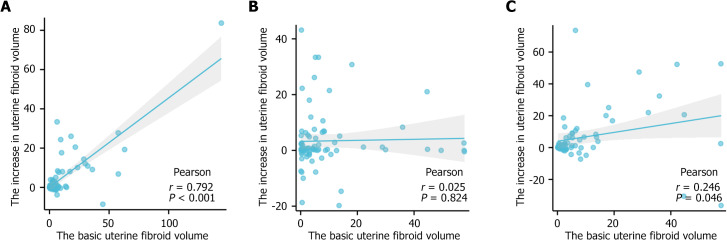
Results: The maximum uterine fibroid diameter and volume increased after 3 months, 6 months and 1 year of dienogest treatment compared with those before treatment (P < 0.01). The maximum diameter and volume of the uterine adenomyoma increased after 3 months of dienogest treatment but decreased after 6 months and 1 year of treatment compared with those before treatment, but the difference was not significant (P > 0.05). Endometrial thickness and antigen 125 levels were significantly thinner and decreased, respectively, after dienogest treatment (P < 0.01). Pearson's correlation analysis revealed that the increase in uterine fibroid volume after 3 months of dienogest treatment was positively correlated with the basic uterine fibroid volume (r = 0.792, P < 0.01). Among 64 patients with dysmenorrhea, 63 experienced significant relief of dysmenorrhea after 6 months of treatment with dienogest, and all patients experienced significant relief of dysmenorrhea after 12 months. Patients were able to tolerate the drugs, with an average drug tolerance score of 8.73.
Conclusion: The use of dienogest in patients with endometriosis or adenomyosis combined with uterine fibroids can effectively relieve the patient's pain symptoms and significantly reduce the sizes of ovarian endometriotic cysts, but it cannot inhibit uterine fibroid growth.
期刊介绍:
The World Journal of Clinical Cases (WJCC) is a high-quality, peer reviewed, open-access journal. The primary task of WJCC is to rapidly publish high-quality original articles, reviews, editorials, and case reports in the field of clinical cases. In order to promote productive academic communication, the peer review process for the WJCC is transparent; to this end, all published manuscripts are accompanied by the anonymized reviewers’ comments as well as the authors’ responses. The primary aims of the WJCC are to improve diagnostic, therapeutic and preventive modalities and the skills of clinicians and to guide clinical practice in clinical cases.



 京公网安备 11010802042870号
京ICP备2023020795号-1
京公网安备 11010802042870号
京ICP备2023020795号-1

 分享
分享
 求助内容:
求助内容: 应助结果提醒方式:
 扫码关注我们
