Sidsel Armand Larsen, Daniel Højrup Johansen, Sándor Beniczky
{"title":"Automated detection of tonic seizures using wearable movement sensor and artificial neural network","authors":"Sidsel Armand Larsen, Daniel Højrup Johansen, Sándor Beniczky","doi":"10.1111/epi.18077","DOIUrl":null,"url":null,"abstract":"<p>Although several validated wearable devices are available for detection of generalized tonic–clonic seizures, automated detection of tonic seizures is still a challenge. In this phase 1 study, we report development and validation of an artificial neural network (ANN) model for automated detection of tonic seizures with visible clinical manifestation using a wearable wristband movement sensor (accelerometer and gyroscope). The dataset prospectively recorded for this study included 70 tonic seizures from 15 patients (seven males, age 3–46 years, median = 19 years). We trained an ANN model to detect tonic seizures. The independent test dataset comprised nocturnal recordings, including 10 tonic seizures from three patients and additional (distractor) data from three subjects without seizures. The ANN model detected nocturnal tonic seizures with visible clinical manifestation with a sensitivity of 100% (95% confidence interval = 69%–100%) and with an average false alarm rate of .16/night. The mean detection latency was 14.1 s (median = 10 s), with a maximum of 47 s. These data suggest that nocturnal tonic seizures can be reliably detected with movement sensors using ANN. Large-scale, multicenter prospective (phase 3) trials are needed to provide compelling evidence for the clinical utility of this device and detection algorithm.</p>","PeriodicalId":11768,"journal":{"name":"Epilepsia","volume":"65 9","pages":"e170-e174"},"PeriodicalIF":6.6000,"publicationDate":"2024-07-30","publicationTypes":"Journal Article","fieldsOfStudy":null,"isOpenAccess":false,"openAccessPdf":"https://onlinelibrary.wiley.com/doi/epdf/10.1111/epi.18077","citationCount":"0","resultStr":null,"platform":"Semanticscholar","paperid":null,"PeriodicalName":"Epilepsia","FirstCategoryId":"3","ListUrlMain":"https://onlinelibrary.wiley.com/doi/10.1111/epi.18077","RegionNum":1,"RegionCategory":"医学","ArticlePicture":[],"TitleCN":null,"AbstractTextCN":null,"PMCID":null,"EPubDate":"","PubModel":"","JCR":"Q1","JCRName":"CLINICAL NEUROLOGY","Score":null,"Total":0}
引用次数: 0
Abstract
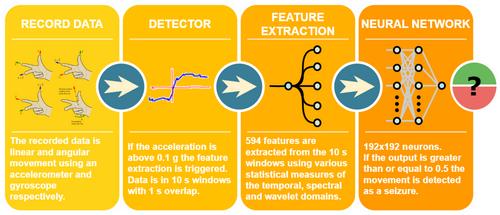
Although several validated wearable devices are available for detection of generalized tonic–clonic seizures, automated detection of tonic seizures is still a challenge. In this phase 1 study, we report development and validation of an artificial neural network (ANN) model for automated detection of tonic seizures with visible clinical manifestation using a wearable wristband movement sensor (accelerometer and gyroscope). The dataset prospectively recorded for this study included 70 tonic seizures from 15 patients (seven males, age 3–46 years, median = 19 years). We trained an ANN model to detect tonic seizures. The independent test dataset comprised nocturnal recordings, including 10 tonic seizures from three patients and additional (distractor) data from three subjects without seizures. The ANN model detected nocturnal tonic seizures with visible clinical manifestation with a sensitivity of 100% (95% confidence interval = 69%–100%) and with an average false alarm rate of .16/night. The mean detection latency was 14.1 s (median = 10 s), with a maximum of 47 s. These data suggest that nocturnal tonic seizures can be reliably detected with movement sensors using ANN. Large-scale, multicenter prospective (phase 3) trials are needed to provide compelling evidence for the clinical utility of this device and detection algorithm.
期刊介绍:
Epilepsia is the leading, authoritative source for innovative clinical and basic science research for all aspects of epilepsy and seizures. In addition, Epilepsia publishes critical reviews, opinion pieces, and guidelines that foster understanding and aim to improve the diagnosis and treatment of people with seizures and epilepsy.




 京公网安备 11010802042870号
京ICP备2023020795号-1
京公网安备 11010802042870号
京ICP备2023020795号-1

 分享
分享
 求助内容:
求助内容: 应助结果提醒方式:
 扫码关注我们
