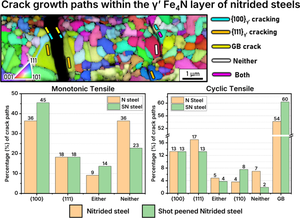
{"title":"Understanding crack growth within the γ′ Fe4N layer in a nitrided low carbon steel during monotonic and cyclic tensile testing","authors":"Rama Srinivas Varanasi, Motomichi Koyama, Mizuho Yokoi, Yusuke Ootani, Momoji Kubo, Kento Tanahara, Osamu Umezawa","doi":"10.1007/s10853-024-10014-x","DOIUrl":null,"url":null,"abstract":"<div><p>Nitriding is a cost-effective method to realize simultaneous improvements in tensile and fatigue properties and resistance to abrasion and corrosion. Previous studies reported that nitriding pure Fe enhances tensile strength by ~ 70% and fatigue limit by ~ 200%. It is due to the increase in surface hardness caused by the formation of γ′(Fe<sub>4</sub>N) and ε(Fe<sub>2-3</sub>N) nitrogen-containing intermetallic compound phases. However, the intermetallic compound layer is prone to brittle-like cracking. To better design nitrided steels, it is crucial to identify the crack growth mechanisms via analysis of the microstructural crack growth paths within the ~ 4–6 µm thick nitride layer. In the current work, we statistically evaluate the crack propagation behavior in the γ′ Fe<sub>4</sub>N layer during monotonic and cyclic tensile deformation in nitrided low-carbon steel (0.1 wt% C). Since nitriding typically results in the formation of columnar grains, the effect of morphology needs to be clarified. To this end, the steel was shot-peened and subsequently nitrided to promote equiaxed nitride grains morphology (~ 16% increase). Crack growth paths were comparatively evaluated for multiple cracks, and no significant effect of nitride morphology was observed. {100}<sub>γ′</sub> is the predominant transgranular crack path in the monotonic tensile tested specimen, followed by {111}<sub>γ′</sub>. It is despite the elastic modulus of {111}<sub>γ′</sub> < {100}<sub>γ′</sub>. This contrary behavior is explained by {100}<sub>γ′</sub> plane having the lowest surface energy (density functional theory calculations). In the cyclic tensile loaded specimen, experiments revealed that transgranular cracking along {100}<sub>γ′</sub> (cracking via symmetric dislocation emission) or {111}<sub>γ′</sub> (slip plane cracking) is equally likely.</p><h3>Graphical abstract</h3><div><figure><div><div><picture><source><img></source></picture></div></div></figure></div></div>","PeriodicalId":645,"journal":{"name":"Journal of Materials Science","volume":"59 31","pages":"14639 - 14652"},"PeriodicalIF":3.9000,"publicationDate":"2024-07-28","publicationTypes":"Journal Article","fieldsOfStudy":null,"isOpenAccess":false,"openAccessPdf":"https://link.springer.com/content/pdf/10.1007/s10853-024-10014-x.pdf","citationCount":"0","resultStr":null,"platform":"Semanticscholar","paperid":null,"PeriodicalName":"Journal of Materials Science","FirstCategoryId":"88","ListUrlMain":"https://link.springer.com/article/10.1007/s10853-024-10014-x","RegionNum":3,"RegionCategory":"材料科学","ArticlePicture":[],"TitleCN":null,"AbstractTextCN":null,"PMCID":null,"EPubDate":"","PubModel":"","JCR":"Q2","JCRName":"MATERIALS SCIENCE, MULTIDISCIPLINARY","Score":null,"Total":0}
引用次数: 0
Abstract
Nitriding is a cost-effective method to realize simultaneous improvements in tensile and fatigue properties and resistance to abrasion and corrosion. Previous studies reported that nitriding pure Fe enhances tensile strength by ~ 70% and fatigue limit by ~ 200%. It is due to the increase in surface hardness caused by the formation of γ′(Fe4N) and ε(Fe2-3N) nitrogen-containing intermetallic compound phases. However, the intermetallic compound layer is prone to brittle-like cracking. To better design nitrided steels, it is crucial to identify the crack growth mechanisms via analysis of the microstructural crack growth paths within the ~ 4–6 µm thick nitride layer. In the current work, we statistically evaluate the crack propagation behavior in the γ′ Fe4N layer during monotonic and cyclic tensile deformation in nitrided low-carbon steel (0.1 wt% C). Since nitriding typically results in the formation of columnar grains, the effect of morphology needs to be clarified. To this end, the steel was shot-peened and subsequently nitrided to promote equiaxed nitride grains morphology (~ 16% increase). Crack growth paths were comparatively evaluated for multiple cracks, and no significant effect of nitride morphology was observed. {100}γ′ is the predominant transgranular crack path in the monotonic tensile tested specimen, followed by {111}γ′. It is despite the elastic modulus of {111}γ′ < {100}γ′. This contrary behavior is explained by {100}γ′ plane having the lowest surface energy (density functional theory calculations). In the cyclic tensile loaded specimen, experiments revealed that transgranular cracking along {100}γ′ (cracking via symmetric dislocation emission) or {111}γ′ (slip plane cracking) is equally likely.
期刊介绍:
The Journal of Materials Science publishes reviews, full-length papers, and short Communications recording original research results on, or techniques for studying the relationship between structure, properties, and uses of materials. The subjects are seen from international and interdisciplinary perspectives covering areas including metals, ceramics, glasses, polymers, electrical materials, composite materials, fibers, nanostructured materials, nanocomposites, and biological and biomedical materials. The Journal of Materials Science is now firmly established as the leading source of primary communication for scientists investigating the structure and properties of all engineering materials.



 京公网安备 11010802042870号
京ICP备2023020795号-1
京公网安备 11010802042870号
京ICP备2023020795号-1

 分享
分享
 求助内容:
求助内容: 应助结果提醒方式:
 扫码关注我们
