Mixed tutton salts K2Mn0.15Co0.85(SO4)2(H2O)6 and K2Mn0.16Zn0.84(SO4)2(H2O)6 for applications in thermochemical devices: experimental physicochemical properties combined with first-principles calculations
João Gomes de Oliveira Neto, Luiz Fernando Lobato da Silva, Tiago Kalil Cortinhas Alves, Andreas Neumann, Francisco Ferreira de Sousa, Alejandro Pedro Ayala, Adenilson Oliveira dos Santos
{"title":"Mixed tutton salts K2Mn0.15Co0.85(SO4)2(H2O)6 and K2Mn0.16Zn0.84(SO4)2(H2O)6 for applications in thermochemical devices: experimental physicochemical properties combined with first-principles calculations","authors":"João Gomes de Oliveira Neto, Luiz Fernando Lobato da Silva, Tiago Kalil Cortinhas Alves, Andreas Neumann, Francisco Ferreira de Sousa, Alejandro Pedro Ayala, Adenilson Oliveira dos Santos","doi":"10.1007/s10853-024-10049-0","DOIUrl":null,"url":null,"abstract":"<div><p>In this paper, two hydrated double salts, whose chemical formulas are K<sub>2</sub>Mn<sub>0.15</sub>Co<sub>0.85</sub>(SO<sub>4</sub>)<sub>2</sub>(H<sub>2</sub>O)<sub>6</sub> (KMn/Co) and K<sub>2</sub>Mn<sub>0.16</sub>Zn<sub>0.84</sub>(SO<sub>4</sub>)<sub>2</sub>(H<sub>2</sub>O)<sub>6</sub> (KMn/Zn), were crystallized via solvent slow evaporation. The structural, thermal, and vibrational properties were explored and discussed. Furthermore, a study of geometric, electronic, and thermodynamic (entropy, enthalpy, and free energy) parameters was performed based on computational calculations. Single-crystal X-ray diffraction indicated that the compounds belong to the family of mixed Tutton salts with monoclinic symmetry, space group <i>P</i>2<sub>1</sub>/<i>c</i> (<span>\\({C}_{2h}^{5}\\)</span>), and occupancy factors of Mn<sub>0.15</sub>/Co<sub>0.85</sub> (KMn/Co) and Mn<sub>0.16</sub>/Zn<sub>0.84</sub> (KMn/Zn). Additionally, the intermolecular contacts and total empties in the unit cells were determined by Hirshfeld surfaces and crystal voids, respectively. The two crystals exhibited thermal stability around 333 K (Mn–Co) and 348 K (Mn–Zn). Above these temperatures, endothermic and exothermic events characteristic of dehydration, crystallization, solid–solid transition, and melting are recorded. Furthermore, KMn/Co and KMn/Zn exhibited significant energy densities, making them promising candidates for thermochemical energy storage systems. An energy band gap of 4.13 eV and 4.49 eV was predicted for KMn/Co and KMn/Zn, respectively. These findings are characteristic of insulating materials with major contributions from <i>p</i> orbitals in the valence and conduction bands. Using group theory and density functional theory (DFT), it was suggested that the two compounds have a total of 183 optical modes in the spectral region from 30 to 3600 cm<sup>−1</sup>. Furthermore, experimental and calculated Raman and infrared spectra showed a good correlation. Our data suggest that the KMn/Co and KMn/Zn salts present promising thermo-structural results, showing that they can be used in heat-storing thermochemical devices due to their low dehydration temperatures, high dehydration enthalpies, and good energy density.</p><h3>Graphical Abstract</h3>\n<div><figure><div><div><picture><source><img></source></picture></div></div></figure></div></div>","PeriodicalId":645,"journal":{"name":"Journal of Materials Science","volume":"59 31","pages":"14445 - 14464"},"PeriodicalIF":4.4000,"publicationDate":"2024-07-28","publicationTypes":"Journal Article","fieldsOfStudy":null,"isOpenAccess":false,"openAccessPdf":"","citationCount":"0","resultStr":null,"platform":"Semanticscholar","paperid":null,"PeriodicalName":"Journal of Materials Science","FirstCategoryId":"88","ListUrlMain":"https://link.springer.com/article/10.1007/s10853-024-10049-0","RegionNum":3,"RegionCategory":"材料科学","ArticlePicture":[],"TitleCN":null,"AbstractTextCN":null,"PMCID":null,"EPubDate":"","PubModel":"","JCR":"Q2","JCRName":"MATERIALS SCIENCE, MULTIDISCIPLINARY","Score":null,"Total":0}
引用次数: 0
Abstract
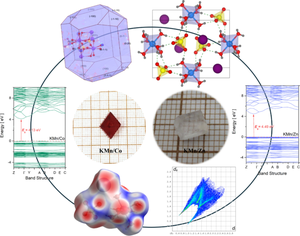
In this paper, two hydrated double salts, whose chemical formulas are K2Mn0.15Co0.85(SO4)2(H2O)6 (KMn/Co) and K2Mn0.16Zn0.84(SO4)2(H2O)6 (KMn/Zn), were crystallized via solvent slow evaporation. The structural, thermal, and vibrational properties were explored and discussed. Furthermore, a study of geometric, electronic, and thermodynamic (entropy, enthalpy, and free energy) parameters was performed based on computational calculations. Single-crystal X-ray diffraction indicated that the compounds belong to the family of mixed Tutton salts with monoclinic symmetry, space group P21/c (\({C}_{2h}^{5}\)), and occupancy factors of Mn0.15/Co0.85 (KMn/Co) and Mn0.16/Zn0.84 (KMn/Zn). Additionally, the intermolecular contacts and total empties in the unit cells were determined by Hirshfeld surfaces and crystal voids, respectively. The two crystals exhibited thermal stability around 333 K (Mn–Co) and 348 K (Mn–Zn). Above these temperatures, endothermic and exothermic events characteristic of dehydration, crystallization, solid–solid transition, and melting are recorded. Furthermore, KMn/Co and KMn/Zn exhibited significant energy densities, making them promising candidates for thermochemical energy storage systems. An energy band gap of 4.13 eV and 4.49 eV was predicted for KMn/Co and KMn/Zn, respectively. These findings are characteristic of insulating materials with major contributions from p orbitals in the valence and conduction bands. Using group theory and density functional theory (DFT), it was suggested that the two compounds have a total of 183 optical modes in the spectral region from 30 to 3600 cm−1. Furthermore, experimental and calculated Raman and infrared spectra showed a good correlation. Our data suggest that the KMn/Co and KMn/Zn salts present promising thermo-structural results, showing that they can be used in heat-storing thermochemical devices due to their low dehydration temperatures, high dehydration enthalpies, and good energy density.
期刊介绍:
The Journal of Materials Science publishes reviews, full-length papers, and short Communications recording original research results on, or techniques for studying the relationship between structure, properties, and uses of materials. The subjects are seen from international and interdisciplinary perspectives covering areas including metals, ceramics, glasses, polymers, electrical materials, composite materials, fibers, nanostructured materials, nanocomposites, and biological and biomedical materials. The Journal of Materials Science is now firmly established as the leading source of primary communication for scientists investigating the structure and properties of all engineering materials.




 京公网安备 11010802042870号
京ICP备2023020795号-1
京公网安备 11010802042870号
京ICP备2023020795号-1

 分享
分享
 求助内容:
求助内容: 应助结果提醒方式:
 扫码关注我们
