{"title":"Ups and Downs in Experience Design","authors":"Hongqiao Chen, Ming Hu, Jingchen Liu, Yaniv Ravid","doi":"10.1177/10591478241265645","DOIUrl":null,"url":null,"abstract":"We show how prospect theory uncovers critical decision-making insights in the design of sequential experiences by formulating a general framework and applying it to three experience design settings. First, we study the problem of releasing a piece of good news versus bad news, where a firm may incrementally reveal the news over a preemptive period. We characterize the optimal release strategy for both types of news and show that when the ultimate news is good (resp., bad) and the audience is sufficiently gain-seeking, it is optimal first to release information of a negative (resp., positive) sentiment. Second, we consider the problem of organizing an event such as a concert with performances of known valuations, where an event organizer needs to arrange the sequence of all performances. We show that for both loss-averse and gain-seeking audiences, interior peaks can be optimal, where pleasant and aversive performances are arranged to alternate throughout the event. Lastly, we investigate the problem of simultaneous versus sequential release of a series, such as songs or TV episodes, where a content provider does not know a priori the audience’s exact valuation of each item. We show that if the audience’s sensitivity to losses is sufficiently small (resp., large), the optimal strategy is to release all items in the series sequentially (resp., simultaneously). Across all of the settings, we show that the audience’s sensitivity to losses relative to a reference point is a critical factor that governs how to design and manage the audience’s evolving experience dynamics.","PeriodicalId":4,"journal":{"name":"ACS Applied Energy Materials","volume":"54 10","pages":""},"PeriodicalIF":5.5000,"publicationDate":"2024-07-26","publicationTypes":"Journal Article","fieldsOfStudy":null,"isOpenAccess":false,"openAccessPdf":"","citationCount":"0","resultStr":null,"platform":"Semanticscholar","paperid":null,"PeriodicalName":"ACS Applied Energy Materials","FirstCategoryId":"91","ListUrlMain":"https://doi.org/10.1177/10591478241265645","RegionNum":3,"RegionCategory":"材料科学","ArticlePicture":[],"TitleCN":null,"AbstractTextCN":null,"PMCID":null,"EPubDate":"","PubModel":"","JCR":"Q2","JCRName":"CHEMISTRY, PHYSICAL","Score":null,"Total":0}
引用次数: 0
Abstract
We show how prospect theory uncovers critical decision-making insights in the design of sequential experiences by formulating a general framework and applying it to three experience design settings. First, we study the problem of releasing a piece of good news versus bad news, where a firm may incrementally reveal the news over a preemptive period. We characterize the optimal release strategy for both types of news and show that when the ultimate news is good (resp., bad) and the audience is sufficiently gain-seeking, it is optimal first to release information of a negative (resp., positive) sentiment. Second, we consider the problem of organizing an event such as a concert with performances of known valuations, where an event organizer needs to arrange the sequence of all performances. We show that for both loss-averse and gain-seeking audiences, interior peaks can be optimal, where pleasant and aversive performances are arranged to alternate throughout the event. Lastly, we investigate the problem of simultaneous versus sequential release of a series, such as songs or TV episodes, where a content provider does not know a priori the audience’s exact valuation of each item. We show that if the audience’s sensitivity to losses is sufficiently small (resp., large), the optimal strategy is to release all items in the series sequentially (resp., simultaneously). Across all of the settings, we show that the audience’s sensitivity to losses relative to a reference point is a critical factor that governs how to design and manage the audience’s evolving experience dynamics.
期刊介绍:
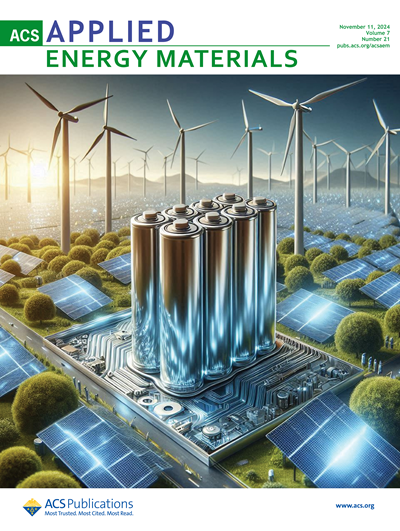
ACS Applied Energy Materials is an interdisciplinary journal publishing original research covering all aspects of materials, engineering, chemistry, physics and biology relevant to energy conversion and storage. The journal is devoted to reports of new and original experimental and theoretical research of an applied nature that integrate knowledge in the areas of materials, engineering, physics, bioscience, and chemistry into important energy applications.



 京公网安备 11010802042870号
京ICP备2023020795号-1
京公网安备 11010802042870号
京ICP备2023020795号-1

 分享
分享
 求助内容:
求助内容: 应助结果提醒方式:
 扫码关注我们
