{"title":"Effect of Different Flow Design Approaches on Undergraduates' Computational Thinking During Pair Programming","authors":"Ruijie Zhou, Chong Xie, Xiuling He, Yangyang Li, Qiong Fan, Ying Yu, Zhonghua Yan","doi":"10.1177/07356331241268474","DOIUrl":null,"url":null,"abstract":"Computational thinking (CT), an essential competency for comprehending and addressing intricate issues in the digital world, has been incorporated into curriculum planning as a goal for programming education. This study introduced flow design into programming curricula to investigate its impact on undergraduates ’CT skills during pair work. Two types of flow design approaches, construct-by-self flow design (CBS-FD) and construct-on-scaffold flow design (COS-FD), were proposed to determine which approach better enhances students’ CT skills. Seventy-six first-year undergraduates participated, including thirty in the CBS group and thirty-six in the COS group. Evaluations made from the results and processes of programming tasks were employed to describe computational performance and computational practices, respectively. Data gathered from CT skill surveys were thoroughly analyzed to gain a deeper understanding of computational perspectives. Our findings highlighted that COS-FD significantly improved participants' computational performance compared with CBS-FD. The COS groups fostered an engaging, sharing atmosphere, while CBS groups spent more energy on negotiating the manipulation of flow design. Moreover, both COS-FD and CBS-FD proved beneficial in enhancing participants' computational perspectives, with the COS groups better improving their algorithm thinking. The study presents valuable perspectives on the design and implementation of collaborative programming activities within curriculum education.","PeriodicalId":4,"journal":{"name":"ACS Applied Energy Materials","volume":"15 2","pages":""},"PeriodicalIF":5.5000,"publicationDate":"2024-07-26","publicationTypes":"Journal Article","fieldsOfStudy":null,"isOpenAccess":false,"openAccessPdf":"","citationCount":"0","resultStr":null,"platform":"Semanticscholar","paperid":null,"PeriodicalName":"ACS Applied Energy Materials","FirstCategoryId":"95","ListUrlMain":"https://doi.org/10.1177/07356331241268474","RegionNum":3,"RegionCategory":"材料科学","ArticlePicture":[],"TitleCN":null,"AbstractTextCN":null,"PMCID":null,"EPubDate":"","PubModel":"","JCR":"Q2","JCRName":"CHEMISTRY, PHYSICAL","Score":null,"Total":0}
引用次数: 0
Abstract
Computational thinking (CT), an essential competency for comprehending and addressing intricate issues in the digital world, has been incorporated into curriculum planning as a goal for programming education. This study introduced flow design into programming curricula to investigate its impact on undergraduates ’CT skills during pair work. Two types of flow design approaches, construct-by-self flow design (CBS-FD) and construct-on-scaffold flow design (COS-FD), were proposed to determine which approach better enhances students’ CT skills. Seventy-six first-year undergraduates participated, including thirty in the CBS group and thirty-six in the COS group. Evaluations made from the results and processes of programming tasks were employed to describe computational performance and computational practices, respectively. Data gathered from CT skill surveys were thoroughly analyzed to gain a deeper understanding of computational perspectives. Our findings highlighted that COS-FD significantly improved participants' computational performance compared with CBS-FD. The COS groups fostered an engaging, sharing atmosphere, while CBS groups spent more energy on negotiating the manipulation of flow design. Moreover, both COS-FD and CBS-FD proved beneficial in enhancing participants' computational perspectives, with the COS groups better improving their algorithm thinking. The study presents valuable perspectives on the design and implementation of collaborative programming activities within curriculum education.
期刊介绍:
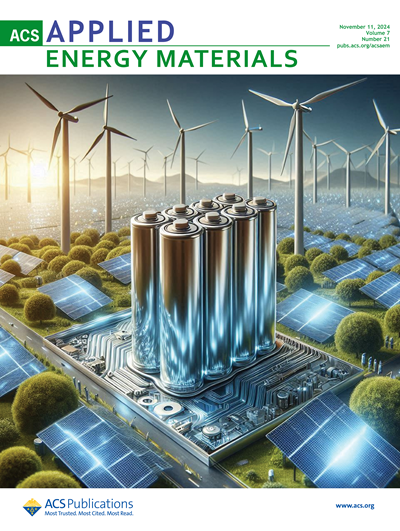
ACS Applied Energy Materials is an interdisciplinary journal publishing original research covering all aspects of materials, engineering, chemistry, physics and biology relevant to energy conversion and storage. The journal is devoted to reports of new and original experimental and theoretical research of an applied nature that integrate knowledge in the areas of materials, engineering, physics, bioscience, and chemistry into important energy applications.



 京公网安备 11010802042870号
京ICP备2023020795号-1
京公网安备 11010802042870号
京ICP备2023020795号-1

 分享
分享
 求助内容:
求助内容: 应助结果提醒方式:
 扫码关注我们
