{"title":"Group Buying Between Competitors: Exogenous and Endogenous Power Structures","authors":"Ke Fu, Guoming Lai, Weixin Shang, Jiayan Xu","doi":"10.1177/10591478241265483","DOIUrl":null,"url":null,"abstract":"Competing firms may engage in group buying (GB) to benefit from a quantity discount from a common supplier. We study GB under different power structures (i.e., Nash and Stackelberg) and investigate how the power structures can be endogenized along with the resulting GB outcome. We employ a game-theoretic framework in which two firms under Cournot competition can group their purchases if it is beneficial compared to individual purchasing. We show that under exogenous power structures, when the two firms have highly asymmetric market bases, Nash GB is unattainable due to severe co-opetition conflict, and Stackelberg GB can better resolve the conflict. Our results suggest that power structures may fundamentally affect firms’ GB incentives, and no power structure is always superior to others. We then endogenize the power structures of the two firms based on a two-stage extended game. Using Pareto-risk dominance, we identify conditions under which one firm endogenously emerges as the Stackelberg leader with the rival as the follower, as well as the conditions under which both firms endogenously choose Nash GB or opt for independent purchasing. We demonstrate that the two firms can largely resolve the battle for GB leadership and achieve an efficient outcome in most cases. Our study is the first to compare different exogenous power structures and consider endogenous power structures in the context of GB.","PeriodicalId":4,"journal":{"name":"ACS Applied Energy Materials","volume":"24 12","pages":""},"PeriodicalIF":5.5000,"publicationDate":"2024-07-26","publicationTypes":"Journal Article","fieldsOfStudy":null,"isOpenAccess":false,"openAccessPdf":"","citationCount":"0","resultStr":null,"platform":"Semanticscholar","paperid":null,"PeriodicalName":"ACS Applied Energy Materials","FirstCategoryId":"91","ListUrlMain":"https://doi.org/10.1177/10591478241265483","RegionNum":3,"RegionCategory":"材料科学","ArticlePicture":[],"TitleCN":null,"AbstractTextCN":null,"PMCID":null,"EPubDate":"","PubModel":"","JCR":"Q2","JCRName":"CHEMISTRY, PHYSICAL","Score":null,"Total":0}
引用次数: 0
Abstract
Competing firms may engage in group buying (GB) to benefit from a quantity discount from a common supplier. We study GB under different power structures (i.e., Nash and Stackelberg) and investigate how the power structures can be endogenized along with the resulting GB outcome. We employ a game-theoretic framework in which two firms under Cournot competition can group their purchases if it is beneficial compared to individual purchasing. We show that under exogenous power structures, when the two firms have highly asymmetric market bases, Nash GB is unattainable due to severe co-opetition conflict, and Stackelberg GB can better resolve the conflict. Our results suggest that power structures may fundamentally affect firms’ GB incentives, and no power structure is always superior to others. We then endogenize the power structures of the two firms based on a two-stage extended game. Using Pareto-risk dominance, we identify conditions under which one firm endogenously emerges as the Stackelberg leader with the rival as the follower, as well as the conditions under which both firms endogenously choose Nash GB or opt for independent purchasing. We demonstrate that the two firms can largely resolve the battle for GB leadership and achieve an efficient outcome in most cases. Our study is the first to compare different exogenous power structures and consider endogenous power structures in the context of GB.
期刊介绍:
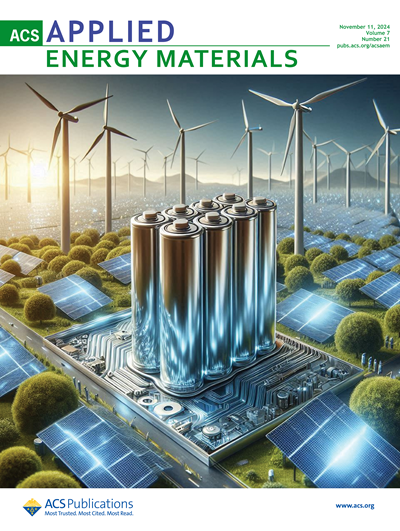
ACS Applied Energy Materials is an interdisciplinary journal publishing original research covering all aspects of materials, engineering, chemistry, physics and biology relevant to energy conversion and storage. The journal is devoted to reports of new and original experimental and theoretical research of an applied nature that integrate knowledge in the areas of materials, engineering, physics, bioscience, and chemistry into important energy applications.



 京公网安备 11010802042870号
京ICP备2023020795号-1
京公网安备 11010802042870号
京ICP备2023020795号-1

 分享
分享
 求助内容:
求助内容: 应助结果提醒方式:
 扫码关注我们
