{"title":"Reduced Indian Ocean Dipole Asymmetry and Increased Extreme Negative Events under Future Greenhouse Warming","authors":"Yiling Zheng, Chi-Yung Tam, M. Collins","doi":"10.1175/jcli-d-24-0107.1","DOIUrl":null,"url":null,"abstract":"\nThe Indian Ocean Dipole (IOD) is a prominent interannual phenomenon in the tropical Indian Ocean (TIO), influencing weather and climate globally, particularly during extreme IOD events. The IOD shows notable amplitude asymmetry in both observations and historical simulations from the Coupled Model Intercomparison Project Phase 6 (CMIP6), with positive events having a greater magnitude than negative events, mainly due to the negative nonlinear dynamical heating. However, simulations under the Shared Socio-economic Pathway 5 (SSP5-8.5) scenario indicate a notable reduction in IOD asymmetry. This reduction points to an increased frequency of extreme negative IOD events under global warming. The primary cause of this reduced IOD asymmetry is less negative nonlinear dynamical heating in future simulations, especially the nonlinear zonal advection. Under global warming, the increased atmospheric static stability weakens the large-scale atmospheric response to sea surface temperature (SST) anomalies forcing. This leads to reduced strength of nonlinear zonal advection, resulting in a decreased IOD asymmetry. Nevertheless, nonlinear vertical advection, another key factor in IOD asymmetry, remains comparable due to the increased upper-ocean stratification in the eastern TIO. The reduced inhibition of negative nonlinear zonal advection and the increased SST response to deepening thermocline contribute to the increased frequency of extreme negative IOD events. These changes underscore the potential risks associated with negative IOD events in a warming world, emphasizing the importance of understanding IOD dynamics for improved climate impact prediction and future preparedness.","PeriodicalId":4,"journal":{"name":"ACS Applied Energy Materials","volume":"57 34","pages":""},"PeriodicalIF":5.5000,"publicationDate":"2024-07-25","publicationTypes":"Journal Article","fieldsOfStudy":null,"isOpenAccess":false,"openAccessPdf":"","citationCount":"0","resultStr":null,"platform":"Semanticscholar","paperid":null,"PeriodicalName":"ACS Applied Energy Materials","FirstCategoryId":"89","ListUrlMain":"https://doi.org/10.1175/jcli-d-24-0107.1","RegionNum":3,"RegionCategory":"材料科学","ArticlePicture":[],"TitleCN":null,"AbstractTextCN":null,"PMCID":null,"EPubDate":"","PubModel":"","JCR":"Q2","JCRName":"CHEMISTRY, PHYSICAL","Score":null,"Total":0}
引用次数: 0
Abstract
The Indian Ocean Dipole (IOD) is a prominent interannual phenomenon in the tropical Indian Ocean (TIO), influencing weather and climate globally, particularly during extreme IOD events. The IOD shows notable amplitude asymmetry in both observations and historical simulations from the Coupled Model Intercomparison Project Phase 6 (CMIP6), with positive events having a greater magnitude than negative events, mainly due to the negative nonlinear dynamical heating. However, simulations under the Shared Socio-economic Pathway 5 (SSP5-8.5) scenario indicate a notable reduction in IOD asymmetry. This reduction points to an increased frequency of extreme negative IOD events under global warming. The primary cause of this reduced IOD asymmetry is less negative nonlinear dynamical heating in future simulations, especially the nonlinear zonal advection. Under global warming, the increased atmospheric static stability weakens the large-scale atmospheric response to sea surface temperature (SST) anomalies forcing. This leads to reduced strength of nonlinear zonal advection, resulting in a decreased IOD asymmetry. Nevertheless, nonlinear vertical advection, another key factor in IOD asymmetry, remains comparable due to the increased upper-ocean stratification in the eastern TIO. The reduced inhibition of negative nonlinear zonal advection and the increased SST response to deepening thermocline contribute to the increased frequency of extreme negative IOD events. These changes underscore the potential risks associated with negative IOD events in a warming world, emphasizing the importance of understanding IOD dynamics for improved climate impact prediction and future preparedness.
期刊介绍:
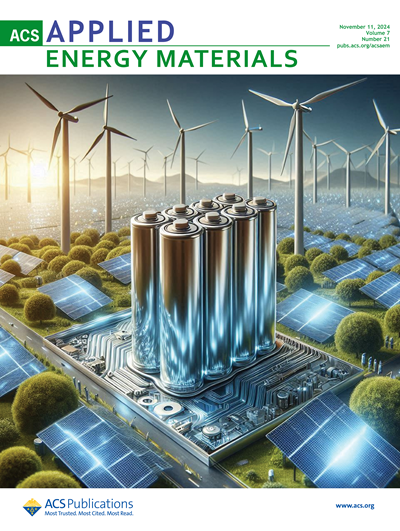
ACS Applied Energy Materials is an interdisciplinary journal publishing original research covering all aspects of materials, engineering, chemistry, physics and biology relevant to energy conversion and storage. The journal is devoted to reports of new and original experimental and theoretical research of an applied nature that integrate knowledge in the areas of materials, engineering, physics, bioscience, and chemistry into important energy applications.




 京公网安备 11010802042870号
京ICP备2023020795号-1
京公网安备 11010802042870号
京ICP备2023020795号-1

 分享
分享
 求助内容:
求助内容: 应助结果提醒方式:
 扫码关注我们
