Colin Groth, Marcus A. Magnor, S. Grogorick, Martin Eisemann, P. Didyk
{"title":"Cybersickness Reduction via Gaze-Contingent Image Deformation","authors":"Colin Groth, Marcus A. Magnor, S. Grogorick, Martin Eisemann, P. Didyk","doi":"10.1145/3658138","DOIUrl":null,"url":null,"abstract":"Virtual reality has ushered in a revolutionary era of immersive content perception. However, a persistent challenge in dynamic environments is the occurrence of cybersickness arising from a conflict between visual and vestibular cues. Prior techniques have demonstrated that limiting illusory self-motion, so-called vection, by blurring the peripheral part of images, introducing tunnel vision, or altering the camera path can effectively reduce the problem. Unfortunately, these methods often alter the user's experience with visible changes to the content. In this paper, we propose a new technique for reducing vection and combating cybersickness by subtly lowering the screen-space speed of objects in the user's peripheral vision. The method is motivated by our hypothesis that small modifications to the objects' velocity in the periphery and geometrical distortions in the peripheral vision can remain unnoticeable yet lead to reduced vection. This paper describes the experiments supporting this hypothesis and derives its limits. Furthermore, we present a method that exploits these findings by introducing subtle, screen-space geometrical distortions to animation frames to counteract the motion contributing to vection. We implement the method as a realtime post-processing step that can be integrated into existing rendering frameworks. The final validation of the technique and comparison to an alternative approach confirms its effectiveness in reducing cybersickness.","PeriodicalId":7,"journal":{"name":"ACS Applied Polymer Materials","volume":"102 47","pages":""},"PeriodicalIF":4.7000,"publicationDate":"2024-07-19","publicationTypes":"Journal Article","fieldsOfStudy":null,"isOpenAccess":false,"openAccessPdf":"","citationCount":"0","resultStr":null,"platform":"Semanticscholar","paperid":null,"PeriodicalName":"ACS Applied Polymer Materials","FirstCategoryId":"94","ListUrlMain":"https://doi.org/10.1145/3658138","RegionNum":2,"RegionCategory":"化学","ArticlePicture":[],"TitleCN":null,"AbstractTextCN":null,"PMCID":null,"EPubDate":"","PubModel":"","JCR":"Q2","JCRName":"MATERIALS SCIENCE, MULTIDISCIPLINARY","Score":null,"Total":0}
引用次数: 0
Abstract
Virtual reality has ushered in a revolutionary era of immersive content perception. However, a persistent challenge in dynamic environments is the occurrence of cybersickness arising from a conflict between visual and vestibular cues. Prior techniques have demonstrated that limiting illusory self-motion, so-called vection, by blurring the peripheral part of images, introducing tunnel vision, or altering the camera path can effectively reduce the problem. Unfortunately, these methods often alter the user's experience with visible changes to the content. In this paper, we propose a new technique for reducing vection and combating cybersickness by subtly lowering the screen-space speed of objects in the user's peripheral vision. The method is motivated by our hypothesis that small modifications to the objects' velocity in the periphery and geometrical distortions in the peripheral vision can remain unnoticeable yet lead to reduced vection. This paper describes the experiments supporting this hypothesis and derives its limits. Furthermore, we present a method that exploits these findings by introducing subtle, screen-space geometrical distortions to animation frames to counteract the motion contributing to vection. We implement the method as a realtime post-processing step that can be integrated into existing rendering frameworks. The final validation of the technique and comparison to an alternative approach confirms its effectiveness in reducing cybersickness.
期刊介绍:
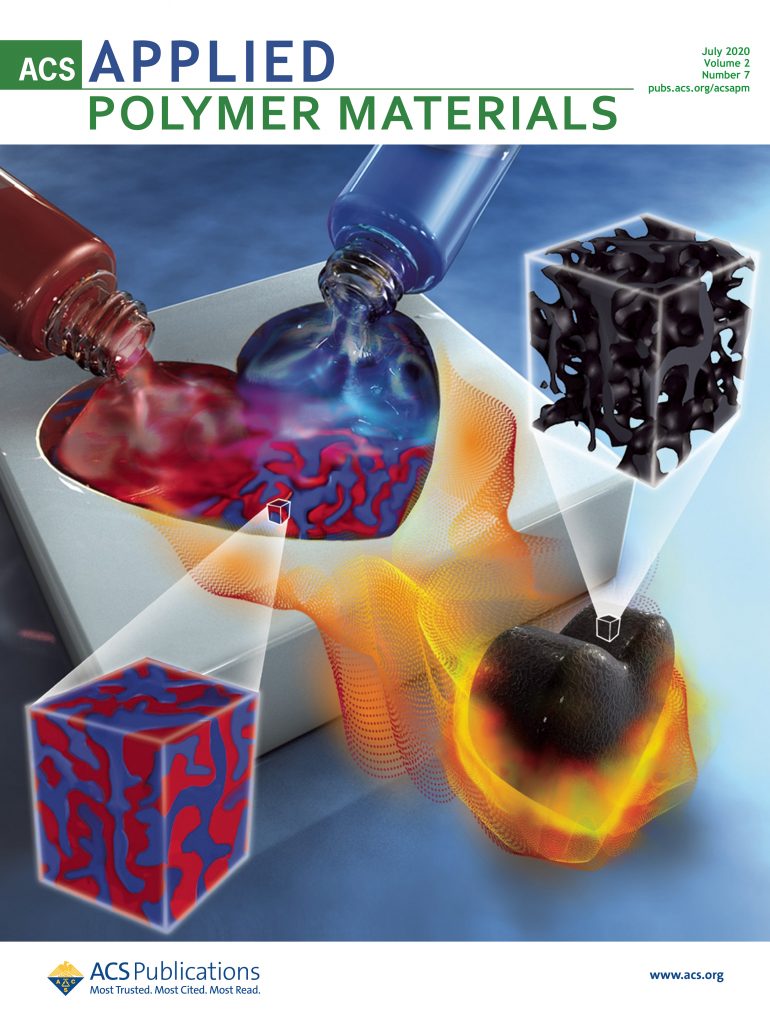
ACS Applied Polymer Materials is an interdisciplinary journal publishing original research covering all aspects of engineering, chemistry, physics, and biology relevant to applications of polymers.
The journal is devoted to reports of new and original experimental and theoretical research of an applied nature that integrates fundamental knowledge in the areas of materials, engineering, physics, bioscience, polymer science and chemistry into important polymer applications. The journal is specifically interested in work that addresses relationships among structure, processing, morphology, chemistry, properties, and function as well as work that provide insights into mechanisms critical to the performance of the polymer for applications.



 京公网安备 11010802042870号
京ICP备2023020795号-1
京公网安备 11010802042870号
京ICP备2023020795号-1

 分享
分享
 求助内容:
求助内容: 应助结果提醒方式:
 扫码关注我们
