Xiaochuan Zhang, Shaodong Sun, Haotian Wang, Jieli Lyu, Xiaojing Yu, Bian Yang, Man Yang, Zongfan Duan, Qing Yang, Jie Cui
{"title":"Mechanism insight into twin-dependent photocatalysis in near-infrared light-responsive Cu2O nanocrystals with rich oxygen vacancies","authors":"Xiaochuan Zhang, Shaodong Sun, Haotian Wang, Jieli Lyu, Xiaojing Yu, Bian Yang, Man Yang, Zongfan Duan, Qing Yang, Jie Cui","doi":"10.1016/j.nanoms.2024.05.014","DOIUrl":null,"url":null,"abstract":"<div><div>Simultaneous integration of rich oxygen vacancies (OVs) and twin crystals in a photocatalyst can not only significantly enhance the near-infrared (NIR) light response but also greatly improve the photocharge separation and transfer efficiency owing to the induced high electrical conductivity and strong built-in electric field. However, thus far, there has been a lack of a model catalyst containing both twin crystals and OVs. Herein, we develop a simple wet chemical strategy for synthesizing of unprecedented NIR light-responsive OVs-rich Cu<sub>2</sub>O black nanoparticles with high-density of twin crystals (denoted as black twinned Cu<sub>2</sub>O). As expected, the black twinned Cu<sub>2</sub>O exhibits higher visible-NIR and NIR light-driven photodegradation of tetracycline (TC) solution than the counterparts. Significantly, the mechanism insight into twin-dependent photocatalysis in NIR light-responsive Cu<sub>2</sub>O black nanocrystals with rich OVs is uncovered in depth by density functional theory (DFT) calculations and a series of experimental evidence. Expectantly, this work would be beneficial for the scientific researchers currently focusing on the NIR light-responsive photocatalysis and twin engineering of photocatalysts.</div></div>","PeriodicalId":33573,"journal":{"name":"Nano Materials Science","volume":"8 1","pages":"Pages 49-58"},"PeriodicalIF":17.9000,"publicationDate":"2026-02-01","publicationTypes":"Journal Article","fieldsOfStudy":null,"isOpenAccess":false,"openAccessPdf":"","citationCount":"0","resultStr":null,"platform":"Semanticscholar","paperid":null,"PeriodicalName":"Nano Materials Science","FirstCategoryId":"1089","ListUrlMain":"https://www.sciencedirect.com/science/article/pii/S2589965124000813","RegionNum":2,"RegionCategory":"材料科学","ArticlePicture":[],"TitleCN":null,"AbstractTextCN":null,"PMCID":null,"EPubDate":"2024/7/27 0:00:00","PubModel":"Epub","JCR":"Q1","JCRName":"Engineering","Score":null,"Total":0}
引用次数: 0
Abstract
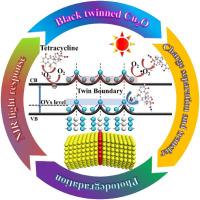
Simultaneous integration of rich oxygen vacancies (OVs) and twin crystals in a photocatalyst can not only significantly enhance the near-infrared (NIR) light response but also greatly improve the photocharge separation and transfer efficiency owing to the induced high electrical conductivity and strong built-in electric field. However, thus far, there has been a lack of a model catalyst containing both twin crystals and OVs. Herein, we develop a simple wet chemical strategy for synthesizing of unprecedented NIR light-responsive OVs-rich Cu2O black nanoparticles with high-density of twin crystals (denoted as black twinned Cu2O). As expected, the black twinned Cu2O exhibits higher visible-NIR and NIR light-driven photodegradation of tetracycline (TC) solution than the counterparts. Significantly, the mechanism insight into twin-dependent photocatalysis in NIR light-responsive Cu2O black nanocrystals with rich OVs is uncovered in depth by density functional theory (DFT) calculations and a series of experimental evidence. Expectantly, this work would be beneficial for the scientific researchers currently focusing on the NIR light-responsive photocatalysis and twin engineering of photocatalysts.
期刊介绍:
Nano Materials Science (NMS) is an international and interdisciplinary, open access, scholarly journal. NMS publishes peer-reviewed original articles and reviews on nanoscale material science and nanometer devices, with topics encompassing preparation and processing; high-throughput characterization; material performance evaluation and application of material characteristics such as the microstructure and properties of one-dimensional, two-dimensional, and three-dimensional nanostructured and nanofunctional materials; design, preparation, and processing techniques; and performance evaluation technology and nanometer device applications.




 京公网安备 11010802042870号
京ICP备2023020795号-1
京公网安备 11010802042870号
京ICP备2023020795号-1

 分享
分享
 求助内容:
求助内容: 应助结果提醒方式:
 扫码关注我们
