Hui Su Yang, Woojo Kim, Hocheon Yoo, Eun Kwang Lee
{"title":"Organic Electrochemical Transistors with Microporous Structures via Phase-Separation for Enhancing Long-Term Plasticity in Artificial Synapses","authors":"Hui Su Yang, Woojo Kim, Hocheon Yoo, Eun Kwang Lee","doi":"10.1002/admt.202400478","DOIUrl":null,"url":null,"abstract":"<p>Artificial synapses, inspired by the intricate design of biological synapses, utilize electrical, chemical, and mechanical signals to transmit and retain information. Recent advances have involved research on artificial synapses based on organic electrochemical transistors (OECTs), emphasizing low power consumption and rapid response times. A notable challenge arises when the gate voltage is removed, causing doped ions to return quickly to the electrolyte. A simple yet efficient approach is used to solve this problem: forming a microporous active layer using a phase separation method. This technique can maximize the contact area between the electrolyte and the active layer, enhancing ion doping/de-doping in OECTs. Improvements in the product of hole mobility and volumetric capacitance is achieved. The electrostatic coupling effect and electrochemical doping in synaptic OECTs occur better than in the pristine active layer, yielding enhanced performance with higher short-term and long-term synaptic plasticity, compared to pristine OECTs. Moreover, improved ambipolar characteristics is shown by <i>n</i>-dopant injection. This paper reports a way to improve performance by simply modifying the surface shape of the active layer using the phase separation, contributing to advancements in artificial synapses for neural networks.</p>","PeriodicalId":7292,"journal":{"name":"Advanced Materials Technologies","volume":"9 24","pages":""},"PeriodicalIF":6.4000,"publicationDate":"2024-08-01","publicationTypes":"Journal Article","fieldsOfStudy":null,"isOpenAccess":false,"openAccessPdf":"https://onlinelibrary.wiley.com/doi/epdf/10.1002/admt.202400478","citationCount":"0","resultStr":null,"platform":"Semanticscholar","paperid":null,"PeriodicalName":"Advanced Materials Technologies","FirstCategoryId":"88","ListUrlMain":"https://advanced.onlinelibrary.wiley.com/doi/10.1002/admt.202400478","RegionNum":3,"RegionCategory":"材料科学","ArticlePicture":[],"TitleCN":null,"AbstractTextCN":null,"PMCID":null,"EPubDate":"","PubModel":"","JCR":"Q1","JCRName":"MATERIALS SCIENCE, MULTIDISCIPLINARY","Score":null,"Total":0}
引用次数: 0
Abstract
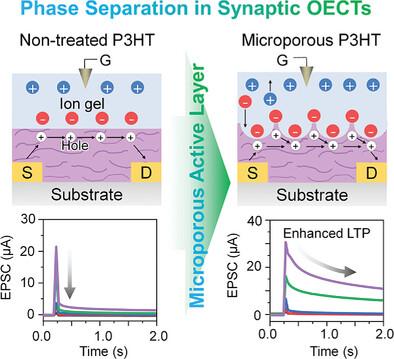
Artificial synapses, inspired by the intricate design of biological synapses, utilize electrical, chemical, and mechanical signals to transmit and retain information. Recent advances have involved research on artificial synapses based on organic electrochemical transistors (OECTs), emphasizing low power consumption and rapid response times. A notable challenge arises when the gate voltage is removed, causing doped ions to return quickly to the electrolyte. A simple yet efficient approach is used to solve this problem: forming a microporous active layer using a phase separation method. This technique can maximize the contact area between the electrolyte and the active layer, enhancing ion doping/de-doping in OECTs. Improvements in the product of hole mobility and volumetric capacitance is achieved. The electrostatic coupling effect and electrochemical doping in synaptic OECTs occur better than in the pristine active layer, yielding enhanced performance with higher short-term and long-term synaptic plasticity, compared to pristine OECTs. Moreover, improved ambipolar characteristics is shown by n-dopant injection. This paper reports a way to improve performance by simply modifying the surface shape of the active layer using the phase separation, contributing to advancements in artificial synapses for neural networks.
期刊介绍:
Advanced Materials Technologies Advanced Materials Technologies is the new home for all technology-related materials applications research, with particular focus on advanced device design, fabrication and integration, as well as new technologies based on novel materials. It bridges the gap between fundamental laboratory research and industry.






 京公网安备 11010802042870号
京ICP备2023020795号-1
京公网安备 11010802042870号
京ICP备2023020795号-1

 分享
分享
 求助内容:
求助内容: 应助结果提醒方式:
 扫码关注我们
