Sanjay Kumar Bhikari Charan Panda, Samrat Mukhopadhyay and Kushal Sen
{"title":"Coloration of ultraviolet-C-assisted combined desizing-scouring cotton fabric","authors":"Sanjay Kumar Bhikari Charan Panda, Samrat Mukhopadhyay and Kushal Sen","doi":"10.1039/D4SU00309H","DOIUrl":null,"url":null,"abstract":"<p >The textile chemical processing industry is one of the most polluting industries. The water and energy consumption in textile wet processing is very high and produces vast amounts of effluent. Desizing, scouring, bleaching, and mercerising are the essential processes involved in textile pretreatment. A novel photocatalytic technique is implemented to minimise the consumption of energy, water and time in a combined desizing and scouring process. The industrial woven cotton grey fabric is treated with an oxidising agent in the padding method and irradiated under ultraviolet-C (UVC). Then, the UVC-exposed fabric is washed at a lower temperature than that used in conventional washing. Furthermore, the scoured fabric is dyed with reactive dyes to study its dyeability. This technique saves 79% of the processing time and is superior to the conventional process in terms of dyeability. The water and energy consumption of the demonstrated process is reduced by 71% and 72%, respectively. The fabric properties are analysed using weight loss, tensile strength, absorbency time, whiteness, colour value, colour fastness, FTIR, WXRD, SEM, and EDX. Life cycle analysis is also conducted.</p>","PeriodicalId":74745,"journal":{"name":"RSC sustainability","volume":" 9","pages":" 2657-2668"},"PeriodicalIF":4.9000,"publicationDate":"2024-07-29","publicationTypes":"Journal Article","fieldsOfStudy":null,"isOpenAccess":false,"openAccessPdf":"https://pubs.rsc.org/en/content/articlepdf/2024/su/d4su00309h?page=search","citationCount":"0","resultStr":null,"platform":"Semanticscholar","paperid":null,"PeriodicalName":"RSC sustainability","FirstCategoryId":"1085","ListUrlMain":"https://pubs.rsc.org/en/content/articlelanding/2024/su/d4su00309h","RegionNum":0,"RegionCategory":null,"ArticlePicture":[],"TitleCN":null,"AbstractTextCN":null,"PMCID":null,"EPubDate":"","PubModel":"","JCR":"","JCRName":"","Score":null,"Total":0}
引用次数: 0
Abstract
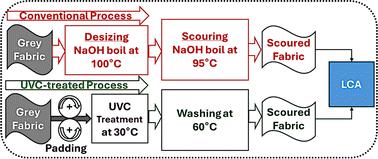
The textile chemical processing industry is one of the most polluting industries. The water and energy consumption in textile wet processing is very high and produces vast amounts of effluent. Desizing, scouring, bleaching, and mercerising are the essential processes involved in textile pretreatment. A novel photocatalytic technique is implemented to minimise the consumption of energy, water and time in a combined desizing and scouring process. The industrial woven cotton grey fabric is treated with an oxidising agent in the padding method and irradiated under ultraviolet-C (UVC). Then, the UVC-exposed fabric is washed at a lower temperature than that used in conventional washing. Furthermore, the scoured fabric is dyed with reactive dyes to study its dyeability. This technique saves 79% of the processing time and is superior to the conventional process in terms of dyeability. The water and energy consumption of the demonstrated process is reduced by 71% and 72%, respectively. The fabric properties are analysed using weight loss, tensile strength, absorbency time, whiteness, colour value, colour fastness, FTIR, WXRD, SEM, and EDX. Life cycle analysis is also conducted.



 京公网安备 11010802042870号
京ICP备2023020795号-1
京公网安备 11010802042870号
京ICP备2023020795号-1

 分享
分享

 求助内容:
求助内容: 应助结果提醒方式:
 扫码关注我们
