R Taylor Sundby, Jeffrey J Szymanski, Alexander C Pan, Paul A Jones, Sana Z Mahmood, Olivia H Reid, Divya Srihari, Amy E Armstrong, Stacey Chamberlain, Sanita Burgic, Kara Weekley, Béga Murray, Sneh Patel, Faridi Qaium, Andrea N Lucas, Margaret Fagan, Anne Dufek, Christian F Meyer, Natalie B Collins, Christine A Pratilas, Eva Dombi, Andrea M Gross, AeRang Kim, John S A Chrisinger, Carina A Dehner, Brigitte C Widemann, Angela C Hirbe, Aadel A Chaudhuri, Jack F Shern
{"title":"Early Detection of Malignant and Premalignant Peripheral Nerve Tumors Using Cell-Free DNA Fragmentomics.","authors":"R Taylor Sundby, Jeffrey J Szymanski, Alexander C Pan, Paul A Jones, Sana Z Mahmood, Olivia H Reid, Divya Srihari, Amy E Armstrong, Stacey Chamberlain, Sanita Burgic, Kara Weekley, Béga Murray, Sneh Patel, Faridi Qaium, Andrea N Lucas, Margaret Fagan, Anne Dufek, Christian F Meyer, Natalie B Collins, Christine A Pratilas, Eva Dombi, Andrea M Gross, AeRang Kim, John S A Chrisinger, Carina A Dehner, Brigitte C Widemann, Angela C Hirbe, Aadel A Chaudhuri, Jack F Shern","doi":"10.1158/1078-0432.CCR-24-0797","DOIUrl":null,"url":null,"abstract":"<p><strong>Purpose: </strong>Early detection of neurofibromatosis type 1 (NF1)-associated peripheral nerve sheath tumors (PNST) informs clinical decision-making, enabling early definitive treatment and potentially averting deadly outcomes. In this study, we describe a cell-free DNA (cfDNA) fragmentomic approach that distinguishes nonmalignant, premalignant, and malignant forms of PNST in the cancer predisposition syndrome, NF1.</p><p><strong>Experimental design: </strong>cfDNA was isolated from plasma samples of a novel cohort of 101 patients with NF1 and 21 healthy controls and underwent whole-genome sequencing. We investigated diagnosis-specific signatures of copy-number alterations with in silico size selection as well as fragment profiles. Fragmentomics were analyzed using complementary feature types: bin-wise fragment size ratios, end motifs, and fragment non-negative matrix factorization signatures.</p><p><strong>Results: </strong>The novel cohort of patients with NF1 validated that our previous cfDNA copy-number alteration-based approach identifies malignant PNST (MPNST) but cannot distinguish between benign and premalignant states. Fragmentomic methods were able to differentiate premalignant states including atypical neurofibromas (AN). Fragmentomics also adjudicated AN cases suspicious for MPNST, correctly diagnosing samples noninvasively, which could have informed clinical management.</p><p><strong>Conclusions: </strong>Novel cfDNA fragmentomic signatures distinguish AN from benign plexiform neurofibromas and MPNST, enabling more precise clinical diagnosis and management. This study pioneers the early detection of malignant and premalignant PNST in NF1 and provides a blueprint for decentralizing noninvasive cancer surveillance in hereditary cancer predisposition syndromes.</p>","PeriodicalId":10279,"journal":{"name":"Clinical Cancer Research","volume":" ","pages":"4363-4376"},"PeriodicalIF":10.2000,"publicationDate":"2024-10-01","publicationTypes":"Journal Article","fieldsOfStudy":null,"isOpenAccess":false,"openAccessPdf":"https://www.ncbi.nlm.nih.gov/pmc/articles/PMC11443212/pdf/","citationCount":"0","resultStr":null,"platform":"Semanticscholar","paperid":null,"PeriodicalName":"Clinical Cancer Research","FirstCategoryId":"3","ListUrlMain":"https://doi.org/10.1158/1078-0432.CCR-24-0797","RegionNum":1,"RegionCategory":"医学","ArticlePicture":[],"TitleCN":null,"AbstractTextCN":null,"PMCID":null,"EPubDate":"","PubModel":"","JCR":"Q1","JCRName":"ONCOLOGY","Score":null,"Total":0}
引用次数: 0
Abstract
Purpose: Early detection of neurofibromatosis type 1 (NF1)-associated peripheral nerve sheath tumors (PNST) informs clinical decision-making, enabling early definitive treatment and potentially averting deadly outcomes. In this study, we describe a cell-free DNA (cfDNA) fragmentomic approach that distinguishes nonmalignant, premalignant, and malignant forms of PNST in the cancer predisposition syndrome, NF1.
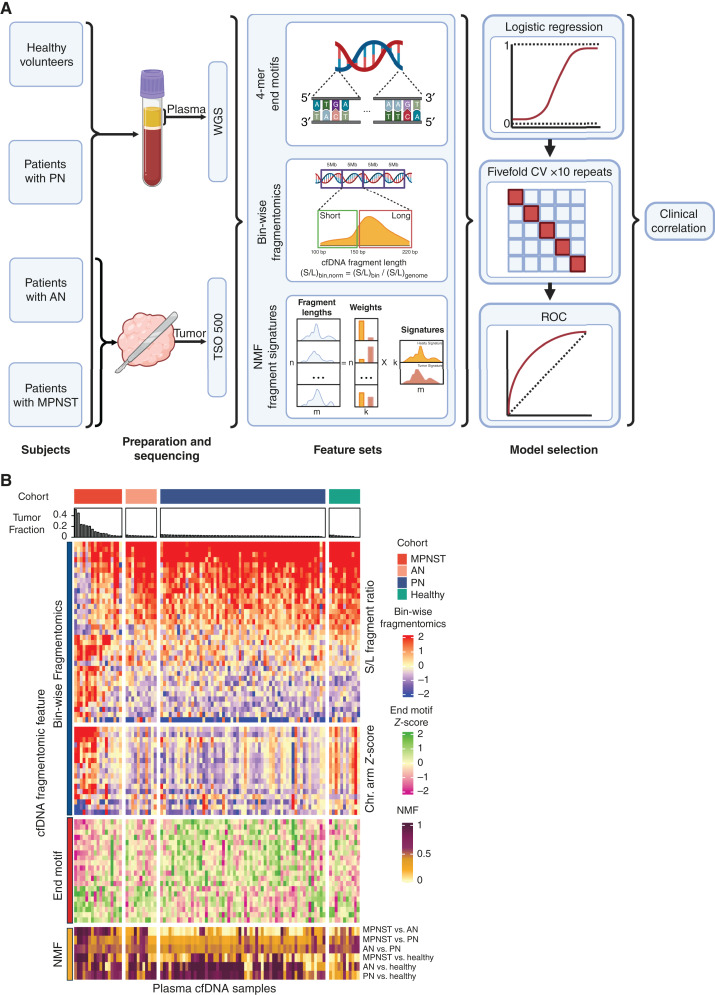
Experimental design: cfDNA was isolated from plasma samples of a novel cohort of 101 patients with NF1 and 21 healthy controls and underwent whole-genome sequencing. We investigated diagnosis-specific signatures of copy-number alterations with in silico size selection as well as fragment profiles. Fragmentomics were analyzed using complementary feature types: bin-wise fragment size ratios, end motifs, and fragment non-negative matrix factorization signatures.
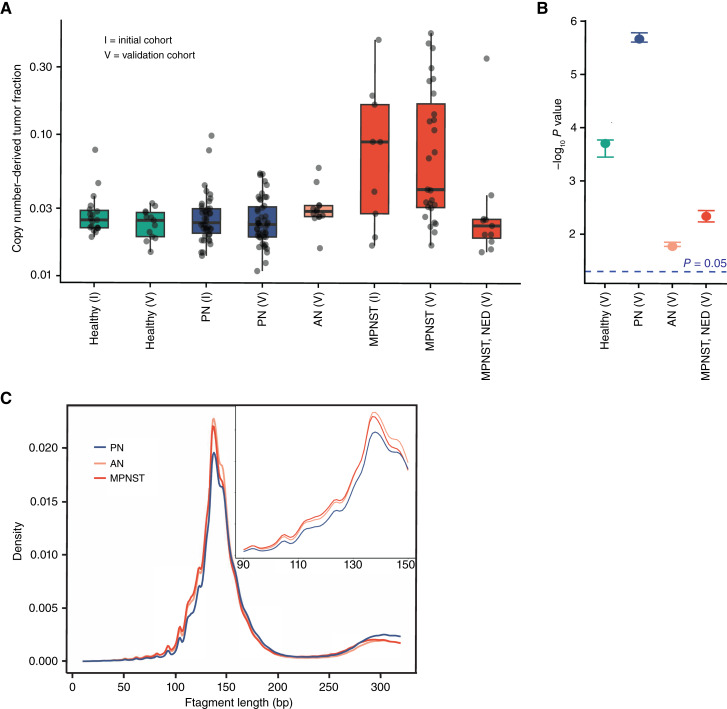
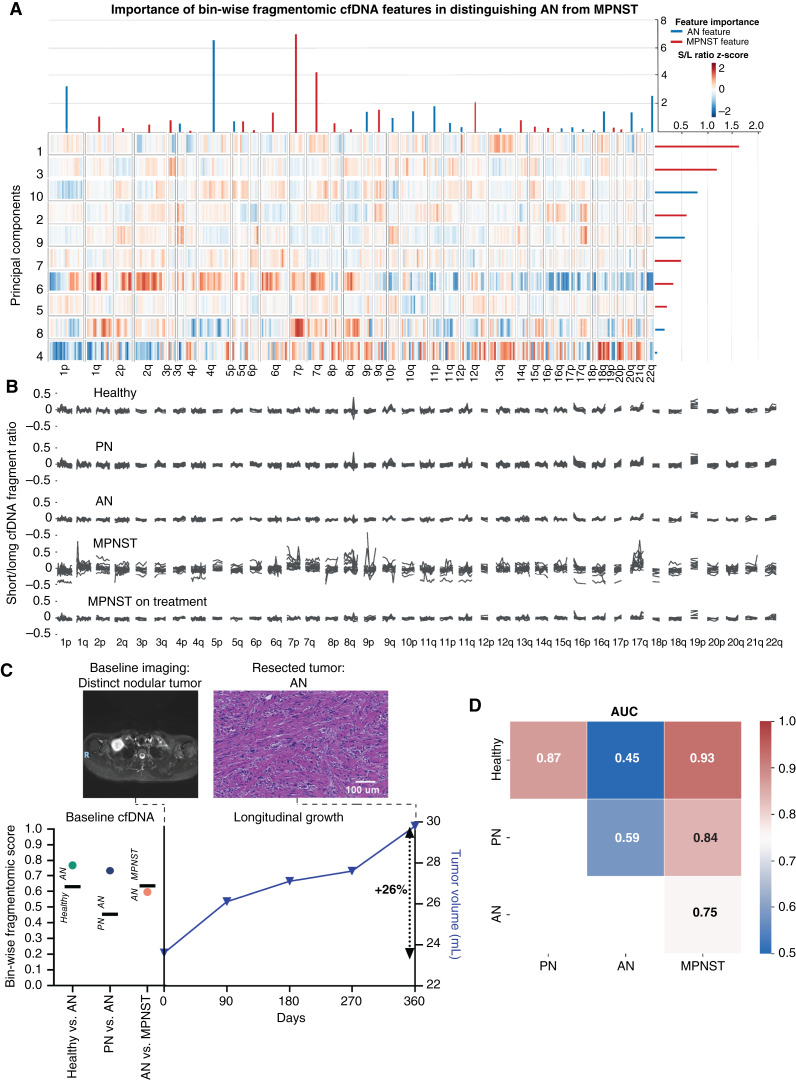
Results: The novel cohort of patients with NF1 validated that our previous cfDNA copy-number alteration-based approach identifies malignant PNST (MPNST) but cannot distinguish between benign and premalignant states. Fragmentomic methods were able to differentiate premalignant states including atypical neurofibromas (AN). Fragmentomics also adjudicated AN cases suspicious for MPNST, correctly diagnosing samples noninvasively, which could have informed clinical management.
Conclusions: Novel cfDNA fragmentomic signatures distinguish AN from benign plexiform neurofibromas and MPNST, enabling more precise clinical diagnosis and management. This study pioneers the early detection of malignant and premalignant PNST in NF1 and provides a blueprint for decentralizing noninvasive cancer surveillance in hereditary cancer predisposition syndromes.
期刊介绍:
Clinical Cancer Research is a journal focusing on groundbreaking research in cancer, specifically in the areas where the laboratory and the clinic intersect. Our primary interest lies in clinical trials that investigate novel treatments, accompanied by research on pharmacology, molecular alterations, and biomarkers that can predict response or resistance to these treatments. Furthermore, we prioritize laboratory and animal studies that explore new drugs and targeted agents with the potential to advance to clinical trials. We also encourage research on targetable mechanisms of cancer development, progression, and metastasis.



 京公网安备 11010802042870号
京ICP备2023020795号-1
京公网安备 11010802042870号
京ICP备2023020795号-1

 分享
分享
 求助内容:
求助内容: 应助结果提醒方式:
 扫码关注我们
