{"title":"Drug repurposing of cyclin-dependent kinase inhibitors for neutrophilic acute respiratory distress syndrome and psoriasis","authors":"Shun-Hua Chen , Chun-Hong Chen , Hsin-Chieh Lin , Shyh-An Yeh , Tsong-Long Hwang , Po-Jen Chen","doi":"10.1016/j.jare.2024.07.026","DOIUrl":null,"url":null,"abstract":"<div><h3>Background</h3><div>Neutrophilic inflammation, characterized by dysregulated neutrophil activation, triggers a variety of inflammatory responses such as chemotactic infiltration, oxidative bursts, degranulation, neutrophil extracellular traps (NETs) formation, and delayed turnover. This type of inflammation is pivotal in the pathogenesis of acute respiratory distress syndrome (ARDS) and psoriasis. Despite current treatments, managing neutrophil-associated inflammatory symptoms remains a significant challenge.</div></div><div><h3>Aim of review:</h3><div>This review emphasizes the role of cyclin-dependent kinases (CDKs) in neutrophil activation and inflammation. It aims to highlight the therapeutic potential of repurposing CDK inhibitors to manage neutrophilic inflammation, particularly in ARDS and psoriasis. Additionally, it discusses the necessary precautions for the clinical application of these inhibitors due to potential off-target effects and the need for dose optimization.</div></div><div><h3>Key scientific concepts of review:</h3><div>CDKs regulate key neutrophilic functions, including chemotactic responses, degranulation, NET formation, and apoptosis. Repurposing CDK inhibitors, originally developed for cancer treatment, shows promise in controlling neutrophilic inflammation. Clinical anticancer drugs, palbociclib and ribociclib, have demonstrated efficacy in treating neutrophilic ARDS and psoriasis by targeting off-label pathways, phosphoinositide 3-kinase (PI3K) and phosphodiesterase 4 (PDE4), respectively. While CDK inhibitors offer promising therapeutic benefits, their clinical repurposing requires careful consideration of off-target effects and dose optimization. Further exploration and clinical trials are necessary to ensure their safety and efficacy in treating inflammatory conditions.</div></div>","PeriodicalId":14952,"journal":{"name":"Journal of Advanced Research","volume":"72 ","pages":"Pages 485-500"},"PeriodicalIF":13.0000,"publicationDate":"2025-06-01","publicationTypes":"Journal Article","fieldsOfStudy":null,"isOpenAccess":false,"openAccessPdf":"","citationCount":"0","resultStr":null,"platform":"Semanticscholar","paperid":null,"PeriodicalName":"Journal of Advanced Research","FirstCategoryId":"103","ListUrlMain":"https://www.sciencedirect.com/science/article/pii/S2090123224003102","RegionNum":1,"RegionCategory":"综合性期刊","ArticlePicture":[],"TitleCN":null,"AbstractTextCN":null,"PMCID":null,"EPubDate":"2024/7/31 0:00:00","PubModel":"Epub","JCR":"Q1","JCRName":"MULTIDISCIPLINARY SCIENCES","Score":null,"Total":0}
引用次数: 0
Abstract
Background
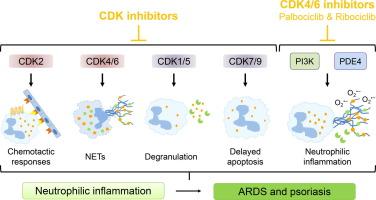
Neutrophilic inflammation, characterized by dysregulated neutrophil activation, triggers a variety of inflammatory responses such as chemotactic infiltration, oxidative bursts, degranulation, neutrophil extracellular traps (NETs) formation, and delayed turnover. This type of inflammation is pivotal in the pathogenesis of acute respiratory distress syndrome (ARDS) and psoriasis. Despite current treatments, managing neutrophil-associated inflammatory symptoms remains a significant challenge.
Aim of review:
This review emphasizes the role of cyclin-dependent kinases (CDKs) in neutrophil activation and inflammation. It aims to highlight the therapeutic potential of repurposing CDK inhibitors to manage neutrophilic inflammation, particularly in ARDS and psoriasis. Additionally, it discusses the necessary precautions for the clinical application of these inhibitors due to potential off-target effects and the need for dose optimization.
Key scientific concepts of review:
CDKs regulate key neutrophilic functions, including chemotactic responses, degranulation, NET formation, and apoptosis. Repurposing CDK inhibitors, originally developed for cancer treatment, shows promise in controlling neutrophilic inflammation. Clinical anticancer drugs, palbociclib and ribociclib, have demonstrated efficacy in treating neutrophilic ARDS and psoriasis by targeting off-label pathways, phosphoinositide 3-kinase (PI3K) and phosphodiesterase 4 (PDE4), respectively. While CDK inhibitors offer promising therapeutic benefits, their clinical repurposing requires careful consideration of off-target effects and dose optimization. Further exploration and clinical trials are necessary to ensure their safety and efficacy in treating inflammatory conditions.
期刊介绍:
Journal of Advanced Research (J. Adv. Res.) is an applied/natural sciences, peer-reviewed journal that focuses on interdisciplinary research. The journal aims to contribute to applied research and knowledge worldwide through the publication of original and high-quality research articles in the fields of Medicine, Pharmaceutical Sciences, Dentistry, Physical Therapy, Veterinary Medicine, and Basic and Biological Sciences.
The following abstracting and indexing services cover the Journal of Advanced Research: PubMed/Medline, Essential Science Indicators, Web of Science, Scopus, PubMed Central, PubMed, Science Citation Index Expanded, Directory of Open Access Journals (DOAJ), and INSPEC.



 京公网安备 11010802042870号
京ICP备2023020795号-1
京公网安备 11010802042870号
京ICP备2023020795号-1

 分享
分享
 求助内容:
求助内容: 应助结果提醒方式:
 扫码关注我们
