{"title":"Role of blood–brain barrier dysfunction in the development of poststroke epilepsy","authors":"Wouter C. Meijer, Jan A. Gorter","doi":"10.1111/epi.18072","DOIUrl":null,"url":null,"abstract":"<p>Stroke is a major contributor to mortality and morbidity worldwide and the most common cause of epilepsy in the elderly in high income nations. In recent years, it has become increasingly evident that both ischemic and hemorrhagic strokes induce dysfunction of the blood–brain barrier (BBB), and that this impairment can contribute to epileptogenesis. Nevertheless, studies directly comparing BBB dysfunction and poststroke epilepsy (PSE) are largely absent. Therefore, this review summarizes the role of BBB dysfunction in the development of PSE in animal models and clinical studies. There are multiple mechanisms whereby stroke induces BBB dysfunction, including increased transcytosis, tight junction dysfunction, spreading depolarizations, astrocyte and pericyte loss, reactive astrocytosis, angiogenesis, matrix metalloproteinase activation, neuroinflammation, adenosine triphosphate depletion, oxidative stress, and finally cell death. The degree to which these effects occur is dependent on the severity of the ischemia, whereby cell death is a more prominent mechanism of BBB disruption in regions of critical ischemia. BBB dysfunction can contribute to epileptogenesis by increasing the risk of hemorrhagic transformation, increasing stroke size and the amount of cerebral vasogenic edema, extravasation of excitatory compounds, and increasing neuroinflammation. Furthermore, albumin extravasation after BBB dysfunction contributes to epileptogenesis primarily via increased transforming growth factor β signaling. Finally, seizures themselves induce BBB dysfunction, thereby contributing to epileptogenesis in a cyclical manner. In repairing this BBB dysfunction, pericyte migration via platelet-derived growth factor β signaling is indispensable and required for reconstruction of the BBB, whereby astrocytes also play a role. Although animal stroke models have their limitations, they provide valuable insights into the development of potential therapeutics designed to restore the BBB after stroke, with the ultimate goal of improving outcomes and minimizing the occurrence of PSE. In pursuit of this goal, rapamycin, statins, losartan, semaglutide, and metformin show promise, whereby modulation of pericyte migration could also be beneficial.</p>","PeriodicalId":11768,"journal":{"name":"Epilepsia","volume":"65 9","pages":"2519-2536"},"PeriodicalIF":6.6000,"publicationDate":"2024-08-05","publicationTypes":"Journal Article","fieldsOfStudy":null,"isOpenAccess":false,"openAccessPdf":"https://onlinelibrary.wiley.com/doi/epdf/10.1111/epi.18072","citationCount":"0","resultStr":null,"platform":"Semanticscholar","paperid":null,"PeriodicalName":"Epilepsia","FirstCategoryId":"3","ListUrlMain":"https://onlinelibrary.wiley.com/doi/10.1111/epi.18072","RegionNum":1,"RegionCategory":"医学","ArticlePicture":[],"TitleCN":null,"AbstractTextCN":null,"PMCID":null,"EPubDate":"","PubModel":"","JCR":"Q1","JCRName":"CLINICAL NEUROLOGY","Score":null,"Total":0}
引用次数: 0
Abstract
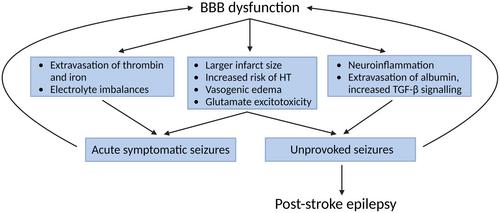
Stroke is a major contributor to mortality and morbidity worldwide and the most common cause of epilepsy in the elderly in high income nations. In recent years, it has become increasingly evident that both ischemic and hemorrhagic strokes induce dysfunction of the blood–brain barrier (BBB), and that this impairment can contribute to epileptogenesis. Nevertheless, studies directly comparing BBB dysfunction and poststroke epilepsy (PSE) are largely absent. Therefore, this review summarizes the role of BBB dysfunction in the development of PSE in animal models and clinical studies. There are multiple mechanisms whereby stroke induces BBB dysfunction, including increased transcytosis, tight junction dysfunction, spreading depolarizations, astrocyte and pericyte loss, reactive astrocytosis, angiogenesis, matrix metalloproteinase activation, neuroinflammation, adenosine triphosphate depletion, oxidative stress, and finally cell death. The degree to which these effects occur is dependent on the severity of the ischemia, whereby cell death is a more prominent mechanism of BBB disruption in regions of critical ischemia. BBB dysfunction can contribute to epileptogenesis by increasing the risk of hemorrhagic transformation, increasing stroke size and the amount of cerebral vasogenic edema, extravasation of excitatory compounds, and increasing neuroinflammation. Furthermore, albumin extravasation after BBB dysfunction contributes to epileptogenesis primarily via increased transforming growth factor β signaling. Finally, seizures themselves induce BBB dysfunction, thereby contributing to epileptogenesis in a cyclical manner. In repairing this BBB dysfunction, pericyte migration via platelet-derived growth factor β signaling is indispensable and required for reconstruction of the BBB, whereby astrocytes also play a role. Although animal stroke models have their limitations, they provide valuable insights into the development of potential therapeutics designed to restore the BBB after stroke, with the ultimate goal of improving outcomes and minimizing the occurrence of PSE. In pursuit of this goal, rapamycin, statins, losartan, semaglutide, and metformin show promise, whereby modulation of pericyte migration could also be beneficial.
期刊介绍:
Epilepsia is the leading, authoritative source for innovative clinical and basic science research for all aspects of epilepsy and seizures. In addition, Epilepsia publishes critical reviews, opinion pieces, and guidelines that foster understanding and aim to improve the diagnosis and treatment of people with seizures and epilepsy.



 京公网安备 11010802042870号
京ICP备2023020795号-1
京公网安备 11010802042870号
京ICP备2023020795号-1

 分享
分享
 求助内容:
求助内容: 应助结果提醒方式:
 扫码关注我们
