Association of serum uric acid to serum creatinine ratio with 1-year stroke outcomes in patients with acute ischemic stroke: A multicenter observational cohort study
{"title":"Association of serum uric acid to serum creatinine ratio with 1-year stroke outcomes in patients with acute ischemic stroke: A multicenter observational cohort study","authors":"Dandan Zhang, Zhongzhong Liu, Weiyan Guo, Qingli Lu, Zhen Lei, Pei Liu, Tong Liu, Linna Peng, Qiaoqiao Chang, Mi Zhang, Xuemei Lin, Fang Wang, Songdi Wu","doi":"10.1111/ene.16431","DOIUrl":null,"url":null,"abstract":"<div>\n \n \n <section>\n \n <h3> Background and purpose</h3>\n \n <p>Considering the reliance of serum uric acid (SUA) levels on renal clearance function, its role in stroke outcomes remains controversial. This study investigated the association of renal function–normalized SUA (SUA to serum creatinine ratio, SUA/SCr), a novel renal function index, with the 1-year outcomes in patients with acute ischemic stroke (AIS).</p>\n </section>\n \n <section>\n \n <h3> Methods</h3>\n \n <p>This is a prospective, multicenter observational study. Renal function–normalized SUA levels were determined by calculating the ratio of SUA to SCr. One-year outcomes included stroke recurrence, all-cause mortality, and poor prognosis. Multivariable Cox regression analyses and restriction cubic splines for curve fitting were used to evaluate SUA/SCr's association with 1-year stroke outcomes.</p>\n </section>\n \n <section>\n \n <h3> Results</h3>\n \n <p>Among 2294 enrolled patients, after adjustment for potential confounders, multivariable Cox regression analyses showed that each one-unit increase in SUA/SCr corresponded to a 19% decrease in 1-year stroke recurrence in patients with AIS. SUA/SCr was analyzed as a continuous variable and categorized into quartiles (Q1–Q4). Compared with the Q1 reference group, Q2, Q3, and Q4 showed significantly lower 1-year stroke recurrence risks. The trend test indicated significant differences in the 1-year stroke recurrence trend from Q1 to Q4. In these patients, SUA/SCr did not show a significant association with poor prognosis or all-cause mortality. Curve fitting revealed SUA/SCr had a negative but nonlinear association with 1-year stroke recurrence.</p>\n </section>\n \n <section>\n \n <h3> Conclusions</h3>\n \n <p>In patients with AIS, low SUA/SCr may be an independent risk factor for 1-year stroke recurrence. Changes in SUA/SCr had no significant impact on 1-year poor prognosis and all-cause mortality.</p>\n </section>\n </div>","PeriodicalId":11954,"journal":{"name":"European Journal of Neurology","volume":"31 12","pages":""},"PeriodicalIF":3.9000,"publicationDate":"2024-08-05","publicationTypes":"Journal Article","fieldsOfStudy":null,"isOpenAccess":false,"openAccessPdf":"https://www.ncbi.nlm.nih.gov/pmc/articles/PMC11555002/pdf/","citationCount":"0","resultStr":null,"platform":"Semanticscholar","paperid":null,"PeriodicalName":"European Journal of Neurology","FirstCategoryId":"3","ListUrlMain":"https://onlinelibrary.wiley.com/doi/10.1111/ene.16431","RegionNum":2,"RegionCategory":"医学","ArticlePicture":[],"TitleCN":null,"AbstractTextCN":null,"PMCID":null,"EPubDate":"","PubModel":"","JCR":"Q1","JCRName":"CLINICAL NEUROLOGY","Score":null,"Total":0}
引用次数: 0
Abstract
Background and purpose
Considering the reliance of serum uric acid (SUA) levels on renal clearance function, its role in stroke outcomes remains controversial. This study investigated the association of renal function–normalized SUA (SUA to serum creatinine ratio, SUA/SCr), a novel renal function index, with the 1-year outcomes in patients with acute ischemic stroke (AIS).
Methods
This is a prospective, multicenter observational study. Renal function–normalized SUA levels were determined by calculating the ratio of SUA to SCr. One-year outcomes included stroke recurrence, all-cause mortality, and poor prognosis. Multivariable Cox regression analyses and restriction cubic splines for curve fitting were used to evaluate SUA/SCr's association with 1-year stroke outcomes.
Results
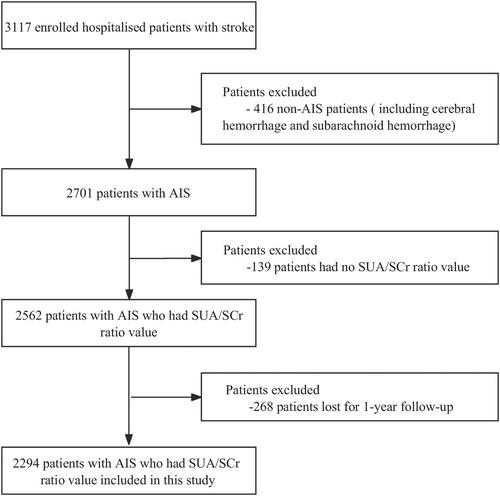
Among 2294 enrolled patients, after adjustment for potential confounders, multivariable Cox regression analyses showed that each one-unit increase in SUA/SCr corresponded to a 19% decrease in 1-year stroke recurrence in patients with AIS. SUA/SCr was analyzed as a continuous variable and categorized into quartiles (Q1–Q4). Compared with the Q1 reference group, Q2, Q3, and Q4 showed significantly lower 1-year stroke recurrence risks. The trend test indicated significant differences in the 1-year stroke recurrence trend from Q1 to Q4. In these patients, SUA/SCr did not show a significant association with poor prognosis or all-cause mortality. Curve fitting revealed SUA/SCr had a negative but nonlinear association with 1-year stroke recurrence.
Conclusions
In patients with AIS, low SUA/SCr may be an independent risk factor for 1-year stroke recurrence. Changes in SUA/SCr had no significant impact on 1-year poor prognosis and all-cause mortality.
期刊介绍:
The European Journal of Neurology is the official journal of the European Academy of Neurology and covers all areas of clinical and basic research in neurology, including pre-clinical research of immediate translational value for new potential treatments. Emphasis is placed on major diseases of large clinical and socio-economic importance (dementia, stroke, epilepsy, headache, multiple sclerosis, movement disorders, and infectious diseases).




 京公网安备 11010802042870号
京ICP备2023020795号-1
京公网安备 11010802042870号
京ICP备2023020795号-1

 分享
分享
 求助内容:
求助内容: 应助结果提醒方式:
 扫码关注我们
