{"title":"Gastrointestinal: A rare etiology of pneumoperitoneum and epigastric pain","authors":"D Li, S Chen, B Chen, B Li, C Lin, W Wang","doi":"10.1111/jgh.16684","DOIUrl":null,"url":null,"abstract":"<p>A 72-year-old woman was presented to the emergency department with the primary complaint of severe epigastric pain lasting 1 day. The patient's medical history was notable for hypertension for 30 years and cholecystolithiasis diagnosed 1 year prior. Initial assessment revealed stable vital signs, albeit with tachycardia (120 beats per minute). A physical examination suggested generalized abdominal tenderness and signs indicative of peritoneal irritation. Laboratory tests highlighted elevated levels of inflammatory markers: high-sensitivity C-reactive protein at 135.40 mg/L and procalcitonin at 43.00 ng/mL, alongside increased enzymatic activities, with alanine aminotransferase at 222 U/L, lipase at 910 U/L, and amylase at 489 U/L. Computed tomography scans revealed segmental thickening of the gastric pylorus and descending duodenum, as well as pneumoperitoneum in the perihepatic and ampullary regions (Figs 1 and 2).</p><p>Perforation of the upper digestive tract and secondary cholecystitis and pancreatitis were suspected; therefore, laparoscopic surgery was performed. During the surgery, yellow, purulent effusion was accumulated in the perihepatic area, and broad inflammation of the hepatoduodenal ligament was noticed. However, the location of the perforation was unfound. Thus, we performed laparotomy to further explore the area of perforation. A careful examination of the stomach, duodenum, and ampullary area was conducted but still failed to identify the perforation. However, multiple abscesses and necrosis were found at the ligamentum teres hepatis, the gall bladder was slightly enlarged, and there was no adhesion between the gallbladder and adjacent areas. To avoid potential omissions, intraoperative gastroscopy was performed to explore the digestive tract from the inside. The mucous of the upper digestive tract remains intact, ruling out the probability of perforation. Given the signs of cholecystitis and pancreatitis, cholecystectomy and complete excision of the necrotized ligament were then performed (Fig. 3). Histological examination revealed gangrenous cholecystitis and necrotizing of the ligamentum teres hepatis (Figs 4 and 5). Next-generation sequencing of the drainage collected during the operation revealed <i>Clostridium perfringens</i> and <i>Enterococcus faecium</i>. These findings establish the diagnosis of an infection of the ligamentum teres hepatis by <i>C. perfringens</i>, potentially secondary to gangrenous cholecystitis.</p><p>Abscess formation within the ligamentum teres hepatis represents an uncommon clinical presentation, frequently obscured by differential diagnoses such as cholecystitis and gastrointestinal tract perforations.<span><sup>1</sup></span> To date, English-language literature reports only 18 cases of ligamentum teres hepatis infection.<span><sup>2, 3</sup></span> This case not only aligns with the clinical presentation of fever and abdominal pain observed in the majority of these cases but also contributes to the understanding of the etiology and management. Some researchers postulated that such abscesses may arise as a sequelae of biliary tract obstructions and retrograde infection of the portal system, which entails bacterial invasion of the hepatic sinusoids and subsequent dissemination to the ligamentum teres hepatis.<span><sup>2, 4</sup></span> Among the previously documented 18 patients, 15 have concomitant disease of the biliary tract system, further validating the credibility of this postulation.<span><sup>3</sup></span></p><p>Overall, the infection of the ligamentum teres hepatis constitutes a distinct clinical entity within the spectrum of acute abdominal conditions, prone to misdiagnosis as more common ailments such as gastrointestinal tract perforation. This case delineates the imperative diagnostic and surgical measures necessary to exclude other potential causes of acute abdomen, emphasizing the importance of considering ligamentum teres hepatis infection in patients presenting with nonspecific and atypical abdominal pain. Following the surgery, the patient also suffered from infection, oliguria, deep vein thrombosis, and stress-induced cardiomyopathy, all of which were addressed promptly. Fortunately, the patient exhibited a favorable recovery trajectory and was discharged 44 days subsequent to the surgical procedure. The successful management and resolution of this case underscore the significance of a comprehensive and nuanced approach to diagnosis and treatment in similar clinical scenarios.</p>","PeriodicalId":15877,"journal":{"name":"Journal of Gastroenterology and Hepatology","volume":"40 1","pages":"5-7"},"PeriodicalIF":3.4000,"publicationDate":"2024-08-05","publicationTypes":"Journal Article","fieldsOfStudy":null,"isOpenAccess":false,"openAccessPdf":"https://www.ncbi.nlm.nih.gov/pmc/articles/PMC11771556/pdf/","citationCount":"0","resultStr":null,"platform":"Semanticscholar","paperid":null,"PeriodicalName":"Journal of Gastroenterology and Hepatology","FirstCategoryId":"3","ListUrlMain":"https://onlinelibrary.wiley.com/doi/10.1111/jgh.16684","RegionNum":3,"RegionCategory":"医学","ArticlePicture":[],"TitleCN":null,"AbstractTextCN":null,"PMCID":null,"EPubDate":"","PubModel":"","JCR":"Q2","JCRName":"GASTROENTEROLOGY & HEPATOLOGY","Score":null,"Total":0}
引用次数: 0
Abstract
A 72-year-old woman was presented to the emergency department with the primary complaint of severe epigastric pain lasting 1 day. The patient's medical history was notable for hypertension for 30 years and cholecystolithiasis diagnosed 1 year prior. Initial assessment revealed stable vital signs, albeit with tachycardia (120 beats per minute). A physical examination suggested generalized abdominal tenderness and signs indicative of peritoneal irritation. Laboratory tests highlighted elevated levels of inflammatory markers: high-sensitivity C-reactive protein at 135.40 mg/L and procalcitonin at 43.00 ng/mL, alongside increased enzymatic activities, with alanine aminotransferase at 222 U/L, lipase at 910 U/L, and amylase at 489 U/L. Computed tomography scans revealed segmental thickening of the gastric pylorus and descending duodenum, as well as pneumoperitoneum in the perihepatic and ampullary regions (Figs 1 and 2).
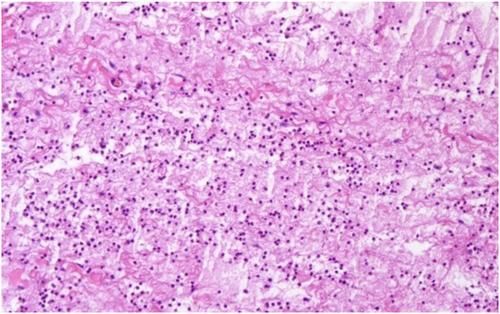
Perforation of the upper digestive tract and secondary cholecystitis and pancreatitis were suspected; therefore, laparoscopic surgery was performed. During the surgery, yellow, purulent effusion was accumulated in the perihepatic area, and broad inflammation of the hepatoduodenal ligament was noticed. However, the location of the perforation was unfound. Thus, we performed laparotomy to further explore the area of perforation. A careful examination of the stomach, duodenum, and ampullary area was conducted but still failed to identify the perforation. However, multiple abscesses and necrosis were found at the ligamentum teres hepatis, the gall bladder was slightly enlarged, and there was no adhesion between the gallbladder and adjacent areas. To avoid potential omissions, intraoperative gastroscopy was performed to explore the digestive tract from the inside. The mucous of the upper digestive tract remains intact, ruling out the probability of perforation. Given the signs of cholecystitis and pancreatitis, cholecystectomy and complete excision of the necrotized ligament were then performed (Fig. 3). Histological examination revealed gangrenous cholecystitis and necrotizing of the ligamentum teres hepatis (Figs 4 and 5). Next-generation sequencing of the drainage collected during the operation revealed Clostridium perfringens and Enterococcus faecium. These findings establish the diagnosis of an infection of the ligamentum teres hepatis by C. perfringens, potentially secondary to gangrenous cholecystitis.
Abscess formation within the ligamentum teres hepatis represents an uncommon clinical presentation, frequently obscured by differential diagnoses such as cholecystitis and gastrointestinal tract perforations.1 To date, English-language literature reports only 18 cases of ligamentum teres hepatis infection.2, 3 This case not only aligns with the clinical presentation of fever and abdominal pain observed in the majority of these cases but also contributes to the understanding of the etiology and management. Some researchers postulated that such abscesses may arise as a sequelae of biliary tract obstructions and retrograde infection of the portal system, which entails bacterial invasion of the hepatic sinusoids and subsequent dissemination to the ligamentum teres hepatis.2, 4 Among the previously documented 18 patients, 15 have concomitant disease of the biliary tract system, further validating the credibility of this postulation.3
Overall, the infection of the ligamentum teres hepatis constitutes a distinct clinical entity within the spectrum of acute abdominal conditions, prone to misdiagnosis as more common ailments such as gastrointestinal tract perforation. This case delineates the imperative diagnostic and surgical measures necessary to exclude other potential causes of acute abdomen, emphasizing the importance of considering ligamentum teres hepatis infection in patients presenting with nonspecific and atypical abdominal pain. Following the surgery, the patient also suffered from infection, oliguria, deep vein thrombosis, and stress-induced cardiomyopathy, all of which were addressed promptly. Fortunately, the patient exhibited a favorable recovery trajectory and was discharged 44 days subsequent to the surgical procedure. The successful management and resolution of this case underscore the significance of a comprehensive and nuanced approach to diagnosis and treatment in similar clinical scenarios.
期刊介绍:
Journal of Gastroenterology and Hepatology is produced 12 times per year and publishes peer-reviewed original papers, reviews and editorials concerned with clinical practice and research in the fields of hepatology, gastroenterology and endoscopy. Papers cover the medical, radiological, pathological, biochemical, physiological and historical aspects of the subject areas. All submitted papers are reviewed by at least two referees expert in the field of the submitted paper.



 京公网安备 11010802042870号
京ICP备2023020795号-1
京公网安备 11010802042870号
京ICP备2023020795号-1

 分享
分享
 求助内容:
求助内容: 应助结果提醒方式:
 扫码关注我们
