Arthur R. van Nieuw Amerongen, Anne Marthe Meppelink, Arko Ghosh, Roland D. Thijs
{"title":"Real-world smartphone data can trace the behavioural impact of epilepsy: A case study","authors":"Arthur R. van Nieuw Amerongen, Anne Marthe Meppelink, Arko Ghosh, Roland D. Thijs","doi":"10.1111/ene.16433","DOIUrl":null,"url":null,"abstract":"<div>\n \n \n <section>\n \n <h3> Background</h3>\n \n <p>Neurobehavioural comorbidities have a detrimental effect on the quality of life of people with epilepsy, yet tracking their impact is challenging as behaviour may vary with seizures and anti-seizure medication (ASM) side effects. Smartphones have the potential to monitor day-to-day neurobehavioural patterns objectively. We present the case of a man in his late twenties with drug-resistant focal epilepsy in whom we ascertained the effects of ASM withdrawal and a convulsive seizure on his touchscreen interactions.</p>\n </section>\n \n <section>\n \n <h3> Methods</h3>\n \n <p>Using a dedicated app, we recorded over 185 days the timestamps of 718,357 interactions. We divided the various smartphone behaviours according to the next-interval dynamics of the interactions by using a joint interval distribution (JID). During two ASM load transitions, namely before versus during tapering and tapering versus restarting medication, we used cluster-based permutation tests to compare the JIDs. We also compared the JID of the seizure day to the average of the previous 3 days.</p>\n </section>\n \n <section>\n \n <h3> Results</h3>\n \n <p>The cluster-based permutation tests revealed significant differences, with accelerated next-interval dynamics during tapering and a reversal upon medication restart. The day of the convulsion exhibited a marked slowing of next-interval dynamics compared to the preceding 3 days.</p>\n </section>\n \n <section>\n \n <h3> Conclusion</h3>\n \n <p>Our findings suggest that the temporal dynamics of smartphone touchscreen interactions may help monitor neurobehavioural comorbidities in neurological care.</p>\n </section>\n </div>","PeriodicalId":11954,"journal":{"name":"European Journal of Neurology","volume":"31 12","pages":""},"PeriodicalIF":3.9000,"publicationDate":"2024-08-07","publicationTypes":"Journal Article","fieldsOfStudy":null,"isOpenAccess":false,"openAccessPdf":"https://www.ncbi.nlm.nih.gov/pmc/articles/PMC11555023/pdf/","citationCount":"0","resultStr":null,"platform":"Semanticscholar","paperid":null,"PeriodicalName":"European Journal of Neurology","FirstCategoryId":"3","ListUrlMain":"https://onlinelibrary.wiley.com/doi/10.1111/ene.16433","RegionNum":2,"RegionCategory":"医学","ArticlePicture":[],"TitleCN":null,"AbstractTextCN":null,"PMCID":null,"EPubDate":"","PubModel":"","JCR":"Q1","JCRName":"CLINICAL NEUROLOGY","Score":null,"Total":0}
引用次数: 0
Abstract
Background
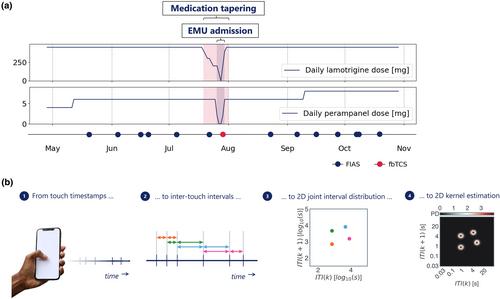
Neurobehavioural comorbidities have a detrimental effect on the quality of life of people with epilepsy, yet tracking their impact is challenging as behaviour may vary with seizures and anti-seizure medication (ASM) side effects. Smartphones have the potential to monitor day-to-day neurobehavioural patterns objectively. We present the case of a man in his late twenties with drug-resistant focal epilepsy in whom we ascertained the effects of ASM withdrawal and a convulsive seizure on his touchscreen interactions.
Methods
Using a dedicated app, we recorded over 185 days the timestamps of 718,357 interactions. We divided the various smartphone behaviours according to the next-interval dynamics of the interactions by using a joint interval distribution (JID). During two ASM load transitions, namely before versus during tapering and tapering versus restarting medication, we used cluster-based permutation tests to compare the JIDs. We also compared the JID of the seizure day to the average of the previous 3 days.
Results
The cluster-based permutation tests revealed significant differences, with accelerated next-interval dynamics during tapering and a reversal upon medication restart. The day of the convulsion exhibited a marked slowing of next-interval dynamics compared to the preceding 3 days.
Conclusion
Our findings suggest that the temporal dynamics of smartphone touchscreen interactions may help monitor neurobehavioural comorbidities in neurological care.
期刊介绍:
The European Journal of Neurology is the official journal of the European Academy of Neurology and covers all areas of clinical and basic research in neurology, including pre-clinical research of immediate translational value for new potential treatments. Emphasis is placed on major diseases of large clinical and socio-economic importance (dementia, stroke, epilepsy, headache, multiple sclerosis, movement disorders, and infectious diseases).



 京公网安备 11010802042870号
京ICP备2023020795号-1
京公网安备 11010802042870号
京ICP备2023020795号-1

 分享
分享
 求助内容:
求助内容: 应助结果提醒方式:
 扫码关注我们
