Maria Cristina Savastano, Claudia Fossataro, Gianni Gravina, Francesca Coccimiglio, Clara Rizzo, Stanislao Rizzo
{"title":"MANAGEMENT OF PERIFOVEAL EXUDATIVE VASCULAR ANOMALOUS COMPLEX.","authors":"Maria Cristina Savastano, Claudia Fossataro, Gianni Gravina, Francesca Coccimiglio, Clara Rizzo, Stanislao Rizzo","doi":"10.1097/ICB.0000000000001649","DOIUrl":null,"url":null,"abstract":"<p><strong>Purpose: </strong>To report a case of a patient with perifoveal exudative vascular anomalous complex (PEVAC) and to analyze morphologic and vascular changes by optical coherence tomography (OCT) and OCT angiography (OCTA) before and after treatment.</p><p><strong>Materials and methods: </strong>The authors reported a case that received multiple treatments for unresponsive effect to repeated aflibercept intravitreal injections, subthreshold micropulse laser therapy duty cycle 5%. At last, the focal full-dose yellow laser was performed.</p><p><strong>Results: </strong>A 57-year-old male patient presented with best-corrected visual acuity (BCVA) of 20/50 in his right eye (RE). The fundoscopic evaluation, structural OCT, and OCTA deposed for a diagnosis of PEVAC. The patient underwent three aflibercept intravitreal injections in the RE. Because no changes were detected, the authors opted for multiple sessions of yellow subthreshold micropulse laser therapy duty cycle 5%; however, no signs of regression were registered. Only after a full-dose yellow laser, signs of edema regression were observed. Structural OCT B-scan showed complete restoration of retinal profile, in the absence of any intraretinal or subretinal fluid and PEVAC lesion, whereas the OCTA showed a slight flow deficit at the previous lesion site.</p><p><strong>Conclusion and importance: </strong>The PEVAC treatment is still unknown. In their experience, the authors reported a case of multiple treatments for unresponsive effect to aflibercept intravitreal injections, subthreshold micropulse laser therapy duty cycle 5%. The focal full-dose yellow laser was the only effective treatment in this patient. The authors proposed the management to share the heterogeneous response at PEVAC entity.</p>","PeriodicalId":53580,"journal":{"name":"Retinal Cases and Brief Reports","volume":" ","pages":"714-720"},"PeriodicalIF":0.0000,"publicationDate":"2025-11-01","publicationTypes":"Journal Article","fieldsOfStudy":null,"isOpenAccess":false,"openAccessPdf":"https://www.ncbi.nlm.nih.gov/pmc/articles/PMC12570618/pdf/","citationCount":"0","resultStr":null,"platform":"Semanticscholar","paperid":null,"PeriodicalName":"Retinal Cases and Brief Reports","FirstCategoryId":"1085","ListUrlMain":"https://doi.org/10.1097/ICB.0000000000001649","RegionNum":0,"RegionCategory":null,"ArticlePicture":[],"TitleCN":null,"AbstractTextCN":null,"PMCID":null,"EPubDate":"","PubModel":"","JCR":"Q3","JCRName":"Medicine","Score":null,"Total":0}
引用次数: 0
Abstract
Purpose: To report a case of a patient with perifoveal exudative vascular anomalous complex (PEVAC) and to analyze morphologic and vascular changes by optical coherence tomography (OCT) and OCT angiography (OCTA) before and after treatment.
Materials and methods: The authors reported a case that received multiple treatments for unresponsive effect to repeated aflibercept intravitreal injections, subthreshold micropulse laser therapy duty cycle 5%. At last, the focal full-dose yellow laser was performed.
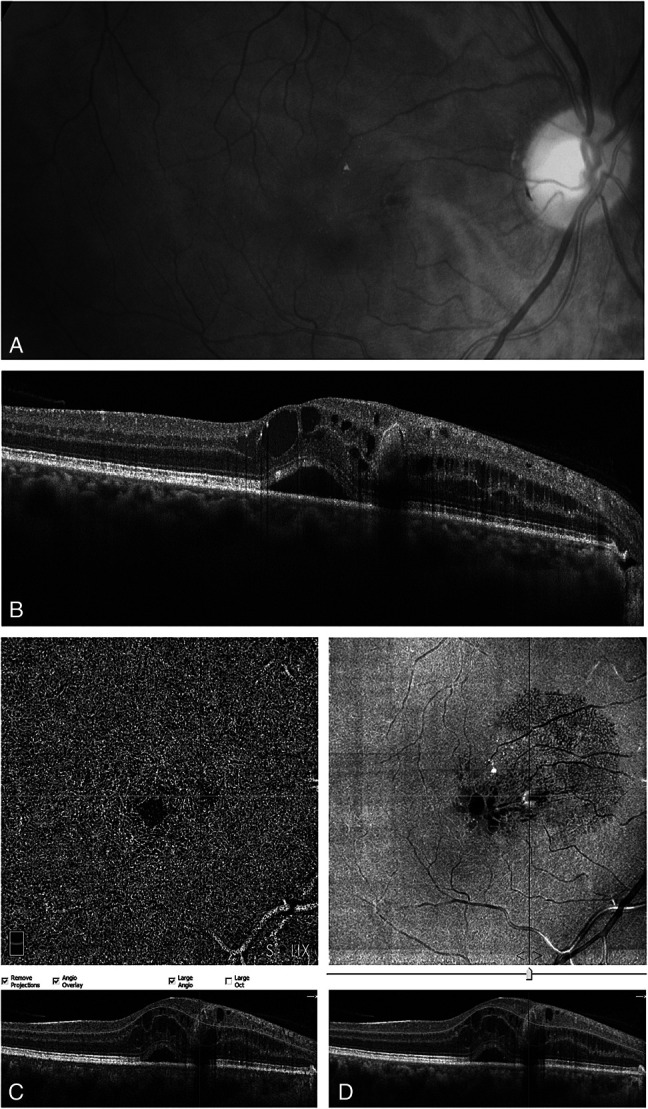
Results: A 57-year-old male patient presented with best-corrected visual acuity (BCVA) of 20/50 in his right eye (RE). The fundoscopic evaluation, structural OCT, and OCTA deposed for a diagnosis of PEVAC. The patient underwent three aflibercept intravitreal injections in the RE. Because no changes were detected, the authors opted for multiple sessions of yellow subthreshold micropulse laser therapy duty cycle 5%; however, no signs of regression were registered. Only after a full-dose yellow laser, signs of edema regression were observed. Structural OCT B-scan showed complete restoration of retinal profile, in the absence of any intraretinal or subretinal fluid and PEVAC lesion, whereas the OCTA showed a slight flow deficit at the previous lesion site.
Conclusion and importance: The PEVAC treatment is still unknown. In their experience, the authors reported a case of multiple treatments for unresponsive effect to aflibercept intravitreal injections, subthreshold micropulse laser therapy duty cycle 5%. The focal full-dose yellow laser was the only effective treatment in this patient. The authors proposed the management to share the heterogeneous response at PEVAC entity.
目的:报告一例眼周渗出性血管异常复合体(PEVAC)患者,并通过OCT和OCTA分析治疗前后的形态学和血管变化:在本病例中,我们报告了一个因重复阿弗利百普玻璃体内注射、阈下微脉冲激光治疗(SMPL)占空比为5%而接受多次治疗无效的病例。最后,进行了病灶全剂量黄色激光治疗:一名 57 岁的男性患者右眼(RE)最佳矫正视力(BCVA)为 20/50,眼底镜评估、结构光学相干断层扫描(OCT)和 OCT 血管造影(OCTA)显示其诊断为 PEVAC。患者的 RE 眼睛接受了三次阿弗利百普(Aflibercept)玻璃体内注射。由于没有发现任何变化,我们选择了多次黄色阈下微脉冲激光治疗(SMPL),占空比为 5%,但没有发现任何消退迹象。只有在全剂量黄色激光治疗后,才观察到水肿消退的迹象。结构性 OCT B 扫描显示视网膜轮廓完全恢复,没有任何视网膜内或视网膜下积液和 PEVAC 病变,而 OCTA 显示之前的病变部位有轻微血流不足:PEVAC 的治疗方法尚不清楚。根据我们的经验,我们报告了一例多次治疗无效的病例:Aflibercept玻璃体内注射、阈下微脉冲激光治疗(SMPL)占空比5%。在我们的患者中,唯一有效的治疗方法是焦点全剂量黄色激光。我们建议我们的管理层在 PEVAC 实体上分享异质性反应。






 京公网安备 11010802042870号
京ICP备2023020795号-1
京公网安备 11010802042870号
京ICP备2023020795号-1

 分享
分享
 求助内容:
求助内容: 应助结果提醒方式:
 扫码关注我们
