{"title":"Hyperangulated videolaryngoscopy: styletiquette","authors":"Jane L. Orrock, Patrick A. Ward","doi":"10.1111/anae.16408","DOIUrl":null,"url":null,"abstract":"<p>We read with interest the approach to hyperangulated videolaryngoscopy recommended by Perry and Chrimes [<span>1</span>], which involves advancement of the stylet/tracheal tube alongside the blade, followed by timely stylet tilting to minimise posterior arytenoid impingement and anterior tracheal wall abutment. While the steps outlined closely match our own ‘in-plane’ technique, it is important to highlight that, if the posterior tilt is performed at the incorrect moment or excessively (in inexperienced hands), a loss of stylet angulation may occur (with malleable stylets) as the stylet can pivot against the tongue base, leading to subsequent posterior tube placement. Vigilance for potential right lateral maxillary incisor trauma during stylet tilting [<span>2</span>] must also be exercised.</p><p>Neither of these issues occur with our preferred ‘out-of-plane’ technique, where the stylet/tracheal tube are introduced at the angle of the mouth (at 90° to the midline/3 o'clock position [<span>3</span>]; Fig. 1), advanced until the tracheal tube tip appears on screen, then rotated anti-clockwise towards the midline (blind rotation should ideally be avoided). This approach is particularly useful when the mouth opening of the patient is restricted, requires no additional time to perform, almost always delivers the tracheal tube tip at the level of the glottis (rather than below it) and often follows a more favourable trajectory for tracheal tube passage through the glottis. We recommend holding the stylet/tracheal tube as proximally as possible as this confers the greatest tracheal tube tip manoeuvrability; and the stylet size must match the selected tracheal tube diameter (an overly slim stylet can lead to unwanted rotation within the tube lumen and loss of directional control). Stylet manipulation, like many aspects of hyperangulated videolaryngoscopy, requires finesse not force.</p><p>In keeping with this mantra, we also advocate holding the videolaryngoscope handle between thumb, index and middle finger (rather than the traditional full-palm grip) as this clearly differentiates hyperangulated videolaryngoscopy from Macintosh-style videolaryngoscopy for learners, improves manoeuvrability, deters excessive blade advancement and/or lifting force and allows simultaneous fine adjustments of blade tip and stylet to seamlessly align glottic orientation with tracheal tube trajectory – maximising first pass tracheal intubation success without incurring trauma.</p><p>Much like in- and out-of-plane ultrasound techniques, we advocate learning and practising both hyperangulated videolaryngoscopy approaches, as this promotes flexibility in the face of variable anatomical/pathological airway management challenges.</p>","PeriodicalId":7742,"journal":{"name":"Anaesthesia","volume":"80 1","pages":"120-121"},"PeriodicalIF":6.9000,"publicationDate":"2024-08-07","publicationTypes":"Journal Article","fieldsOfStudy":null,"isOpenAccess":false,"openAccessPdf":"https://onlinelibrary.wiley.com/doi/epdf/10.1111/anae.16408","citationCount":"0","resultStr":null,"platform":"Semanticscholar","paperid":null,"PeriodicalName":"Anaesthesia","FirstCategoryId":"3","ListUrlMain":"https://associationofanaesthetists-publications.onlinelibrary.wiley.com/doi/10.1111/anae.16408","RegionNum":1,"RegionCategory":"医学","ArticlePicture":[],"TitleCN":null,"AbstractTextCN":null,"PMCID":null,"EPubDate":"","PubModel":"","JCR":"Q1","JCRName":"ANESTHESIOLOGY","Score":null,"Total":0}
引用次数: 0
Abstract
We read with interest the approach to hyperangulated videolaryngoscopy recommended by Perry and Chrimes [1], which involves advancement of the stylet/tracheal tube alongside the blade, followed by timely stylet tilting to minimise posterior arytenoid impingement and anterior tracheal wall abutment. While the steps outlined closely match our own ‘in-plane’ technique, it is important to highlight that, if the posterior tilt is performed at the incorrect moment or excessively (in inexperienced hands), a loss of stylet angulation may occur (with malleable stylets) as the stylet can pivot against the tongue base, leading to subsequent posterior tube placement. Vigilance for potential right lateral maxillary incisor trauma during stylet tilting [2] must also be exercised.
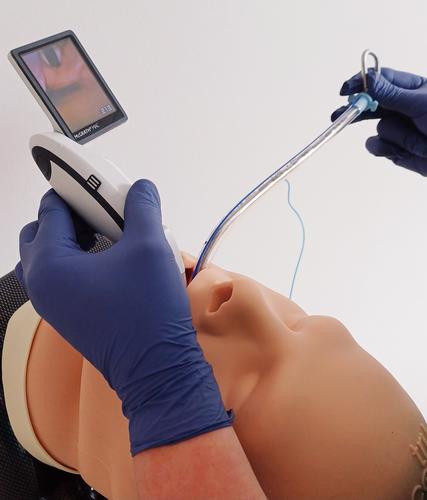
Neither of these issues occur with our preferred ‘out-of-plane’ technique, where the stylet/tracheal tube are introduced at the angle of the mouth (at 90° to the midline/3 o'clock position [3]; Fig. 1), advanced until the tracheal tube tip appears on screen, then rotated anti-clockwise towards the midline (blind rotation should ideally be avoided). This approach is particularly useful when the mouth opening of the patient is restricted, requires no additional time to perform, almost always delivers the tracheal tube tip at the level of the glottis (rather than below it) and often follows a more favourable trajectory for tracheal tube passage through the glottis. We recommend holding the stylet/tracheal tube as proximally as possible as this confers the greatest tracheal tube tip manoeuvrability; and the stylet size must match the selected tracheal tube diameter (an overly slim stylet can lead to unwanted rotation within the tube lumen and loss of directional control). Stylet manipulation, like many aspects of hyperangulated videolaryngoscopy, requires finesse not force.
In keeping with this mantra, we also advocate holding the videolaryngoscope handle between thumb, index and middle finger (rather than the traditional full-palm grip) as this clearly differentiates hyperangulated videolaryngoscopy from Macintosh-style videolaryngoscopy for learners, improves manoeuvrability, deters excessive blade advancement and/or lifting force and allows simultaneous fine adjustments of blade tip and stylet to seamlessly align glottic orientation with tracheal tube trajectory – maximising first pass tracheal intubation success without incurring trauma.
Much like in- and out-of-plane ultrasound techniques, we advocate learning and practising both hyperangulated videolaryngoscopy approaches, as this promotes flexibility in the face of variable anatomical/pathological airway management challenges.
期刊介绍:
The official journal of the Association of Anaesthetists is Anaesthesia. It is a comprehensive international publication that covers a wide range of topics. The journal focuses on general and regional anaesthesia, as well as intensive care and pain therapy. It includes original articles that have undergone peer review, covering all aspects of these fields, including research on equipment.







 京公网安备 11010802042870号
京ICP备2023020795号-1
京公网安备 11010802042870号
京ICP备2023020795号-1

 分享
分享
 求助内容:
求助内容: 应助结果提醒方式:
 扫码关注我们
