{"title":"Fasting before contrast-enhanced CT and the incidence of acute adverse reactions: a single-center randomized clinical trial.","authors":"Laila Zitan Saidi, Maricela Moreira Cabrera, Teresa Góngora Lencina, Fuensanta Marín Morón, Raquel Alarcón Rodríguez, Jessica García González","doi":"10.1186/s13244-024-01767-9","DOIUrl":null,"url":null,"abstract":"<p><strong>Objectives: </strong>To evaluate the effect of eliminating the traditional preparatory fasting policy before contrast-enhanced CT on acute adverse reactions and to identify potential risk factors in a Spanish population sample, since many European patients still experience this unnecessary measure in clinical practice.</p><p><strong>Methods: </strong>Outpatients who underwent non-emergency CT to either 6 h of solid food fasting (control group) or an unrestricted consumption of solids (intervention group). Adverse reactions during contrast media administration and up to 30 min afterward were recorded and their incidence was calculated. Using univariate and multivariate logistic regression analyses, various patient-related and technical factors were evaluated to identify risk factors for nausea and vomiting.</p><p><strong>Results: </strong>One thousand one hundred three patients were evaluated, 560 patients in the control group, and 543 patients in the intervention group. Moderate and severe acute adverse reactions were not identified in either group. No statistical difference was found in the overall acute adverse reactions (hypersensitivity and chemotoxicity) incidence between groups (3.21% vs 2.30% p = 0.36). The total incidence of emetic adverse reactions (nausea and vomiting) was significantly lower in the intervention group than in the control group (0.92% vs 2.86% p = 0.02). Multivariate logistic regression analysis revealed that fasting, age, allergies, neurological diseases, and contrast media concentration were independent risk factors for nausea and vomiting.</p><p><strong>Conclusion: </strong>Unrestricted food intake did not increase the overall incidence of acute adverse reactions and diminished the incidence of nausea and vomiting.</p><p><strong>Trial registration: </strong>ANZCTR, ACTRN12623000071628. Registered 23 January 2023-retrospectively registered, https://www.anzctr.org.au/Trial/Registration/TrialReview.aspx?id=384985&showOriginal=true&isReview=true .</p><p><strong>Critical relevance statement: </strong>This randomized clinical trial carried out in adults undergoing a non-emergent CT scan demonstrates that fasting as a preparation before a contrast-enhanced CT scan should be discontinued and reserved only for certain specific imaging tests.</p><p><strong>Key points: </strong>Despite low osmolar CT contrast media becoming ubiquitous, preparatory fasting is still widely practiced. The overall incidence of acute adverse reactions was unchanged after abolishing preparative fasting. Traditional preparatory fasting should be discontinued and reserved only for certain specific imaging tests.</p>","PeriodicalId":13639,"journal":{"name":"Insights into Imaging","volume":"15 1","pages":"195"},"PeriodicalIF":5.6000,"publicationDate":"2024-08-07","publicationTypes":"Journal Article","fieldsOfStudy":null,"isOpenAccess":false,"openAccessPdf":"https://www.ncbi.nlm.nih.gov/pmc/articles/PMC11306810/pdf/","citationCount":"0","resultStr":null,"platform":"Semanticscholar","paperid":null,"PeriodicalName":"Insights into Imaging","FirstCategoryId":"3","ListUrlMain":"https://doi.org/10.1186/s13244-024-01767-9","RegionNum":2,"RegionCategory":"医学","ArticlePicture":[],"TitleCN":null,"AbstractTextCN":null,"PMCID":null,"EPubDate":"","PubModel":"","JCR":"Q1","JCRName":"RADIOLOGY, NUCLEAR MEDICINE & MEDICAL IMAGING","Score":null,"Total":0}
引用次数: 0
Abstract
Objectives: To evaluate the effect of eliminating the traditional preparatory fasting policy before contrast-enhanced CT on acute adverse reactions and to identify potential risk factors in a Spanish population sample, since many European patients still experience this unnecessary measure in clinical practice.
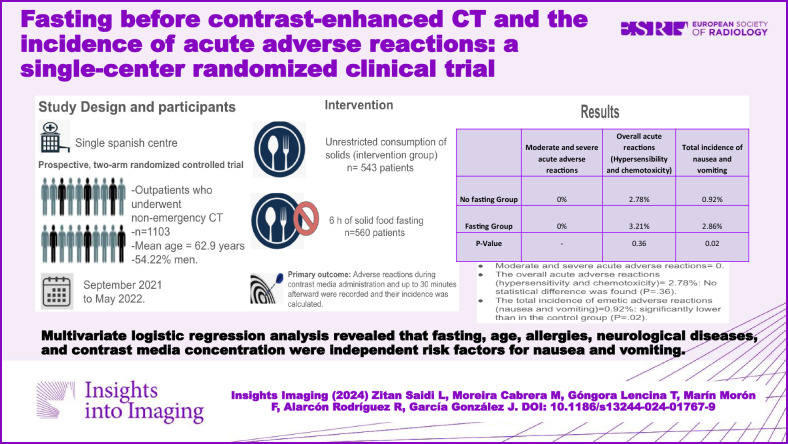
Methods: Outpatients who underwent non-emergency CT to either 6 h of solid food fasting (control group) or an unrestricted consumption of solids (intervention group). Adverse reactions during contrast media administration and up to 30 min afterward were recorded and their incidence was calculated. Using univariate and multivariate logistic regression analyses, various patient-related and technical factors were evaluated to identify risk factors for nausea and vomiting.
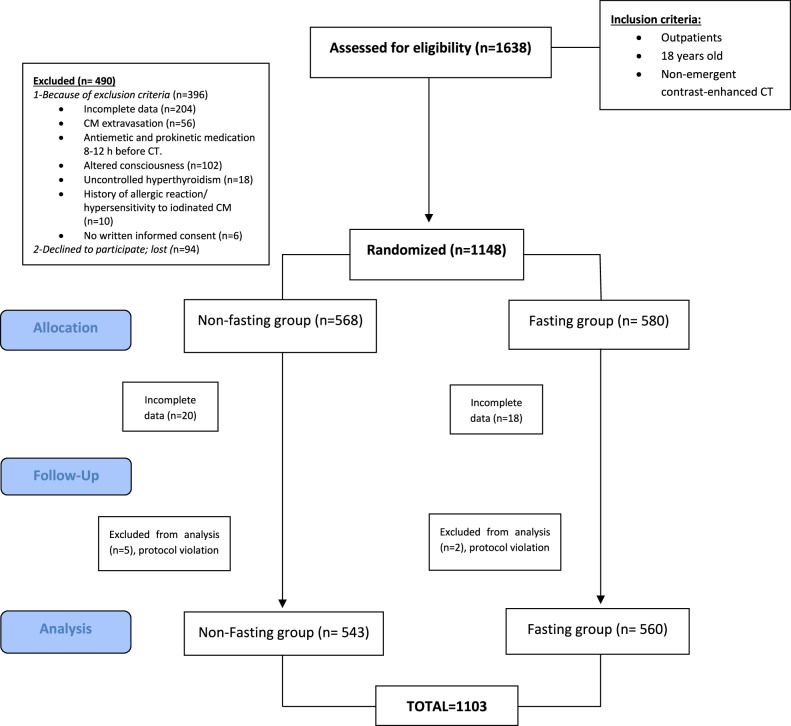
Results: One thousand one hundred three patients were evaluated, 560 patients in the control group, and 543 patients in the intervention group. Moderate and severe acute adverse reactions were not identified in either group. No statistical difference was found in the overall acute adverse reactions (hypersensitivity and chemotoxicity) incidence between groups (3.21% vs 2.30% p = 0.36). The total incidence of emetic adverse reactions (nausea and vomiting) was significantly lower in the intervention group than in the control group (0.92% vs 2.86% p = 0.02). Multivariate logistic regression analysis revealed that fasting, age, allergies, neurological diseases, and contrast media concentration were independent risk factors for nausea and vomiting.
Conclusion: Unrestricted food intake did not increase the overall incidence of acute adverse reactions and diminished the incidence of nausea and vomiting.
Critical relevance statement: This randomized clinical trial carried out in adults undergoing a non-emergent CT scan demonstrates that fasting as a preparation before a contrast-enhanced CT scan should be discontinued and reserved only for certain specific imaging tests.
Key points: Despite low osmolar CT contrast media becoming ubiquitous, preparatory fasting is still widely practiced. The overall incidence of acute adverse reactions was unchanged after abolishing preparative fasting. Traditional preparatory fasting should be discontinued and reserved only for certain specific imaging tests.
期刊介绍:
Insights into Imaging (I³) is a peer-reviewed open access journal published under the brand SpringerOpen. All content published in the journal is freely available online to anyone, anywhere!
I³ continuously updates scientific knowledge and progress in best-practice standards in radiology through the publication of original articles and state-of-the-art reviews and opinions, along with recommendations and statements from the leading radiological societies in Europe.
Founded by the European Society of Radiology (ESR), I³ creates a platform for educational material, guidelines and recommendations, and a forum for topics of controversy.
A balanced combination of review articles, original papers, short communications from European radiological congresses and information on society matters makes I³ an indispensable source for current information in this field.
I³ is owned by the ESR, however authors retain copyright to their article according to the Creative Commons Attribution License (see Copyright and License Agreement). All articles can be read, redistributed and reused for free, as long as the author of the original work is cited properly.
The open access fees (article-processing charges) for this journal are kindly sponsored by ESR for all Members.
The journal went open access in 2012, which means that all articles published since then are freely available online.




 京公网安备 11010802042870号
京ICP备2023020795号-1
京公网安备 11010802042870号
京ICP备2023020795号-1

 分享
分享
 求助内容:
求助内容: 应助结果提醒方式:
 扫码关注我们
