A dual-signal mode electrochemical aptasensor based on tetrahedral DNA nanostructures for sensitive detection of citrinin in food using PtPdCo mesoporous nanozymes
Shi Tang , Baoshan He , Yao Liu , Longdi Wang , Ying Liang , Jinshui Wang , Huali Jin , Min Wei , Wenjie Ren , Zhiguang Suo , Yiwei Xu
{"title":"A dual-signal mode electrochemical aptasensor based on tetrahedral DNA nanostructures for sensitive detection of citrinin in food using PtPdCo mesoporous nanozymes","authors":"Shi Tang , Baoshan He , Yao Liu , Longdi Wang , Ying Liang , Jinshui Wang , Huali Jin , Min Wei , Wenjie Ren , Zhiguang Suo , Yiwei Xu","doi":"10.1016/j.foodchem.2024.140739","DOIUrl":null,"url":null,"abstract":"<div><p>Citrinin (CIT) is a mycotoxin with nephrotoxicity and hepatotoxicity, presenting a significant threat to human health that is often overlooked. Therefore, a dual-signal mode (DPV and SWV) aptasensor for citrinin (CIT) detection was constructed based on tetrahedral DNA nanostructures (TDN) in this study. Furthermore, PtPdCo mesoporous nanozymes exhibit catalase-like catalytic functions, generating significant electrochemical signals through a Fenton-like reaction. Meanwhile their excellent Methylene Blue (MB) loading capability ensures independent dual signal outputs. The RecJf exonuclease-assisted (RecJf Exo-assisted) process can expand the linear detection range, enabling further amplification of the signal. Under optimized conditions, the constructed aptaensor exhibited excellent detection performance with limits of detection (LODs) of 7.67 × 10<sup>−3</sup> ng·mL<sup>−1</sup> (DPV mode) and 1.57 × 10<sup>−3</sup> ng·mL<sup>−1</sup> (SWV mode). Due to its multiple signal amplification and highly accurate dual-signal mode detection capability, this aptasensor shows promising potential for the in situ detection.</p></div>","PeriodicalId":318,"journal":{"name":"Food Chemistry","volume":"460 ","pages":"Article 140739"},"PeriodicalIF":9.8000,"publicationDate":"2024-12-01","publicationTypes":"Journal Article","fieldsOfStudy":null,"isOpenAccess":false,"openAccessPdf":"","citationCount":"0","resultStr":null,"platform":"Semanticscholar","paperid":null,"PeriodicalName":"Food Chemistry","FirstCategoryId":"97","ListUrlMain":"https://www.sciencedirect.com/science/article/pii/S0308814624023896","RegionNum":1,"RegionCategory":"农林科学","ArticlePicture":[],"TitleCN":null,"AbstractTextCN":null,"PMCID":null,"EPubDate":"2024/8/3 0:00:00","PubModel":"Epub","JCR":"Q1","JCRName":"CHEMISTRY, APPLIED","Score":null,"Total":0}
引用次数: 0
Abstract
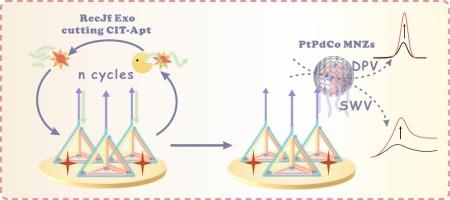
Citrinin (CIT) is a mycotoxin with nephrotoxicity and hepatotoxicity, presenting a significant threat to human health that is often overlooked. Therefore, a dual-signal mode (DPV and SWV) aptasensor for citrinin (CIT) detection was constructed based on tetrahedral DNA nanostructures (TDN) in this study. Furthermore, PtPdCo mesoporous nanozymes exhibit catalase-like catalytic functions, generating significant electrochemical signals through a Fenton-like reaction. Meanwhile their excellent Methylene Blue (MB) loading capability ensures independent dual signal outputs. The RecJf exonuclease-assisted (RecJf Exo-assisted) process can expand the linear detection range, enabling further amplification of the signal. Under optimized conditions, the constructed aptaensor exhibited excellent detection performance with limits of detection (LODs) of 7.67 × 10⁻³ ng·mL−1 (DPV mode) and 1.57 × 10⁻³ ng·mL−1 (SWV mode). Due to its multiple signal amplification and highly accurate dual-signal mode detection capability, this aptasensor shows promising potential for the in situ detection.
期刊介绍:
Food Chemistry publishes original research papers dealing with the advancement of the chemistry and biochemistry of foods or the analytical methods/ approach used. All papers should focus on the novelty of the research carried out.




 京公网安备 11010802042870号
京ICP备2023020795号-1
京公网安备 11010802042870号
京ICP备2023020795号-1

 分享
分享
 求助内容:
求助内容: 应助结果提醒方式:
 扫码关注我们
