{"title":"Effect of ultrasonic and conventional extraction on bioactive components, glucosinolate content and antidiabetic activity of Crambe tataria","authors":"Emine Okumus","doi":"10.1016/j.fitote.2024.106177","DOIUrl":null,"url":null,"abstract":"<div><p>This study was conducted to determine and compare the phenolic compounds, glucosinolate contents and antidiabetic effects of the extracts obtained by ultrasonic and conventional extraction method of the leaves and flowers of the <em>Crambe tataria</em>. The highest antioxidant activity (12.95 mg/mL IC<sub>50</sub> value) and total phenolic content (1313.57 mg GAE/100 g fw) were detected in the ultrasonic flower extract. In total flavonoid results, extracts obtained from the flower part of <em>C. tataria</em> had higher values than that of extracts obtained from the leaf part. The most abundant phenolic component in the flower extract was catechin. The highest catechin content in all samples was detected in the ultrasonic flower extract with a value of 374.37 mg/kg. Rutin was the dominant phenolic component in the leaf extract. Rutin values were 654.38 mg/kg and 757.30 mg/kg for conventional and ultrasonic extraction, respectively. In glucosinolate analysis, the highest glucoraphanin content was obtained in flower samples and by conventional extraction method (3466.84 mg/kg). The highest contents of sinigrin (689.97 mg/kg), glucotropaeolin (420.89 mg/kg), glucoerucin (357.27 mg/kg), glucoraphasatin (181.11 mg/kg) and gluconasturtin (66.07 mg/kg) were detected in ultrasonic flower extracts. The highest α-amylase and α-glucosidase enzyme inhibition effects belonged to the ultrasonic flower extract with values of 3.70 mg/mL and 4.89 mg/mL, respectively. As a result, this study determined for the first time that ultrasonic extraction of <em>C. tataria</em> flowers has much higher bioactive components and antidiabetic effects, revealing the potential use of this plant in the fields of medicine, pharmacology and chemistry.</p></div>","PeriodicalId":12147,"journal":{"name":"Fitoterapia","volume":"178 ","pages":"Article 106177"},"PeriodicalIF":2.6000,"publicationDate":"2024-10-01","publicationTypes":"Journal Article","fieldsOfStudy":null,"isOpenAccess":false,"openAccessPdf":"","citationCount":"0","resultStr":null,"platform":"Semanticscholar","paperid":null,"PeriodicalName":"Fitoterapia","FirstCategoryId":"3","ListUrlMain":"https://www.sciencedirect.com/science/article/pii/S0367326X24003605","RegionNum":3,"RegionCategory":"医学","ArticlePicture":[],"TitleCN":null,"AbstractTextCN":null,"PMCID":null,"EPubDate":"2024/8/8 0:00:00","PubModel":"Epub","JCR":"Q3","JCRName":"CHEMISTRY, MEDICINAL","Score":null,"Total":0}
引用次数: 0
Abstract
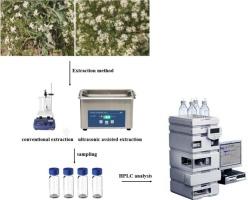
This study was conducted to determine and compare the phenolic compounds, glucosinolate contents and antidiabetic effects of the extracts obtained by ultrasonic and conventional extraction method of the leaves and flowers of the Crambe tataria. The highest antioxidant activity (12.95 mg/mL IC50 value) and total phenolic content (1313.57 mg GAE/100 g fw) were detected in the ultrasonic flower extract. In total flavonoid results, extracts obtained from the flower part of C. tataria had higher values than that of extracts obtained from the leaf part. The most abundant phenolic component in the flower extract was catechin. The highest catechin content in all samples was detected in the ultrasonic flower extract with a value of 374.37 mg/kg. Rutin was the dominant phenolic component in the leaf extract. Rutin values were 654.38 mg/kg and 757.30 mg/kg for conventional and ultrasonic extraction, respectively. In glucosinolate analysis, the highest glucoraphanin content was obtained in flower samples and by conventional extraction method (3466.84 mg/kg). The highest contents of sinigrin (689.97 mg/kg), glucotropaeolin (420.89 mg/kg), glucoerucin (357.27 mg/kg), glucoraphasatin (181.11 mg/kg) and gluconasturtin (66.07 mg/kg) were detected in ultrasonic flower extracts. The highest α-amylase and α-glucosidase enzyme inhibition effects belonged to the ultrasonic flower extract with values of 3.70 mg/mL and 4.89 mg/mL, respectively. As a result, this study determined for the first time that ultrasonic extraction of C. tataria flowers has much higher bioactive components and antidiabetic effects, revealing the potential use of this plant in the fields of medicine, pharmacology and chemistry.
期刊介绍:
Fitoterapia is a Journal dedicated to medicinal plants and to bioactive natural products of plant origin. It publishes original contributions in seven major areas:
1. Characterization of active ingredients of medicinal plants
2. Development of standardization method for bioactive plant extracts and natural products
3. Identification of bioactivity in plant extracts
4. Identification of targets and mechanism of activity of plant extracts
5. Production and genomic characterization of medicinal plants biomass
6. Chemistry and biochemistry of bioactive natural products of plant origin
7. Critical reviews of the historical, clinical and legal status of medicinal plants, and accounts on topical issues.




 京公网安备 11010802042870号
京ICP备2023020795号-1
京公网安备 11010802042870号
京ICP备2023020795号-1

 分享
分享
 求助内容:
求助内容: 应助结果提醒方式:
 扫码关注我们
