Gazi Saadmaan, Anette Hall, Tiia Ngandu, Nina Kemppainen, Francesca Mangialasche, Gayle M. Wittenberg, Anna Matton, Juha O. Rinne, Miia Kivipelto, Alina Solomon
{"title":"Brain amyloid load, subjective memory complaints, and cognitive trajectories in older individuals at risk for dementia","authors":"Gazi Saadmaan, Anette Hall, Tiia Ngandu, Nina Kemppainen, Francesca Mangialasche, Gayle M. Wittenberg, Anna Matton, Juha O. Rinne, Miia Kivipelto, Alina Solomon","doi":"10.1111/ene.16436","DOIUrl":null,"url":null,"abstract":"<div>\n \n \n <section>\n \n <h3> Background and Purpose</h3>\n \n <p>This study evaluated associations of brain amyloid with 2-year objective and subjective cognitive measures in a trial-ready older general population at risk for dementia.</p>\n </section>\n \n <section>\n \n <h3> Methods</h3>\n \n <p>Forty-eight participants in the Finnish Geriatric Intervention Study to Prevent Cognitive Impairment and Disability underwent <sup>11</sup>C-Pittsburgh compound B (PiB) positron emission tomography (PET) scans and assessment of cognition (modified Neuropsychological Test Battery [NTB]) and subjective memory complaints (Prospective and Retrospective Memory Questionnaire).</p>\n </section>\n \n <section>\n \n <h3> Results</h3>\n \n <p>Mean age was 71.4 ± 5.06 years, and 20 participants (42%) had positive baseline PiB-PET scans. Amyloid positivity was associated with lower NTB executive function at baseline and less favorable 2-year NTB total score and memory trajectories, but not with other objective or subjective cognitive measures. Overall, there was little cognitive decline during 2 years.</p>\n </section>\n \n <section>\n \n <h3> Conclusions</h3>\n \n <p>Amyloid accumulation may affect objective but not necessarily subjective cognition from a very early at-risk stage, although substantial decline likely requires >2 years to occur.</p>\n </section>\n </div>","PeriodicalId":11954,"journal":{"name":"European Journal of Neurology","volume":"31 12","pages":""},"PeriodicalIF":4.3000,"publicationDate":"2024-08-12","publicationTypes":"Journal Article","fieldsOfStudy":null,"isOpenAccess":false,"openAccessPdf":"https://www.ncbi.nlm.nih.gov/pmc/articles/PMC11554848/pdf/","citationCount":"0","resultStr":null,"platform":"Semanticscholar","paperid":null,"PeriodicalName":"European Journal of Neurology","FirstCategoryId":"3","ListUrlMain":"https://onlinelibrary.wiley.com/doi/10.1111/ene.16436","RegionNum":2,"RegionCategory":"医学","ArticlePicture":[],"TitleCN":null,"AbstractTextCN":null,"PMCID":null,"EPubDate":"","PubModel":"","JCR":"Q1","JCRName":"CLINICAL NEUROLOGY","Score":null,"Total":0}
引用次数: 0
Abstract
Background and Purpose
This study evaluated associations of brain amyloid with 2-year objective and subjective cognitive measures in a trial-ready older general population at risk for dementia.
Methods
Forty-eight participants in the Finnish Geriatric Intervention Study to Prevent Cognitive Impairment and Disability underwent 11C-Pittsburgh compound B (PiB) positron emission tomography (PET) scans and assessment of cognition (modified Neuropsychological Test Battery [NTB]) and subjective memory complaints (Prospective and Retrospective Memory Questionnaire).
Results
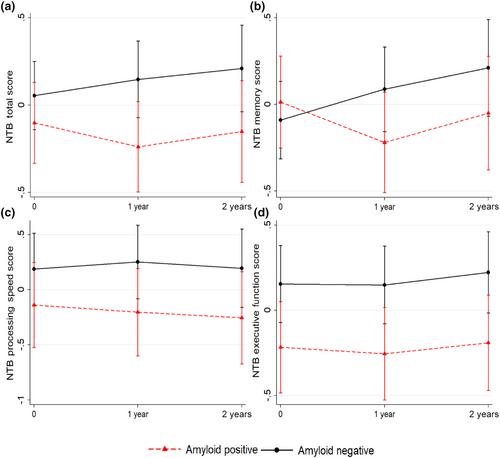
Mean age was 71.4 ± 5.06 years, and 20 participants (42%) had positive baseline PiB-PET scans. Amyloid positivity was associated with lower NTB executive function at baseline and less favorable 2-year NTB total score and memory trajectories, but not with other objective or subjective cognitive measures. Overall, there was little cognitive decline during 2 years.
Conclusions
Amyloid accumulation may affect objective but not necessarily subjective cognition from a very early at-risk stage, although substantial decline likely requires >2 years to occur.
期刊介绍:
The European Journal of Neurology is the official journal of the European Academy of Neurology and covers all areas of clinical and basic research in neurology, including pre-clinical research of immediate translational value for new potential treatments. Emphasis is placed on major diseases of large clinical and socio-economic importance (dementia, stroke, epilepsy, headache, multiple sclerosis, movement disorders, and infectious diseases).




 京公网安备 11010802042870号
京ICP备2023020795号-1
京公网安备 11010802042870号
京ICP备2023020795号-1

 分享
分享
 求助内容:
求助内容: 应助结果提醒方式:
 扫码关注我们
