Ludhovik Luiz Madrid, Ser John Lynon Perez, Susan Arco
{"title":"RAFT copolymerization of methyl methacrylate and di(ethylene glycol) methyl ether methacrylate in a hexylpyridinium ionic liquid","authors":"Ludhovik Luiz Madrid, Ser John Lynon Perez, Susan Arco","doi":"10.1002/jccs.202400197","DOIUrl":null,"url":null,"abstract":"<p>Smart polymers undergo significant physical or chemical changes in response to stimuli like temperature and pH. Achieving a narrow molecular weight distribution is crucial for their sensitivity. Reversible addition–fragmentation chain transfer (RAFT) in ionic liquids is an effective method for synthesizing such polymers due to its favorable kinetics and environmental benefits. Most studies use imidazolium ionic liquids, while pyridinium ionic liquids are less common despite their easy synthesis. This study reports the first successful RAFT copolymerization of di(ethylene glycol) methyl ether methacrylate (DEGMEMA) and methyl methacrylate in <i>N</i>-hexylpyridinium hexafluorophosphate ([HPY][PF<sub>6</sub>]). Both linear and hyperbranched copolymers (<i>M</i><sub><i>n</i></sub> > 25,000) with narrow molecular weight distribution were synthesized, showing observable temperature responses and biocompatibility. The linear copolymers had a desirable dispersity (<i>Ð</i>) of less than 1.10, while the hyperbranched copolymer had a <i>Ð</i> of 2.034. The lower critical solution temperatures (LCSTs) of the copolymers were close to or below the LCST of PDEGMEMA (26°C). This study indicates that pyridinium ionic liquids can be explored as a suitable solvent for synthesizing methacrylate-based smart polymers.</p>","PeriodicalId":17262,"journal":{"name":"Journal of The Chinese Chemical Society","volume":"71 10","pages":"1172-1185"},"PeriodicalIF":1.5000,"publicationDate":"2024-08-10","publicationTypes":"Journal Article","fieldsOfStudy":null,"isOpenAccess":false,"openAccessPdf":"","citationCount":"0","resultStr":null,"platform":"Semanticscholar","paperid":null,"PeriodicalName":"Journal of The Chinese Chemical Society","FirstCategoryId":"92","ListUrlMain":"https://onlinelibrary.wiley.com/doi/10.1002/jccs.202400197","RegionNum":4,"RegionCategory":"化学","ArticlePicture":[],"TitleCN":null,"AbstractTextCN":null,"PMCID":null,"EPubDate":"","PubModel":"","JCR":"Q3","JCRName":"CHEMISTRY, MULTIDISCIPLINARY","Score":null,"Total":0}
引用次数: 0
Abstract
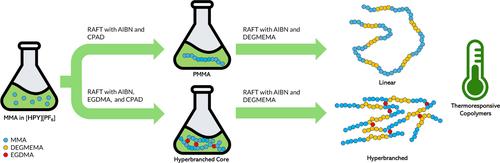
Smart polymers undergo significant physical or chemical changes in response to stimuli like temperature and pH. Achieving a narrow molecular weight distribution is crucial for their sensitivity. Reversible addition–fragmentation chain transfer (RAFT) in ionic liquids is an effective method for synthesizing such polymers due to its favorable kinetics and environmental benefits. Most studies use imidazolium ionic liquids, while pyridinium ionic liquids are less common despite their easy synthesis. This study reports the first successful RAFT copolymerization of di(ethylene glycol) methyl ether methacrylate (DEGMEMA) and methyl methacrylate in N-hexylpyridinium hexafluorophosphate ([HPY][PF6]). Both linear and hyperbranched copolymers (Mn > 25,000) with narrow molecular weight distribution were synthesized, showing observable temperature responses and biocompatibility. The linear copolymers had a desirable dispersity (Ð) of less than 1.10, while the hyperbranched copolymer had a Ð of 2.034. The lower critical solution temperatures (LCSTs) of the copolymers were close to or below the LCST of PDEGMEMA (26°C). This study indicates that pyridinium ionic liquids can be explored as a suitable solvent for synthesizing methacrylate-based smart polymers.
期刊介绍:
The Journal of the Chinese Chemical Society was founded by The Chemical Society Located in Taipei in 1954, and is the oldest general chemistry journal in Taiwan. It is strictly peer-reviewed and welcomes review articles, full papers, notes and communications written in English. The scope of the Journal of the Chinese Chemical Society covers all major areas of chemistry: organic chemistry, inorganic chemistry, analytical chemistry, biochemistry, physical chemistry, and materials science.



 京公网安备 11010802042870号
京ICP备2023020795号-1
京公网安备 11010802042870号
京ICP备2023020795号-1

 分享
分享
 求助内容:
求助内容: 应助结果提醒方式:
 扫码关注我们
