Peter M. George, C. Rennison-Jones, Giacomo Benvenuti, Aliki Sifostratoudaki, F. Ottink, W. Bou-Zeid, Roberta Eufrasia Ledda, Roqia Fatmawati, Abul Kadir, Bushra Johari, C. Fernandez, G. Harston, O. Joly, S. Gerry, A. Devaraj
{"title":"Evaluation of e-Lung automated quantitative CT biomarkers in idiopathic pulmonary fibrosis","authors":"Peter M. George, C. Rennison-Jones, Giacomo Benvenuti, Aliki Sifostratoudaki, F. Ottink, W. Bou-Zeid, Roberta Eufrasia Ledda, Roqia Fatmawati, Abul Kadir, Bushra Johari, C. Fernandez, G. Harston, O. Joly, S. Gerry, A. Devaraj","doi":"10.1183/23120541.00570-2024","DOIUrl":null,"url":null,"abstract":"In patients with idiopathic pulmonary fibrosis (IPF), there is a need to identify biomarkers that i) are associated with increased risk of adverse outcome and ii) can be used to monitor treatment response or identify disease progression over time.Two consecutive cohorts of patients with IPF were accessed from the Open Source Imaging Consortium database. Automated CT biomarkers of disease severity incorporating fibrotic and pulmonary vascular features (the reticulovascular score and weighted reticulovascular score (WRVS)), were studied. Relationships between imaging biomarkers, lung function and survival were analysed.In separate test and validation cohorts, 168 and 176 patients with IPF respectively (median survival 2.6 years) were studied. A threshold of WRVS ≥15% at baseline CT was most strongly associated with transplant free survival (HR 3.00, 95% CI 1.47, 6.10, p=0.002) when adjusted for baseline FVC and age. In patients with 12 month follow up CT and lung function tests (n=89) an increase in 3% of WRVS (the minimal clinically important difference) was also significantly associated with reduced survival independent of FVC, and outperformed visual evaluation of progressive fibrosis.WRVS is an automated CT biomarker which can identify patients with IPF at increased risk of progression and is able to reliably capture disease progression over time.","PeriodicalId":4,"journal":{"name":"ACS Applied Energy Materials","volume":"87 3","pages":""},"PeriodicalIF":5.5000,"publicationDate":"2024-08-08","publicationTypes":"Journal Article","fieldsOfStudy":null,"isOpenAccess":false,"openAccessPdf":"","citationCount":"0","resultStr":null,"platform":"Semanticscholar","paperid":null,"PeriodicalName":"ACS Applied Energy Materials","FirstCategoryId":"3","ListUrlMain":"https://doi.org/10.1183/23120541.00570-2024","RegionNum":3,"RegionCategory":"材料科学","ArticlePicture":[],"TitleCN":null,"AbstractTextCN":null,"PMCID":null,"EPubDate":"","PubModel":"","JCR":"Q2","JCRName":"CHEMISTRY, PHYSICAL","Score":null,"Total":0}
引用次数: 0
Abstract
In patients with idiopathic pulmonary fibrosis (IPF), there is a need to identify biomarkers that i) are associated with increased risk of adverse outcome and ii) can be used to monitor treatment response or identify disease progression over time.Two consecutive cohorts of patients with IPF were accessed from the Open Source Imaging Consortium database. Automated CT biomarkers of disease severity incorporating fibrotic and pulmonary vascular features (the reticulovascular score and weighted reticulovascular score (WRVS)), were studied. Relationships between imaging biomarkers, lung function and survival were analysed.In separate test and validation cohorts, 168 and 176 patients with IPF respectively (median survival 2.6 years) were studied. A threshold of WRVS ≥15% at baseline CT was most strongly associated with transplant free survival (HR 3.00, 95% CI 1.47, 6.10, p=0.002) when adjusted for baseline FVC and age. In patients with 12 month follow up CT and lung function tests (n=89) an increase in 3% of WRVS (the minimal clinically important difference) was also significantly associated with reduced survival independent of FVC, and outperformed visual evaluation of progressive fibrosis.WRVS is an automated CT biomarker which can identify patients with IPF at increased risk of progression and is able to reliably capture disease progression over time.
期刊介绍:
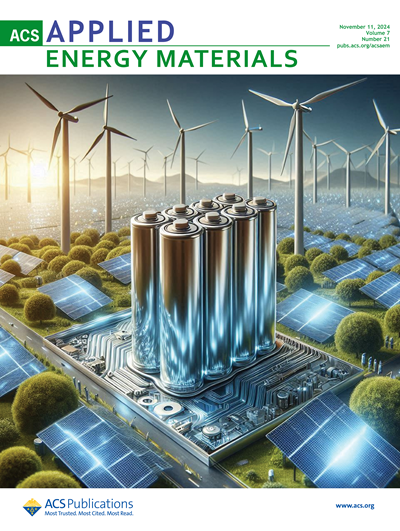
ACS Applied Energy Materials is an interdisciplinary journal publishing original research covering all aspects of materials, engineering, chemistry, physics and biology relevant to energy conversion and storage. The journal is devoted to reports of new and original experimental and theoretical research of an applied nature that integrate knowledge in the areas of materials, engineering, physics, bioscience, and chemistry into important energy applications.



 京公网安备 11010802042870号
京ICP备2023020795号-1
京公网安备 11010802042870号
京ICP备2023020795号-1

 分享
分享
 求助内容:
求助内容: 应助结果提醒方式:
 扫码关注我们
