Pedro Urbano Alves, Gemma Quinn, Michael J. Strain, Emek Goksu Durmusoglu, Manoj Sharma, Hilmi Volkan Demir, Paul R. Edwards, Robert W. Martin, Martin D. Dawson, Nicolas Laurand
{"title":"Colloidal Semiconductor Quantum Well Supraparticles as Low-Threshold and Photostable Microlasers","authors":"Pedro Urbano Alves, Gemma Quinn, Michael J. Strain, Emek Goksu Durmusoglu, Manoj Sharma, Hilmi Volkan Demir, Paul R. Edwards, Robert W. Martin, Martin D. Dawson, Nicolas Laurand","doi":"10.1002/admt.202401152","DOIUrl":null,"url":null,"abstract":"<p>This study introduces and compares the lasing performance of micron-sized and sphere-shaped supraparticle (SP) lasers fabricated through bottom-up assembly of II-VI semiconductor colloidal quantum wells (CQWs) with their counterparts made of quantum dots (CQDs). CQWs consist of a 4-monolayers thick CdSe core and an 8-monolayers thick Cd<i><sub>x</sub></i>Zn<sub>1-</sub><i><sub>x</sub></i>S shell with a nominal size of 14 × 15 × 4.2 nm, and CQDs of CdS<i><sub>x</sub></i>Se<sub>1-</sub><i><sub>x</sub></i>/ZnS with 6 nm diameter. SPs are optically characterized with a 0.76 ns pulse laser (spot size: 2.88 × 10<sup>−7</sup> cm<sup>2</sup>) at 532 nm, and emit in the 620–670 nm spectral range. Results show that CQW SPs have lasing thresholds twice as low (0.1–0.3 nJ) as CQD SPs (0.3–0.6 nJ), and stress tests using a constant 0.6 nJ optical pump energy demonstrate that CQW SPs withstand lasing emission for longer than CQD SPs. Lasing emission in CQW and CQD SPs under continuous operation yields half-lives of τ<sub><i>CQW</i> <i>SP</i></sub> ≈150 min and τ<sub><i>CQD</i> <i>SP</i></sub> ≈22 min, respectively. The half-life of CQW SPs is further extended to τ<sub><i>QW</i></sub> ≈385 min when optically pumped at 0.5 nJ. Such results compare favorably to those in the literature and highlight the performance of CdSe-based CQW SPs for laser applications.</p>","PeriodicalId":7292,"journal":{"name":"Advanced Materials Technologies","volume":"10 1","pages":""},"PeriodicalIF":6.4000,"publicationDate":"2024-08-08","publicationTypes":"Journal Article","fieldsOfStudy":null,"isOpenAccess":false,"openAccessPdf":"https://onlinelibrary.wiley.com/doi/epdf/10.1002/admt.202401152","citationCount":"0","resultStr":null,"platform":"Semanticscholar","paperid":null,"PeriodicalName":"Advanced Materials Technologies","FirstCategoryId":"88","ListUrlMain":"https://advanced.onlinelibrary.wiley.com/doi/10.1002/admt.202401152","RegionNum":3,"RegionCategory":"材料科学","ArticlePicture":[],"TitleCN":null,"AbstractTextCN":null,"PMCID":null,"EPubDate":"","PubModel":"","JCR":"Q1","JCRName":"MATERIALS SCIENCE, MULTIDISCIPLINARY","Score":null,"Total":0}
引用次数: 0
Abstract
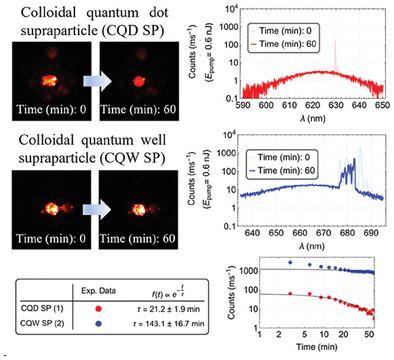
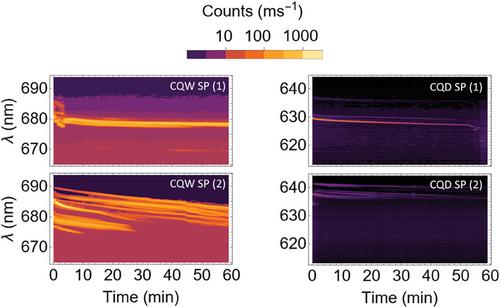
This study introduces and compares the lasing performance of micron-sized and sphere-shaped supraparticle (SP) lasers fabricated through bottom-up assembly of II-VI semiconductor colloidal quantum wells (CQWs) with their counterparts made of quantum dots (CQDs). CQWs consist of a 4-monolayers thick CdSe core and an 8-monolayers thick CdxZn1-xS shell with a nominal size of 14 × 15 × 4.2 nm, and CQDs of CdSxSe1-x/ZnS with 6 nm diameter. SPs are optically characterized with a 0.76 ns pulse laser (spot size: 2.88 × 10⁻⁷ cm2) at 532 nm, and emit in the 620–670 nm spectral range. Results show that CQW SPs have lasing thresholds twice as low (0.1–0.3 nJ) as CQD SPs (0.3–0.6 nJ), and stress tests using a constant 0.6 nJ optical pump energy demonstrate that CQW SPs withstand lasing emission for longer than CQD SPs. Lasing emission in CQW and CQD SPs under continuous operation yields half-lives of τCQWSP ≈150 min and τCQDSP ≈22 min, respectively. The half-life of CQW SPs is further extended to τQW ≈385 min when optically pumped at 0.5 nJ. Such results compare favorably to those in the literature and highlight the performance of CdSe-based CQW SPs for laser applications.
期刊介绍:
Advanced Materials Technologies Advanced Materials Technologies is the new home for all technology-related materials applications research, with particular focus on advanced device design, fabrication and integration, as well as new technologies based on novel materials. It bridges the gap between fundamental laboratory research and industry.






 京公网安备 11010802042870号
京ICP备2023020795号-1
京公网安备 11010802042870号
京ICP备2023020795号-1

 分享
分享
 求助内容:
求助内容: 应助结果提醒方式:
 扫码关注我们
