Xiaoli Zhu , Ying Xin , Long Yu , Shuai Liu , Dongxu Han , Junxiu Jia , Jin Wang , Zhaoliang Zhang
{"title":"Zeolite-based materials eliminating nitrogen oxides (NOx) and volatile organic compounds (VOCs): advances and future perspectives","authors":"Xiaoli Zhu , Ying Xin , Long Yu , Shuai Liu , Dongxu Han , Junxiu Jia , Jin Wang , Zhaoliang Zhang","doi":"10.1039/d4cy00841c","DOIUrl":null,"url":null,"abstract":"<div><p>As awareness of environmental protection increases, the most inextricably linked issue of greatest concern is atmospheric pollution. In particular, the major gaseous pollutants, such as nitrogen oxides (NO<sub>x</sub>) and volatile organic compounds (VOCs), which are the precursors for the formation of fine particulate matter and ozone, have attracted significant attention. To eliminate these pollutants, zeolite-based materials have become the indispensable adsorbents and/or catalysts due to their remarkable shape selectivity, adsorption and ion exchange capability, high hydrothermal durability, tunable acidity and polarity, and affordable production expenses. Furthermore, modifying their porous architectures and compositions, and the incorporation of exotic species could lead to an unprecedented high performance in a wide range of challenging environmental governance processes. In this perspective, we focus on the latest advancements in employing zeolite-based materials to eliminate NO<sub>x</sub> and VOCs. Especially, the impacts of porous structures and components on the performance of adsorption and catalytic conversion were elucidated. Finally, the potential challenges and future opportunities for the utilization of zeolite-based materials are identified and outlined to meet the ever-increasing requirements for the improved atmospheric environment in the future.</p></div>","PeriodicalId":66,"journal":{"name":"Catalysis Science & Technology","volume":"14 17","pages":"Pages 4756-4774"},"PeriodicalIF":4.2000,"publicationDate":"2024-08-27","publicationTypes":"Journal Article","fieldsOfStudy":null,"isOpenAccess":false,"openAccessPdf":"","citationCount":"0","resultStr":null,"platform":"Semanticscholar","paperid":null,"PeriodicalName":"Catalysis Science & Technology","FirstCategoryId":"92","ListUrlMain":"https://www.sciencedirect.com/org/science/article/pii/S204447532400412X","RegionNum":3,"RegionCategory":"化学","ArticlePicture":[],"TitleCN":null,"AbstractTextCN":null,"PMCID":null,"EPubDate":"2024/7/31 0:00:00","PubModel":"Epub","JCR":"Q2","JCRName":"CHEMISTRY, PHYSICAL","Score":null,"Total":0}
引用次数: 0
Abstract
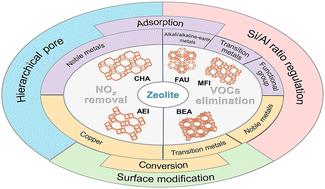
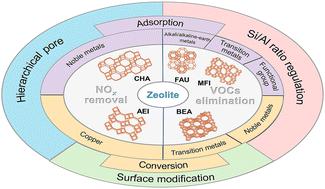
As awareness of environmental protection increases, the most inextricably linked issue of greatest concern is atmospheric pollution. In particular, the major gaseous pollutants, such as nitrogen oxides (NOx) and volatile organic compounds (VOCs), which are the precursors for the formation of fine particulate matter and ozone, have attracted significant attention. To eliminate these pollutants, zeolite-based materials have become the indispensable adsorbents and/or catalysts due to their remarkable shape selectivity, adsorption and ion exchange capability, high hydrothermal durability, tunable acidity and polarity, and affordable production expenses. Furthermore, modifying their porous architectures and compositions, and the incorporation of exotic species could lead to an unprecedented high performance in a wide range of challenging environmental governance processes. In this perspective, we focus on the latest advancements in employing zeolite-based materials to eliminate NOx and VOCs. Especially, the impacts of porous structures and components on the performance of adsorption and catalytic conversion were elucidated. Finally, the potential challenges and future opportunities for the utilization of zeolite-based materials are identified and outlined to meet the ever-increasing requirements for the improved atmospheric environment in the future.
期刊介绍:
A multidisciplinary journal focusing on cutting edge research across all fundamental science and technological aspects of catalysis.
Editor-in-chief: Bert Weckhuysen
Impact factor: 5.0
Time to first decision (peer reviewed only): 31 days



 京公网安备 11010802042870号
京ICP备2023020795号-1
京公网安备 11010802042870号
京ICP备2023020795号-1

 分享
分享
 求助内容:
求助内容: 应助结果提醒方式:
 扫码关注我们
