Zhiqi Gu, Xiaoxia He, Bin Miao, Zhan Xu, Shuxian Li, Jiadong Li
{"title":"Application of a Discrete AlGaN/GaN HEMT Sensor for In-Situ Regenerative Soot Particulate Detection","authors":"Zhiqi Gu, Xiaoxia He, Bin Miao, Zhan Xu, Shuxian Li, Jiadong Li","doi":"10.1002/elan.202400221","DOIUrl":null,"url":null,"abstract":"<p>An in-situ regenerative soot particulate matter sensor for automotive exhaust systems based on a discrete AlGaN/GaN high electron mobility transistor (HEMT) was developed and tested, where charge-sensitive AlGaN/GaN HEMT was utilized to detect the signal variations caused by the presence of soot particulate matters, and the micro-hotplate serves as soot deposition, while the self-heating unit was used for sensing and in-situ regeneration. The two parts were connected for electrical signal transmission. Soot particulate were generated by a laminar diesel flame with an adsorption rate of 23.29 μg cm<sup>−2</sup> min<sup>−1</sup> on the sensor surface, resulting in 1.32% sensing response after 20 s deposition and reached saturation after a 12 minute deposition of soot. After soot deposition, the sensor was successfully regenerated when a voltage of 2 V was applied to the micro-hot plate, causing in-situ heat-up to reach 600°C for 30 seconds. Moreover, benefiting from the advantage of discrete structure, the sensor exhibited consistent and stable response characteristics even after undergoing more than 10 consecutive regeneration cycles, and the replaceable micro-hotplate could further extend the service life of the sensor. These results show that the discrete AlGaN/GaN HEMT sensor can be a promising soot particulate sensing platform for automotive exhaust systems.</p>","PeriodicalId":162,"journal":{"name":"Electroanalysis","volume":"37 1","pages":""},"PeriodicalIF":2.3000,"publicationDate":"2024-08-04","publicationTypes":"Journal Article","fieldsOfStudy":null,"isOpenAccess":false,"openAccessPdf":"","citationCount":"0","resultStr":null,"platform":"Semanticscholar","paperid":null,"PeriodicalName":"Electroanalysis","FirstCategoryId":"92","ListUrlMain":"https://analyticalsciencejournals.onlinelibrary.wiley.com/doi/10.1002/elan.202400221","RegionNum":3,"RegionCategory":"化学","ArticlePicture":[],"TitleCN":null,"AbstractTextCN":null,"PMCID":null,"EPubDate":"","PubModel":"","JCR":"Q2","JCRName":"CHEMISTRY, ANALYTICAL","Score":null,"Total":0}
引用次数: 0
Abstract
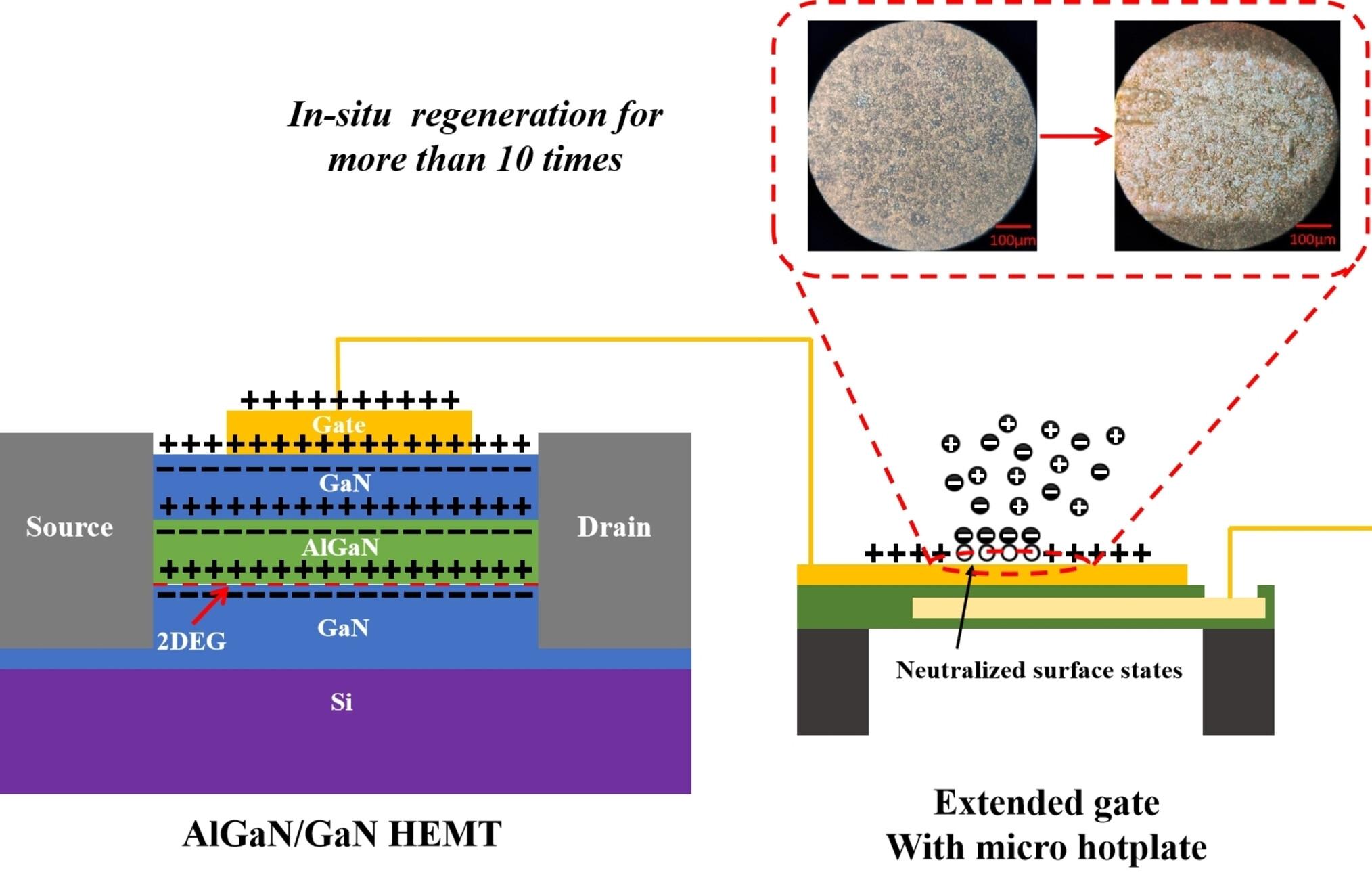
An in-situ regenerative soot particulate matter sensor for automotive exhaust systems based on a discrete AlGaN/GaN high electron mobility transistor (HEMT) was developed and tested, where charge-sensitive AlGaN/GaN HEMT was utilized to detect the signal variations caused by the presence of soot particulate matters, and the micro-hotplate serves as soot deposition, while the self-heating unit was used for sensing and in-situ regeneration. The two parts were connected for electrical signal transmission. Soot particulate were generated by a laminar diesel flame with an adsorption rate of 23.29 μg cm−2 min−1 on the sensor surface, resulting in 1.32% sensing response after 20 s deposition and reached saturation after a 12 minute deposition of soot. After soot deposition, the sensor was successfully regenerated when a voltage of 2 V was applied to the micro-hot plate, causing in-situ heat-up to reach 600°C for 30 seconds. Moreover, benefiting from the advantage of discrete structure, the sensor exhibited consistent and stable response characteristics even after undergoing more than 10 consecutive regeneration cycles, and the replaceable micro-hotplate could further extend the service life of the sensor. These results show that the discrete AlGaN/GaN HEMT sensor can be a promising soot particulate sensing platform for automotive exhaust systems.
期刊介绍:
Electroanalysis is an international, peer-reviewed journal covering all branches of electroanalytical chemistry, including both fundamental and application papers as well as reviews dealing with new electrochemical sensors and biosensors, nanobioelectronics devices, analytical voltammetry, potentiometry, new electrochemical detection schemes based on novel nanomaterials, fuel cells and biofuel cells, and important practical applications.
Serving as a vital communication link between the research labs and the field, Electroanalysis helps you to quickly adapt the latest innovations into practical clinical, environmental, food analysis, industrial and energy-related applications. Electroanalysis provides the most comprehensive coverage of the field and is the number one source for information on electroanalytical chemistry, electrochemical sensors and biosensors and fuel/biofuel cells.





 京公网安备 11010802042870号
京ICP备2023020795号-1
京公网安备 11010802042870号
京ICP备2023020795号-1

 分享
分享
 求助内容:
求助内容: 应助结果提醒方式:
 扫码关注我们
