{"title":"Comparison of the efficacy of COVID-19 responses in South Korea and the United States.","authors":"Oliver Choi, Sunjoo Kim","doi":"10.1080/16549716.2024.2370611","DOIUrl":null,"url":null,"abstract":"<p><strong>Background: </strong>The COVID-19 pandemic devastated many countries worldwide by causing large numbers of fatalities. In our research, we wanted to answer the question: Why was there such a large difference in the mortality rate between South Korea and the United States? This is because many East Asian countries, such as Korea, had a lower mortality rate than many countries, including developed ones, across the world - the mortality rate of South Korea was about five times lower than the United States.</p><p><strong>Methods: </strong>This study comprehensively compares strategies used to address the COVID-19 pandemic in two different countries: South Korea and the United States. The various aspects of these two countries' responses are examined, including initial response, information dissemination and public compliance, mitigation strategies, and vaccine rollout and their impacts.</p><p><strong>Results: </strong>Early and widespread testing, rigorous contact tracing, the clear release of government information, and an organized vaccine rollout powered a proactive approach in South Korea. The United States had a contrasting response consisting of delayed and more decentralized measures, where testing lagged due to varying policies and the political controversies facing vaccine distribution.</p><p><strong>Conclusions: </strong>We signify the gravity of rapid response and testing, clear communication, and efficient vaccine distribution, as we believe this could correlate with a lower mortality rate. In addition, we discuss future directions, including the need for a specific health infrastructure and protocol against highly infectious outbreaks.</p>","PeriodicalId":49197,"journal":{"name":"Global Health Action","volume":"17 1","pages":"2370611"},"PeriodicalIF":2.6000,"publicationDate":"2024-12-31","publicationTypes":"Journal Article","fieldsOfStudy":null,"isOpenAccess":false,"openAccessPdf":"https://www.ncbi.nlm.nih.gov/pmc/articles/PMC11328807/pdf/","citationCount":"0","resultStr":null,"platform":"Semanticscholar","paperid":null,"PeriodicalName":"Global Health Action","FirstCategoryId":"3","ListUrlMain":"https://doi.org/10.1080/16549716.2024.2370611","RegionNum":3,"RegionCategory":"医学","ArticlePicture":[],"TitleCN":null,"AbstractTextCN":null,"PMCID":null,"EPubDate":"2024/8/13 0:00:00","PubModel":"Epub","JCR":"Q2","JCRName":"PUBLIC, ENVIRONMENTAL & OCCUPATIONAL HEALTH","Score":null,"Total":0}
引用次数: 0
Abstract
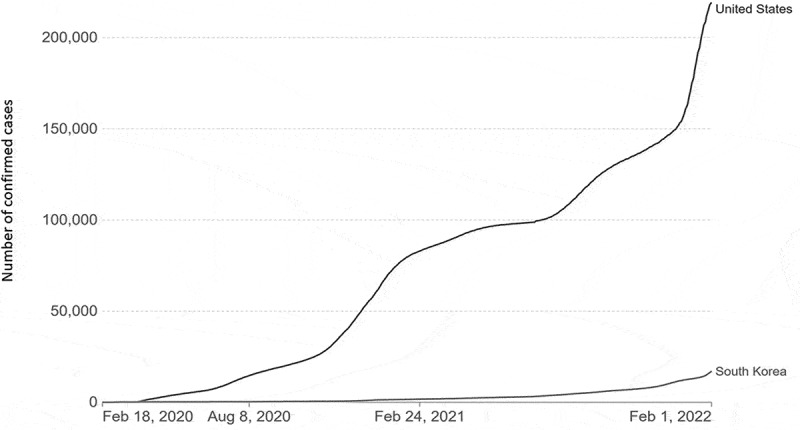
Background: The COVID-19 pandemic devastated many countries worldwide by causing large numbers of fatalities. In our research, we wanted to answer the question: Why was there such a large difference in the mortality rate between South Korea and the United States? This is because many East Asian countries, such as Korea, had a lower mortality rate than many countries, including developed ones, across the world - the mortality rate of South Korea was about five times lower than the United States.
Methods: This study comprehensively compares strategies used to address the COVID-19 pandemic in two different countries: South Korea and the United States. The various aspects of these two countries' responses are examined, including initial response, information dissemination and public compliance, mitigation strategies, and vaccine rollout and their impacts.
Results: Early and widespread testing, rigorous contact tracing, the clear release of government information, and an organized vaccine rollout powered a proactive approach in South Korea. The United States had a contrasting response consisting of delayed and more decentralized measures, where testing lagged due to varying policies and the political controversies facing vaccine distribution.
Conclusions: We signify the gravity of rapid response and testing, clear communication, and efficient vaccine distribution, as we believe this could correlate with a lower mortality rate. In addition, we discuss future directions, including the need for a specific health infrastructure and protocol against highly infectious outbreaks.
期刊介绍:
Global Health Action is an international peer-reviewed Open Access journal affiliated with the Unit of Epidemiology and Global Health, Department of Public Health and Clinical Medicine at Umeå University, Sweden. The Unit hosts the Umeå International School of Public Health and the Umeå Centre for Global Health Research.
Vision: Our vision is to be a leading journal in the global health field, narrowing health information gaps and contributing to the implementation of policies and actions that lead to improved global health.
Aim: The widening gap between the winners and losers of globalisation presents major public health challenges. To meet these challenges, it is crucial to generate new knowledge and evidence in the field and in settings where the evidence is lacking, as well as to bridge the gaps between existing knowledge and implementation of relevant findings. Thus, the aim of Global Health Action is to contribute to fuelling a more concrete, hands-on approach to addressing global health challenges. Manuscripts suggesting strategies for practical interventions and research implementations where none already exist are specifically welcomed. Further, the journal encourages articles from low- and middle-income countries, while also welcoming articles originated from South-South and South-North collaborations. All articles are expected to address a global agenda and include a strong implementation or policy component.






 京公网安备 11010802042870号
京ICP备2023020795号-1
京公网安备 11010802042870号
京ICP备2023020795号-1

 分享
分享
 求助内容:
求助内容: 应助结果提醒方式:
 扫码关注我们
