S. Ram Prasad, Sruthi Sudheendran Leena, Ani Deepthi, A. N. Resmi, Ramapurath S. Jayasree, K. S. Sandhya and A. Jayakrishnan
{"title":"Doxorubicin-Polysorbate 80 conjugates: targeting effective and sustained delivery to the brain†","authors":"S. Ram Prasad, Sruthi Sudheendran Leena, Ani Deepthi, A. N. Resmi, Ramapurath S. Jayasree, K. S. Sandhya and A. Jayakrishnan","doi":"10.1039/D4PM00053F","DOIUrl":null,"url":null,"abstract":"<p >Targeting therapeutic agents to the brain to treat central nervous system (CNS) diseases is a major challenge due to the blood–brain barrier (BBB). In this study, an attempt was made to deliver a model drug such as doxorubicin (DOX), to the brain in a mouse model through DOX-Polysorbate 80 (DOX-PS80) conjugates. DOX was successfully conjugated with the non-ionic surfactant Polysorbate 80 (PS80) by carbamate linkage and the conjugate was characterized by different spectroscopic techniques, such as FTIR, UV-Visible and NMR. The DOX conjugation efficacy was found to be 43.69 ± 4.72%. The <em>in vitro</em> cumulative release of DOX from the conjugates was found to be 4.9 ± 0.8% in PBS of pH 7.3 and 3.9 ± 0.6% in simulated cerebrospinal fluid (CSF) of pH 7.3 at the end of 10 days. An <em>in vitro</em> BBB permeability assay was carried out using bEnd.3 cells and DOX-PS80 conjugate showed a 3-fold increase in BBB permeability compared with controls. <em>In vitro</em> cytotoxicity assay using U251 human glioblastoma cells showed an IC<small><sub>50</sub></small> value of 38.10 μg mL<small><sup>−1</sup></small> for DOX-PS80. Cell uptake studies revealed that DOX-PS80 was effectively taken up (90%) by the bEnd.3 and U251 cells and localized in cytoplasm at the end of 24 h. Pharmacokinetic parameters for DOX-PS80 were evaluated using <em>in silico</em> studies. Tumor spheroid assay and <em>in vivo</em> experiments in Swiss albino mouse demonstrated the possibility of DOX-PS80 conjugate crossing the BBB and delivering the drug molecules to the target site for treating CNS disorders.</p>","PeriodicalId":101141,"journal":{"name":"RSC Pharmaceutics","volume":" 3","pages":" 412-429"},"PeriodicalIF":0.0000,"publicationDate":"2024-05-10","publicationTypes":"Journal Article","fieldsOfStudy":null,"isOpenAccess":false,"openAccessPdf":"https://pubs.rsc.org/en/content/articlepdf/2024/pm/d4pm00053f?page=search","citationCount":"0","resultStr":null,"platform":"Semanticscholar","paperid":null,"PeriodicalName":"RSC Pharmaceutics","FirstCategoryId":"1085","ListUrlMain":"https://pubs.rsc.org/en/content/articlelanding/2024/pm/d4pm00053f","RegionNum":0,"RegionCategory":null,"ArticlePicture":[],"TitleCN":null,"AbstractTextCN":null,"PMCID":null,"EPubDate":"","PubModel":"","JCR":"","JCRName":"","Score":null,"Total":0}
引用次数: 0
Abstract
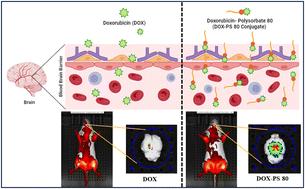
Targeting therapeutic agents to the brain to treat central nervous system (CNS) diseases is a major challenge due to the blood–brain barrier (BBB). In this study, an attempt was made to deliver a model drug such as doxorubicin (DOX), to the brain in a mouse model through DOX-Polysorbate 80 (DOX-PS80) conjugates. DOX was successfully conjugated with the non-ionic surfactant Polysorbate 80 (PS80) by carbamate linkage and the conjugate was characterized by different spectroscopic techniques, such as FTIR, UV-Visible and NMR. The DOX conjugation efficacy was found to be 43.69 ± 4.72%. The in vitro cumulative release of DOX from the conjugates was found to be 4.9 ± 0.8% in PBS of pH 7.3 and 3.9 ± 0.6% in simulated cerebrospinal fluid (CSF) of pH 7.3 at the end of 10 days. An in vitro BBB permeability assay was carried out using bEnd.3 cells and DOX-PS80 conjugate showed a 3-fold increase in BBB permeability compared with controls. In vitro cytotoxicity assay using U251 human glioblastoma cells showed an IC50 value of 38.10 μg mL−1 for DOX-PS80. Cell uptake studies revealed that DOX-PS80 was effectively taken up (90%) by the bEnd.3 and U251 cells and localized in cytoplasm at the end of 24 h. Pharmacokinetic parameters for DOX-PS80 were evaluated using in silico studies. Tumor spheroid assay and in vivo experiments in Swiss albino mouse demonstrated the possibility of DOX-PS80 conjugate crossing the BBB and delivering the drug molecules to the target site for treating CNS disorders.



 京公网安备 11010802042870号
京ICP备2023020795号-1
京公网安备 11010802042870号
京ICP备2023020795号-1

 分享
分享

 求助内容:
求助内容: 应助结果提醒方式:
 扫码关注我们
