Beth L Pineles, Christopher P Bonafide, Laura Ellen Ashcraft
{"title":"Deimplementation of ineffective and harmful medical practices: a data-driven commentary.","authors":"Beth L Pineles, Christopher P Bonafide, Laura Ellen Ashcraft","doi":"10.1093/aje/kwae285","DOIUrl":null,"url":null,"abstract":"<p><p>Deimplementation is the discontinuation or abandonment of medical practices that are ineffective or of unclear effectiveness, ranging from simply unhelpful to harmful. With epidemiology expanding to include more translational sciences, epidemiologists can contribute to deimplementation by defining evidence, establishing causality, and advising on study design. An estimated 10%-30% of health care practices have minimal to no benefit to patients and should be targeted for deimplementation. The steps in deimplementation are (1) identify low-value clinical practices, (2) facilitate the deimplementation process, (3) evaluate deimplementation outcomes, and (4) sustain deimplementation, each of which is a complex project. Deimplementation science involves researchers, health care and clinical stakeholders, and patient and community partners affected by the medical practice. Increasing collaboration between epidemiologists and implementation scientists is important to optimizing health care delivery.</p>","PeriodicalId":7472,"journal":{"name":"American journal of epidemiology","volume":" ","pages":"889-897"},"PeriodicalIF":4.8000,"publicationDate":"2025-04-08","publicationTypes":"Journal Article","fieldsOfStudy":null,"isOpenAccess":false,"openAccessPdf":"","citationCount":"0","resultStr":null,"platform":"Semanticscholar","paperid":null,"PeriodicalName":"American journal of epidemiology","FirstCategoryId":"3","ListUrlMain":"https://doi.org/10.1093/aje/kwae285","RegionNum":2,"RegionCategory":"医学","ArticlePicture":[],"TitleCN":null,"AbstractTextCN":null,"PMCID":null,"EPubDate":"","PubModel":"","JCR":"Q1","JCRName":"PUBLIC, ENVIRONMENTAL & OCCUPATIONAL HEALTH","Score":null,"Total":0}
引用次数: 0
Abstract
Deimplementation is the discontinuation or abandonment of medical practices that are ineffective or of unclear effectiveness, ranging from simply unhelpful to harmful. With epidemiology expanding to include more translational sciences, epidemiologists can contribute to deimplementation by defining evidence, establishing causality, and advising on study design. An estimated 10%-30% of health care practices have minimal to no benefit to patients and should be targeted for deimplementation. The steps in deimplementation are (1) identify low-value clinical practices, (2) facilitate the deimplementation process, (3) evaluate deimplementation outcomes, and (4) sustain deimplementation, each of which is a complex project. Deimplementation science involves researchers, health care and clinical stakeholders, and patient and community partners affected by the medical practice. Increasing collaboration between epidemiologists and implementation scientists is important to optimizing health care delivery.
期刊介绍:
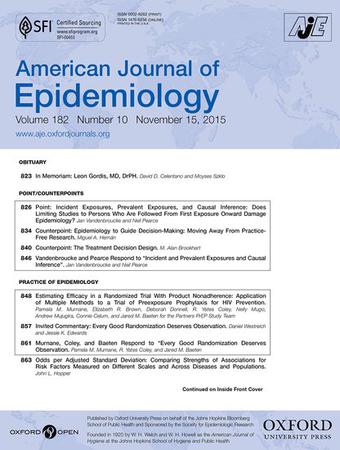
The American Journal of Epidemiology is the oldest and one of the premier epidemiologic journals devoted to the publication of empirical research findings, opinion pieces, and methodological developments in the field of epidemiologic research.
It is a peer-reviewed journal aimed at both fellow epidemiologists and those who use epidemiologic data, including public health workers and clinicians.



 京公网安备 11010802042870号
京ICP备2023020795号-1
京公网安备 11010802042870号
京ICP备2023020795号-1

 分享
分享
 求助内容:
求助内容: 应助结果提醒方式:
 扫码关注我们
