{"title":"A Survey on Haptics: Communication, Sensing and Feedback","authors":"Melika Emami;Amirhossein Bayat;Rahim Tafazolli;Atta Quddus","doi":"10.1109/COMST.2024.3444051","DOIUrl":null,"url":null,"abstract":"Haptic communications represent a vast area of research focused on integrating the sense of touch into digital sensory experiences. Achieving effective haptic communication requires meticulous design and implementation of all subsystems. As implied by the term, the two primary subsystems are haptic and communication. Haptic refers to replicating the touch sensation in various applications such as augmented reality, virtual reality and teleoperation, and communication involves optimising network structures to transmit and receive haptic information alongside other sensory data. In this survey paper, we discuss both haptic interfaces and network requirements simultaneously. For haptic interfaces, we comprehensively explore the mechanisms of touch perception, haptic sensing, and haptic feedback. We delve into haptic sensing by examining state-of-the-art sensors and approaches to capture data related to touch, such as pressure, force, and motion, and translate these physical interactions into digital data that a haptic system can interpret and respond to. Subsequently, we discuss various methods of achieving haptic feedback, including different mechanical actuators and electrical stimulation. We also investigate the incorporation of artificial intelligence in this field, proposing new areas where it could enhance system performance. Additionally, we address open challenges and future research directions, covering critical issues related to privacy, data transmission, cybersickness, performance and wearability of haptic interface, integrated systems, power supply and evaluation of these devices. Through this interdisciplinary approach, which merges haptic feedback, haptic sensing, and communication, our paper aims to inspire further research and development, ultimately advancing technology and enhancing haptic experiences.","PeriodicalId":55029,"journal":{"name":"IEEE Communications Surveys and Tutorials","volume":"27 3","pages":"2006-2050"},"PeriodicalIF":34.4000,"publicationDate":"2024-08-14","publicationTypes":"Journal Article","fieldsOfStudy":null,"isOpenAccess":false,"openAccessPdf":"https://ieeexplore.ieee.org/stamp/stamp.jsp?tp=&arnumber=10637258","citationCount":"0","resultStr":null,"platform":"Semanticscholar","paperid":null,"PeriodicalName":"IEEE Communications Surveys and Tutorials","FirstCategoryId":"94","ListUrlMain":"https://ieeexplore.ieee.org/document/10637258/","RegionNum":1,"RegionCategory":"计算机科学","ArticlePicture":[],"TitleCN":null,"AbstractTextCN":null,"PMCID":null,"EPubDate":"","PubModel":"","JCR":"Q1","JCRName":"COMPUTER SCIENCE, INFORMATION SYSTEMS","Score":null,"Total":0}
引用次数: 0
Abstract
Haptic communications represent a vast area of research focused on integrating the sense of touch into digital sensory experiences. Achieving effective haptic communication requires meticulous design and implementation of all subsystems. As implied by the term, the two primary subsystems are haptic and communication. Haptic refers to replicating the touch sensation in various applications such as augmented reality, virtual reality and teleoperation, and communication involves optimising network structures to transmit and receive haptic information alongside other sensory data. In this survey paper, we discuss both haptic interfaces and network requirements simultaneously. For haptic interfaces, we comprehensively explore the mechanisms of touch perception, haptic sensing, and haptic feedback. We delve into haptic sensing by examining state-of-the-art sensors and approaches to capture data related to touch, such as pressure, force, and motion, and translate these physical interactions into digital data that a haptic system can interpret and respond to. Subsequently, we discuss various methods of achieving haptic feedback, including different mechanical actuators and electrical stimulation. We also investigate the incorporation of artificial intelligence in this field, proposing new areas where it could enhance system performance. Additionally, we address open challenges and future research directions, covering critical issues related to privacy, data transmission, cybersickness, performance and wearability of haptic interface, integrated systems, power supply and evaluation of these devices. Through this interdisciplinary approach, which merges haptic feedback, haptic sensing, and communication, our paper aims to inspire further research and development, ultimately advancing technology and enhancing haptic experiences.
期刊介绍:
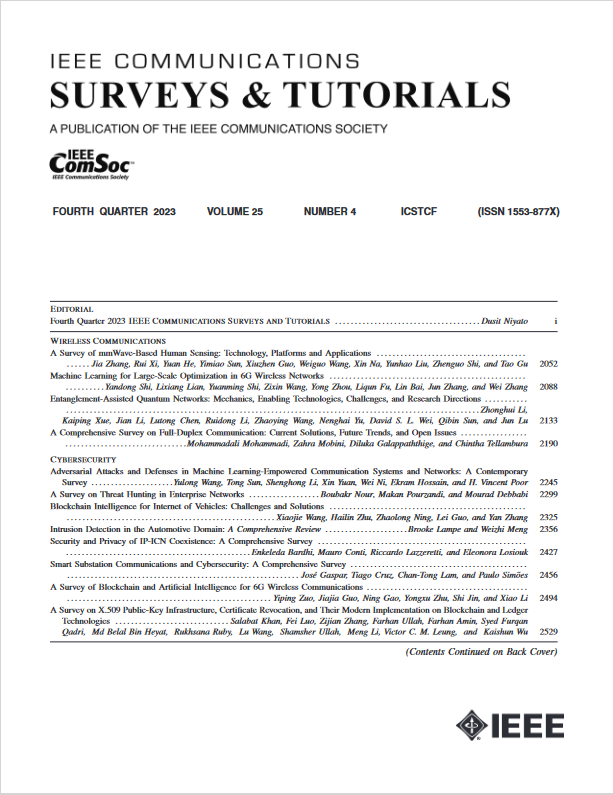
IEEE Communications Surveys & Tutorials is an online journal published by the IEEE Communications Society for tutorials and surveys covering all aspects of the communications field. Telecommunications technology is progressing at a rapid pace, and the IEEE Communications Society is committed to providing researchers and other professionals the information and tools to stay abreast. IEEE Communications Surveys and Tutorials focuses on integrating and adding understanding to the existing literature on communications, putting results in context. Whether searching for in-depth information about a familiar area or an introduction into a new area, IEEE Communications Surveys & Tutorials aims to be the premier source of peer-reviewed, comprehensive tutorials and surveys, and pointers to further sources. IEEE Communications Surveys & Tutorials publishes only articles exclusively written for IEEE Communications Surveys & Tutorials and go through a rigorous review process before their publication in the quarterly issues.
A tutorial article in the IEEE Communications Surveys & Tutorials should be designed to help the reader to become familiar with and learn something specific about a chosen topic. In contrast, the term survey, as applied here, is defined to mean a survey of the literature. A survey article in IEEE Communications Surveys & Tutorials should provide a comprehensive review of developments in a selected area, covering its development from its inception to its current state and beyond, and illustrating its development through liberal citations from the literature. Both tutorials and surveys should be tutorial in nature and should be written in a style comprehensible to readers outside the specialty of the article.



 京公网安备 11010802042870号
京ICP备2023020795号-1
京公网安备 11010802042870号
京ICP备2023020795号-1

 分享
分享
 求助内容:
求助内容: 应助结果提醒方式:
 扫码关注我们
