Jesús Duque-Afonso, Pia Veratti, Usama-Ur Rehman, Heike Herzog, Jan Mitschke, Gabriele Greve, Julian Eble, Bettina Berberich, Johanna Thomas, Milena Pantic, Miguel Waterhouse, Gaia Gentile, Olaf Heidenreich, Cornelius Miething, Michael Lübbert
{"title":"Identification of epigenetic modifiers essential for growth and survival of AML1/ETO-positive leukemia","authors":"Jesús Duque-Afonso, Pia Veratti, Usama-Ur Rehman, Heike Herzog, Jan Mitschke, Gabriele Greve, Julian Eble, Bettina Berberich, Johanna Thomas, Milena Pantic, Miguel Waterhouse, Gaia Gentile, Olaf Heidenreich, Cornelius Miething, Michael Lübbert","doi":"10.1002/ijc.35134","DOIUrl":null,"url":null,"abstract":"<p>Aberrant gene expression patterns in acute myeloid leukemia (AML) with balanced chromosomal translocations are often associated with dysregulation of epigenetic modifiers. The AML1/ETO (RUNX1/MTG8) fusion protein, caused by the translocation (8;21)(q22;q22), leads to the epigenetic repression of its target genes. We aimed in this work to identify critical epigenetic modifiers, on which AML1/ETO-positive AML cells depend on for proliferation and survival using shRNA library screens and global transcriptomics approaches. Using shRNA library screens, we identified 41 commonly depleted genes in two AML1/ETO-positive cell lines Kasumi-1 and SKNO-1. We validated, genetically and pharmacologically, <i>DNMT1</i> and <i>ATR</i> using several AML1/ETO-positive and negative cell lines. We also demonstrated in vivo differentiation of myeloblasts after treatment with the DNMT1 inhibitor decitabine in a patient with an AML1/ETO-positive AML. Bioinformatic analysis of global transcriptomics after AML1/ETO induction in 9/14/18-U937 cells identified 973 differentially expressed genes (DEGs). Three genes (<i>PARP2</i>, PRKCD, and <i>SMARCA4</i>) were both downregulated after AML1/ETO induction, and identified in shRNA screens. In conclusion, using unbiased shRNA library screens and global transcriptomics, we have identified several driver epigenetic regulators for proliferation in AML1/ETO-positive AML. DNMT1 and ATR were validated and are susceptible to pharmacological inhibition by small molecules showing promising preclinical and clinical efficacy.</p>","PeriodicalId":180,"journal":{"name":"International Journal of Cancer","volume":"155 11","pages":"2068-2079"},"PeriodicalIF":4.7000,"publicationDate":"2024-08-15","publicationTypes":"Journal Article","fieldsOfStudy":null,"isOpenAccess":false,"openAccessPdf":"https://onlinelibrary.wiley.com/doi/epdf/10.1002/ijc.35134","citationCount":"0","resultStr":null,"platform":"Semanticscholar","paperid":null,"PeriodicalName":"International Journal of Cancer","FirstCategoryId":"3","ListUrlMain":"https://onlinelibrary.wiley.com/doi/10.1002/ijc.35134","RegionNum":2,"RegionCategory":"医学","ArticlePicture":[],"TitleCN":null,"AbstractTextCN":null,"PMCID":null,"EPubDate":"","PubModel":"","JCR":"Q1","JCRName":"ONCOLOGY","Score":null,"Total":0}
引用次数: 0
Abstract
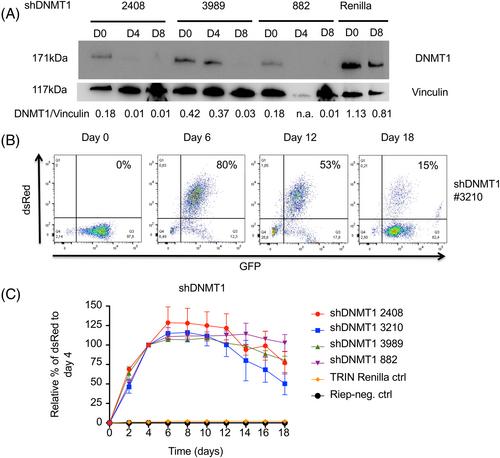
Aberrant gene expression patterns in acute myeloid leukemia (AML) with balanced chromosomal translocations are often associated with dysregulation of epigenetic modifiers. The AML1/ETO (RUNX1/MTG8) fusion protein, caused by the translocation (8;21)(q22;q22), leads to the epigenetic repression of its target genes. We aimed in this work to identify critical epigenetic modifiers, on which AML1/ETO-positive AML cells depend on for proliferation and survival using shRNA library screens and global transcriptomics approaches. Using shRNA library screens, we identified 41 commonly depleted genes in two AML1/ETO-positive cell lines Kasumi-1 and SKNO-1. We validated, genetically and pharmacologically, DNMT1 and ATR using several AML1/ETO-positive and negative cell lines. We also demonstrated in vivo differentiation of myeloblasts after treatment with the DNMT1 inhibitor decitabine in a patient with an AML1/ETO-positive AML. Bioinformatic analysis of global transcriptomics after AML1/ETO induction in 9/14/18-U937 cells identified 973 differentially expressed genes (DEGs). Three genes (PARP2, PRKCD, and SMARCA4) were both downregulated after AML1/ETO induction, and identified in shRNA screens. In conclusion, using unbiased shRNA library screens and global transcriptomics, we have identified several driver epigenetic regulators for proliferation in AML1/ETO-positive AML. DNMT1 and ATR were validated and are susceptible to pharmacological inhibition by small molecules showing promising preclinical and clinical efficacy.
期刊介绍:
The International Journal of Cancer (IJC) is the official journal of the Union for International Cancer Control—UICC; it appears twice a month. IJC invites submission of manuscripts under a broad scope of topics relevant to experimental and clinical cancer research and publishes original Research Articles and Short Reports under the following categories:
-Cancer Epidemiology-
Cancer Genetics and Epigenetics-
Infectious Causes of Cancer-
Innovative Tools and Methods-
Molecular Cancer Biology-
Tumor Immunology and Microenvironment-
Tumor Markers and Signatures-
Cancer Therapy and Prevention



 京公网安备 11010802042870号
京ICP备2023020795号-1
京公网安备 11010802042870号
京ICP备2023020795号-1

 分享
分享

 求助内容:
求助内容: 应助结果提醒方式:
 扫码关注我们
