Luan Pereira Diniz , Ana Paula Bergamo Araujo , Clara Fernandes Carvalho , Isadora Matias , Lívia de Sá Hayashide , Mariana Marques , Bruna Pessoa , Cherley Borba Vieira Andrade , Gabriele Vargas , Daniela Dias Queiroz , Jorge José de Carvalho , Antonio Galina , Flávia Carvalho Alcantara Gomes
{"title":"Accumulation of damaged mitochondria in aging astrocytes due to mitophagy dysfunction: Implications for susceptibility to mitochondrial stress","authors":"Luan Pereira Diniz , Ana Paula Bergamo Araujo , Clara Fernandes Carvalho , Isadora Matias , Lívia de Sá Hayashide , Mariana Marques , Bruna Pessoa , Cherley Borba Vieira Andrade , Gabriele Vargas , Daniela Dias Queiroz , Jorge José de Carvalho , Antonio Galina , Flávia Carvalho Alcantara Gomes","doi":"10.1016/j.bbadis.2024.167470","DOIUrl":null,"url":null,"abstract":"<div><p>Aging disrupts brain function, leading to cognitive decline and neurodegenerative diseases. Senescent astrocytes, a hallmark of aging, contribute to this process through unknown mechanisms. This study investigates how senescence impacts astrocytic mitochondrial dynamics, which are critical for brain health. Our research, conducted using aged mouse brains, represents the first evidence of morphologically damaged mitochondria in astrocytes, along with functional alterations in mitochondrial respiration. <em>In vitro</em> experiments revealed that senescent astrocytes exhibit an increase in mitochondrial fragmentation and impaired mitophagy. Concurrently, there was an upregulation of mitochondrial biogenesis, indicating a compensatory response to mitochondrial damage. Importantly, these senescent astrocytes were more susceptible to mitochondrial stress, a vulnerability reversed by rapamycin treatment. These findings suggest a potential link between senescence, impaired mitochondrial quality control, and increased susceptibility to mitochondrial stress in astrocytes. Overall, our study highlights the importance of addressing mitochondrial dysfunction and senescence-related changes in astrocytes as a promising approach for developing therapies to counter age-related neurodegeneration and improve brain health.</p></div>","PeriodicalId":8821,"journal":{"name":"Biochimica et biophysica acta. Molecular basis of disease","volume":"1870 8","pages":"Article 167470"},"PeriodicalIF":4.2000,"publicationDate":"2024-12-01","publicationTypes":"Journal Article","fieldsOfStudy":null,"isOpenAccess":false,"openAccessPdf":"","citationCount":"0","resultStr":null,"platform":"Semanticscholar","paperid":null,"PeriodicalName":"Biochimica et biophysica acta. Molecular basis of disease","FirstCategoryId":"99","ListUrlMain":"https://www.sciencedirect.com/science/article/pii/S0925443924004630","RegionNum":2,"RegionCategory":"生物学","ArticlePicture":[],"TitleCN":null,"AbstractTextCN":null,"PMCID":null,"EPubDate":"2024/8/15 0:00:00","PubModel":"Epub","JCR":"Q2","JCRName":"BIOCHEMISTRY & MOLECULAR BIOLOGY","Score":null,"Total":0}
引用次数: 0
Abstract
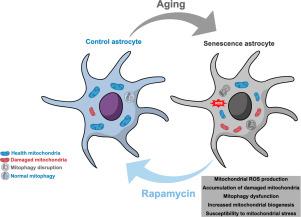
Aging disrupts brain function, leading to cognitive decline and neurodegenerative diseases. Senescent astrocytes, a hallmark of aging, contribute to this process through unknown mechanisms. This study investigates how senescence impacts astrocytic mitochondrial dynamics, which are critical for brain health. Our research, conducted using aged mouse brains, represents the first evidence of morphologically damaged mitochondria in astrocytes, along with functional alterations in mitochondrial respiration. In vitro experiments revealed that senescent astrocytes exhibit an increase in mitochondrial fragmentation and impaired mitophagy. Concurrently, there was an upregulation of mitochondrial biogenesis, indicating a compensatory response to mitochondrial damage. Importantly, these senescent astrocytes were more susceptible to mitochondrial stress, a vulnerability reversed by rapamycin treatment. These findings suggest a potential link between senescence, impaired mitochondrial quality control, and increased susceptibility to mitochondrial stress in astrocytes. Overall, our study highlights the importance of addressing mitochondrial dysfunction and senescence-related changes in astrocytes as a promising approach for developing therapies to counter age-related neurodegeneration and improve brain health.
期刊介绍:
BBA Molecular Basis of Disease addresses the biochemistry and molecular genetics of disease processes and models of human disease. This journal covers aspects of aging, cancer, metabolic-, neurological-, and immunological-based disease. Manuscripts focused on using animal models to elucidate biochemical and mechanistic insight in each of these conditions, are particularly encouraged. Manuscripts should emphasize the underlying mechanisms of disease pathways and provide novel contributions to the understanding and/or treatment of these disorders. Highly descriptive and method development submissions may be declined without full review. The submission of uninvited reviews to BBA - Molecular Basis of Disease is strongly discouraged, and any such uninvited review should be accompanied by a coverletter outlining the compelling reasons why the review should be considered.



 京公网安备 11010802042870号
京ICP备2023020795号-1
京公网安备 11010802042870号
京ICP备2023020795号-1

 分享
分享
 求助内容:
求助内容: 应助结果提醒方式:
 扫码关注我们
