The efficacy and safety of insulin glargine 100 U/mL + lixisenatide versus insulin degludec + insulin aspart in Chinese people with type 2 diabetes suboptimally controlled with oral antidiabetic drugs: The Soli-D randomized controlled trial
{"title":"The efficacy and safety of insulin glargine 100 U/mL + lixisenatide versus insulin degludec + insulin aspart in Chinese people with type 2 diabetes suboptimally controlled with oral antidiabetic drugs: The Soli-D randomized controlled trial","authors":"Yiming Mu MD","doi":"10.1111/dom.15857","DOIUrl":null,"url":null,"abstract":"<p>Following the publication of the Soli-D randomized controlled clinical trial in <i>Diabetes, Obesity and Metabolism</i>,<span><sup>1</sup></span> several questions have been raised regarding the results for postprandial glucose (PPG), which was measured by seven-point self-monitored plasma glucose (SMPG). Here we present additional data on the timing of (IDegAsp) injections to contextualize the results and clarify their clinical implications.</p><p>In the Soli-D study, the strongest effect on average PPG from seven-point SMPG with insulin glargine 100 U/mL + lixisenatide (iGlarLixi) was observed with the meal following the injection, which was the first meal of the day. However, the effect of iGlarLixi on PPG after all meals was clinically relevant and within the Chinese Diabetes Society guidelines recommended target PPG value of ≤10.0 mmol/L.<span><sup>2</sup></span> iGlarLixi demonstrated a greater reduction in average PPG from seven-point SMPG for the mean of all meals from baseline to Week 24 compared with IDegAsp, with mean (standard error) reductions of −3.94 ± 0.14 mmol/L and −3.15 ± 0.14 mmol/L, respectively (Figure 1). iGlarLixi treatment resulted in a greater reduction in average PPG from seven-point SMPG from baseline to Week 24 compared with IDegAsp at breakfast and lunch (Table 1); there was no difference observed between the treatments at dinner (Table 1).<span><sup>1</sup></span></p><p>When interpreting the PPG data, it is important to consider the timing of the injection of each therapy. iGlarLixi was injected before the first meal of the day (per study protocol), while IDegAsp was injected before the main meal of the day (per label). In the IDegAsp arm of the study, 47.8% administered IDegAsp at breakfast, 18.6% at lunch, and 33.7% at dinner. The insulin aspart component of IDegAsp is a rapid-acting insulin with an onset of 9–14 min<span><sup>3</sup></span> and is injected before the largest meal of the day to provide the greatest reduction in PPG excursions.<span><sup>4</sup></span> The similar PPG levels observed for iGlarLixi and IDegAsp post-dinner may be explained by the fact that one-third of participants in the IDegAsp group injected prior to dinner, impacting the result of this timepoint more than that in the iGlarLixi group (in which patients injected before the first meal of the day).</p><p>The results of the Soli-D study align with several previous studies of iGlarLixi, in which iGlarLixi demonstrated clinically relevant reductions in mean PPG after all meals in participants with type 2 diabetes, previously uncontrolled with oral antidiabetic drugs (OADs),<span><sup>5, 6</sup></span> or basal insulin plus OADs.<span><sup>7, 8</sup></span> In these studies, including the LixiLan-O Asia Pacific study, conducted in a similar population to the Soli-D study, iGlarLixi maintained PPG levels below the recommended threshold of ≤10 mmol/L after all meals.<span><sup>5-8</sup></span></p><p>In conclusion, both iGlarLixi and IDegAsp effectively addressed PPG in Chinese people with type 2 diabetes, previously suboptimally controlled with OAD(s), with iGlarLixi achieving a greater mean reduction in PPG at breakfast, lunch and for the mean of all meals.</p><p>YM contributed to the design, conduct, data analysis, review and approval of the letter.</p><p>This study was funded by Sanofi.</p><p>YM reports having received honoraria and personal fees from Eli Lilly Diabetes, Novo Nordisk and Sanofi outside the submitted work.</p>","PeriodicalId":158,"journal":{"name":"Diabetes, Obesity & Metabolism","volume":"26 11","pages":"5497-5499"},"PeriodicalIF":6.1000,"publicationDate":"2024-08-19","publicationTypes":"Journal Article","fieldsOfStudy":null,"isOpenAccess":false,"openAccessPdf":"https://onlinelibrary.wiley.com/doi/epdf/10.1111/dom.15857","citationCount":"0","resultStr":null,"platform":"Semanticscholar","paperid":null,"PeriodicalName":"Diabetes, Obesity & Metabolism","FirstCategoryId":"3","ListUrlMain":"https://dom-pubs.onlinelibrary.wiley.com/doi/10.1111/dom.15857","RegionNum":2,"RegionCategory":"医学","ArticlePicture":[],"TitleCN":null,"AbstractTextCN":null,"PMCID":null,"EPubDate":"","PubModel":"","JCR":"Q1","JCRName":"ENDOCRINOLOGY & METABOLISM","Score":null,"Total":0}
引用次数: 0
Abstract
Following the publication of the Soli-D randomized controlled clinical trial in Diabetes, Obesity and Metabolism,1 several questions have been raised regarding the results for postprandial glucose (PPG), which was measured by seven-point self-monitored plasma glucose (SMPG). Here we present additional data on the timing of (IDegAsp) injections to contextualize the results and clarify their clinical implications.
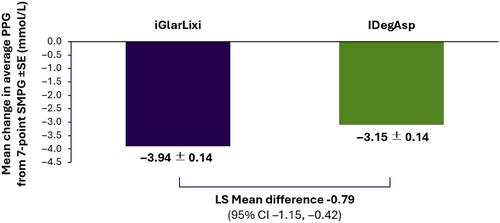
In the Soli-D study, the strongest effect on average PPG from seven-point SMPG with insulin glargine 100 U/mL + lixisenatide (iGlarLixi) was observed with the meal following the injection, which was the first meal of the day. However, the effect of iGlarLixi on PPG after all meals was clinically relevant and within the Chinese Diabetes Society guidelines recommended target PPG value of ≤10.0 mmol/L.2 iGlarLixi demonstrated a greater reduction in average PPG from seven-point SMPG for the mean of all meals from baseline to Week 24 compared with IDegAsp, with mean (standard error) reductions of −3.94 ± 0.14 mmol/L and −3.15 ± 0.14 mmol/L, respectively (Figure 1). iGlarLixi treatment resulted in a greater reduction in average PPG from seven-point SMPG from baseline to Week 24 compared with IDegAsp at breakfast and lunch (Table 1); there was no difference observed between the treatments at dinner (Table 1).1
When interpreting the PPG data, it is important to consider the timing of the injection of each therapy. iGlarLixi was injected before the first meal of the day (per study protocol), while IDegAsp was injected before the main meal of the day (per label). In the IDegAsp arm of the study, 47.8% administered IDegAsp at breakfast, 18.6% at lunch, and 33.7% at dinner. The insulin aspart component of IDegAsp is a rapid-acting insulin with an onset of 9–14 min3 and is injected before the largest meal of the day to provide the greatest reduction in PPG excursions.4 The similar PPG levels observed for iGlarLixi and IDegAsp post-dinner may be explained by the fact that one-third of participants in the IDegAsp group injected prior to dinner, impacting the result of this timepoint more than that in the iGlarLixi group (in which patients injected before the first meal of the day).
The results of the Soli-D study align with several previous studies of iGlarLixi, in which iGlarLixi demonstrated clinically relevant reductions in mean PPG after all meals in participants with type 2 diabetes, previously uncontrolled with oral antidiabetic drugs (OADs),5, 6 or basal insulin plus OADs.7, 8 In these studies, including the LixiLan-O Asia Pacific study, conducted in a similar population to the Soli-D study, iGlarLixi maintained PPG levels below the recommended threshold of ≤10 mmol/L after all meals.5-8
In conclusion, both iGlarLixi and IDegAsp effectively addressed PPG in Chinese people with type 2 diabetes, previously suboptimally controlled with OAD(s), with iGlarLixi achieving a greater mean reduction in PPG at breakfast, lunch and for the mean of all meals.
YM contributed to the design, conduct, data analysis, review and approval of the letter.
This study was funded by Sanofi.
YM reports having received honoraria and personal fees from Eli Lilly Diabetes, Novo Nordisk and Sanofi outside the submitted work.
期刊介绍:
Diabetes, Obesity and Metabolism is primarily a journal of clinical and experimental pharmacology and therapeutics covering the interrelated areas of diabetes, obesity and metabolism. The journal prioritises high-quality original research that reports on the effects of new or existing therapies, including dietary, exercise and lifestyle (non-pharmacological) interventions, in any aspect of metabolic and endocrine disease, either in humans or animal and cellular systems. ‘Metabolism’ may relate to lipids, bone and drug metabolism, or broader aspects of endocrine dysfunction. Preclinical pharmacology, pharmacokinetic studies, meta-analyses and those addressing drug safety and tolerability are also highly suitable for publication in this journal. Original research may be published as a main paper or as a research letter.





 京公网安备 11010802042870号
京ICP备2023020795号-1
京公网安备 11010802042870号
京ICP备2023020795号-1

 分享
分享
 求助内容:
求助内容: 应助结果提醒方式:
 扫码关注我们
