Linong Ji MD, Leili Gao MD, Zhikai Feng MD, Guoliang Chen MS, Jing Fu MD, Erin Morgan BS, Sanjay Bhanot MD, Shan Gao PhD, Hongyan Zhang PhD, Zicai Liang PhD, Li-Ming Gan MD
{"title":"The efficacy and safety of ISIS 449884 injection as monotherapy in patients with type 2 diabetes: A randomized phase II study","authors":"Linong Ji MD, Leili Gao MD, Zhikai Feng MD, Guoliang Chen MS, Jing Fu MD, Erin Morgan BS, Sanjay Bhanot MD, Shan Gao PhD, Hongyan Zhang PhD, Zicai Liang PhD, Li-Ming Gan MD","doi":"10.1111/dom.15862","DOIUrl":null,"url":null,"abstract":"<p>Diabetes is a group of clinical syndromes characterized by hyperglycaemia, caused by genetic and environmental factors.<span><sup>1</sup></span> China has the largest number of diabetes patients in the world, with more than 90% of diabetes patients having type 2 diabetes (T2D).<span><sup>2</sup></span></p><p>Glucagon from islet alpha cells binds to and activates the glucagon receptor (GCGR) to raise blood glucose and antagonize insulin.<span><sup>3</sup></span> Glucagon can also bind to the glucagon-like peptide-1 (GLP-1) receptor to regulate beta-cell function.<span><sup>4</sup></span> Antagonists targeting GCGR have shown safety and efficacy in patients with T2D.<span><sup>5</sup></span></p><p>ISIS 449884, jointly developed by Ribo (Hong Kong) Biotechnology Co., Ltd and the US Ionis company, is a second generation 2′-O-methoxyethyl (2′-MOE) chimeric antisense oligonucleotide targeting GCGR. Three studies in patients with T2D on stable doses of metformin showed that inhibition of GCGR with ISIS 449884 led to statistically significant dose-dependent improvements in HbA1c without increasing the risk of symptomatic hypoglycaemia.<span><sup>6</sup></span> However, there is still a lack of efficacy and safety data regarding ISIS 449884 injection in the Chinese population with poor glycaemic control after diet and exercise intervention.</p><p>This was a multicentre, placebo-controlled (2:1), randomized, double-blind phase II study to evaluate the efficacy and safety of ISIS 449884 in Chinese patients with T2D who were inadequately controlled (7.5% ≤ HbA1c ≤ 10.5%) by diet and exercise interventions. The study was conducted at 20 sites in China and is registered on the Clinical Trial Registration and Information Disclosure Platform (www.chinadrugtrials.org.cn, CTR20190151). Detailed eligibility criteria are provided in the supporting information.</p><p>The schematic of the study design is shown in Figure S1; all the participants received ISIS 449884 solution (200 mg/mL solution) for injection (75 mg) or an equal volume of placebo (0.375 mL). Based on the results of the three phase II clinical studies of ISIS 449884, a 75-mg dose administered once weekly was selected for ISIS449884 injection. The primary efficacy endpoint was the change from baseline in HbA1c at week 17.</p><p>Investigators, staff, participants, monitors and the sponsor were blinded to the study treatment allocation. Eligible participants were randomized using an interactive web response system to receive a subcutaneous injection of ISIS 449884 or placebo in a ratio of 2: 1. Permuted block randomization was applied in the trial.</p><p>Statistical analysis was performed using SAS System 9.4 or higher. Analysis of the change from baseline in efficacy endpoints was performed by an analysis of covariance model.</p><p>Based on experience from the previous phase II clinical trial of ISIS 449884 injection, it was estimated that the standard deviation (SD) of the change from baseline in HbA1c in the untreated T2D population would be approximately 1.2% with 85% power (two-sided α = .05). It was estimated that this would require 28 participants in the ISIS 449884 group and 14 participants in the placebo group. With a dropout rate of 25%, 57 participants with T2D were expected to be randomized: 38 in the ISIS 449884 group and 19 in the placebo group.</p><p>The disposition of participants is shown in Figure S2. Demographic and baseline characteristics were comparable, except for a higher proportion of men in the placebo group (Table 1).</p><p>ISIS 449884 significantly reduced HbA1c compared with placebo after 16 weeks of treatment. The mean (± SD) baseline HbA1c levels were 8.6% ± 0.59% and 8.7% ± 0.78% in the ISIS 449884 group and placebo group, respectively. The mean (± SD) HbA1c at week 17 in the ISIS 449884 group was 7.1% ± 0.84% with an adjusted least-squares (LS) mean change from baseline of −1.47% (95% CI: −1.83%, −1. 11%). The mean (± SD) HbA1c at week 17 in the placebo group was 7.8% ± 1.25%, with an adjusted LS mean change from baseline of −0.83% (95% CI: −1.28%, −0.39%). The difference in LS mean for the ISIS 449884 group compared with placebo was −0.63% (95% CI: −1.09%, −0.17%; <i>P</i> = .008), indicating a significant difference between treatment groups in the primary efficacy endpoint (Figure 1A,B and Table S1). There was also a decrease in the change from baseline in HbA1c at week 20, which was 4 weeks off treatment. More patients in the ISIS 449884 group than in the placebo group achieved an HbA1c of less than 7.0% or of less than 6.5% at week 17 (Figure 1C).</p><p>ISIS 449884 significantly increased fasting glucagon levels compared with placebo at week 17 (<i>P</i> = .002), with fasting glucagon levels peaking at week 17 (Figure S3A,B). ISIS 449884 significantly increased mean fasting total GLP-1 levels compared with placebo at week 17 (<i>P</i> = .002), with total GLP-1 levels peaking at week 17 (Figure S3C,D). ISIS 449884 significantly reduced fasting serum glucose compared with placebo at week 17 (<i>P</i> < .001) (Figure S3E,F). Fasting serum insulin, fasting active GLP-1, serum C-peptide and self-monitored blood glucose showed no significant difference in the two groups at week 17.</p><p>Throughout the study, 35 of 38 participants (92.1%) in the ISIS 449884 group and 13 of 19 participants (68.4%) in the placebo group experienced treatment emergent adverse events (TEAEs); a summary of the TEAEs is presented in Table S2.</p><p>This study focused on aspartate aminotransferase (AST) and alanine aminotransferase (ALT) profiles. Figure S4 shows that ALT and AST were elevated in the ISIS 449884 group after administration and gradually decreased after the end of treatment, eventually returning to baseline levels. Table S3 shows that in the ISIS 449884 group, the levels of ALT and AST were 23.63 and 19.37 U/L at baseline; they peaked at week 16 (49.10 and 40.14 U/L, respectively) then returned to baseline levels at week 24 (26.56 U/L) and week 32 (23.35 U/L), respectively. While ALT and AST in the placebo group remained at baseline levels with slight fluctuations, no significant changes were observed throughout the study period. Additionally, no AST or ALT three or more times the upper limit of normal (ULN) was observed in the placebo group. By contrast, seven participants in the ISIS 449884 group had ALT three or more times the ULN, and six had AST three or more times the ULN. No AST or ALT five or more times the ULN was observed. No participant in this study experienced total bilirubin 1.5 or more times the ULN.</p><p>A total of 3/38 participants (7.9%) in the ISIS 449884 group had hypoglycaemic events, compared with 3/19 (15.8%) in the placebo group. There were no serious hypoglycaemic events during the study. Lipids (low-density lipoproteins, cholesterol and triglycerides), body weight and blood pressure fluctuated throughout the study without significant changes, and no significant differences between the two groups were observed.</p><p>In the current study, we observed a greater reduction in HbA1c at week 20 than the placebo group, showing the stable and long duration of glucose lowering in the off-treatment period in the ISIS 449884 treatment group. Additionally, we found that ALT and AST were elevated in the ISIS 449884 group, and this comparable reversible increase in liver transaminase levels was consistent with the results of previous clinical trials of small molecule antagonists targeting GCGR.<span><sup>7-9</sup></span> In contrast to the increases in lipids, body weight and blood pressure that had been observed with other glucagon receptor antagonists,<span><sup>10, 11</sup></span> there were no significant changes in lipids, body weight and blood pressure with ISIS 449884 treatment.</p><p>This study has some limitations, including a comparatively small sample size, an absence of hepatic lipid values and an absence of data on hepatic fat content. Moreover, the long-term consequences of changes in hepatic steatosis and potential islet morphology were not documented in this study, which may be considered in future trials.</p><p>In summary, compared with placebo, the use of ISIS 449884 injection 75 mg subcutaneously once weekly for 16 weeks in Chinese T2D patients with poor glycaemic control after diet and exercise interventions resulted in a significant improvement in HbA1c, with an acceptable safety and tolerability profile.</p><p>ZF, GC, JF, SG, HZ, ZL and LMG are employees of Suzhou Ribo Life Science Co. Ltd. EM and SB are employees of Ionis Pharmaceuticals, Inc. LJ reports receiving consulting and lecture fees from Eli Lilly and Company, Novo Nordisk, Merck, Bayer, Sanofi-Aventis, Roche, Merck Sharp & Dohme, Metronics, AstraZeneca, Boehinger Ingelheim and Abbott. LG has nothing to disclose.</p>","PeriodicalId":158,"journal":{"name":"Diabetes, Obesity & Metabolism","volume":"26 11","pages":"5466-5469"},"PeriodicalIF":5.7000,"publicationDate":"2024-08-19","publicationTypes":"Journal Article","fieldsOfStudy":null,"isOpenAccess":false,"openAccessPdf":"https://onlinelibrary.wiley.com/doi/epdf/10.1111/dom.15862","citationCount":"0","resultStr":null,"platform":"Semanticscholar","paperid":null,"PeriodicalName":"Diabetes, Obesity & Metabolism","FirstCategoryId":"3","ListUrlMain":"https://dom-pubs.onlinelibrary.wiley.com/doi/10.1111/dom.15862","RegionNum":2,"RegionCategory":"医学","ArticlePicture":[],"TitleCN":null,"AbstractTextCN":null,"PMCID":null,"EPubDate":"","PubModel":"","JCR":"Q1","JCRName":"ENDOCRINOLOGY & METABOLISM","Score":null,"Total":0}
引用次数: 0
Abstract
Diabetes is a group of clinical syndromes characterized by hyperglycaemia, caused by genetic and environmental factors.1 China has the largest number of diabetes patients in the world, with more than 90% of diabetes patients having type 2 diabetes (T2D).2
Glucagon from islet alpha cells binds to and activates the glucagon receptor (GCGR) to raise blood glucose and antagonize insulin.3 Glucagon can also bind to the glucagon-like peptide-1 (GLP-1) receptor to regulate beta-cell function.4 Antagonists targeting GCGR have shown safety and efficacy in patients with T2D.5
ISIS 449884, jointly developed by Ribo (Hong Kong) Biotechnology Co., Ltd and the US Ionis company, is a second generation 2′-O-methoxyethyl (2′-MOE) chimeric antisense oligonucleotide targeting GCGR. Three studies in patients with T2D on stable doses of metformin showed that inhibition of GCGR with ISIS 449884 led to statistically significant dose-dependent improvements in HbA1c without increasing the risk of symptomatic hypoglycaemia.6 However, there is still a lack of efficacy and safety data regarding ISIS 449884 injection in the Chinese population with poor glycaemic control after diet and exercise intervention.
This was a multicentre, placebo-controlled (2:1), randomized, double-blind phase II study to evaluate the efficacy and safety of ISIS 449884 in Chinese patients with T2D who were inadequately controlled (7.5% ≤ HbA1c ≤ 10.5%) by diet and exercise interventions. The study was conducted at 20 sites in China and is registered on the Clinical Trial Registration and Information Disclosure Platform (www.chinadrugtrials.org.cn, CTR20190151). Detailed eligibility criteria are provided in the supporting information.
The schematic of the study design is shown in Figure S1; all the participants received ISIS 449884 solution (200 mg/mL solution) for injection (75 mg) or an equal volume of placebo (0.375 mL). Based on the results of the three phase II clinical studies of ISIS 449884, a 75-mg dose administered once weekly was selected for ISIS449884 injection. The primary efficacy endpoint was the change from baseline in HbA1c at week 17.
Investigators, staff, participants, monitors and the sponsor were blinded to the study treatment allocation. Eligible participants were randomized using an interactive web response system to receive a subcutaneous injection of ISIS 449884 or placebo in a ratio of 2: 1. Permuted block randomization was applied in the trial.
Statistical analysis was performed using SAS System 9.4 or higher. Analysis of the change from baseline in efficacy endpoints was performed by an analysis of covariance model.
Based on experience from the previous phase II clinical trial of ISIS 449884 injection, it was estimated that the standard deviation (SD) of the change from baseline in HbA1c in the untreated T2D population would be approximately 1.2% with 85% power (two-sided α = .05). It was estimated that this would require 28 participants in the ISIS 449884 group and 14 participants in the placebo group. With a dropout rate of 25%, 57 participants with T2D were expected to be randomized: 38 in the ISIS 449884 group and 19 in the placebo group.
The disposition of participants is shown in Figure S2. Demographic and baseline characteristics were comparable, except for a higher proportion of men in the placebo group (Table 1).
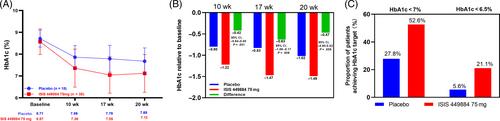
ISIS 449884 significantly reduced HbA1c compared with placebo after 16 weeks of treatment. The mean (± SD) baseline HbA1c levels were 8.6% ± 0.59% and 8.7% ± 0.78% in the ISIS 449884 group and placebo group, respectively. The mean (± SD) HbA1c at week 17 in the ISIS 449884 group was 7.1% ± 0.84% with an adjusted least-squares (LS) mean change from baseline of −1.47% (95% CI: −1.83%, −1. 11%). The mean (± SD) HbA1c at week 17 in the placebo group was 7.8% ± 1.25%, with an adjusted LS mean change from baseline of −0.83% (95% CI: −1.28%, −0.39%). The difference in LS mean for the ISIS 449884 group compared with placebo was −0.63% (95% CI: −1.09%, −0.17%; P = .008), indicating a significant difference between treatment groups in the primary efficacy endpoint (Figure 1A,B and Table S1). There was also a decrease in the change from baseline in HbA1c at week 20, which was 4 weeks off treatment. More patients in the ISIS 449884 group than in the placebo group achieved an HbA1c of less than 7.0% or of less than 6.5% at week 17 (Figure 1C).
ISIS 449884 significantly increased fasting glucagon levels compared with placebo at week 17 (P = .002), with fasting glucagon levels peaking at week 17 (Figure S3A,B). ISIS 449884 significantly increased mean fasting total GLP-1 levels compared with placebo at week 17 (P = .002), with total GLP-1 levels peaking at week 17 (Figure S3C,D). ISIS 449884 significantly reduced fasting serum glucose compared with placebo at week 17 (P < .001) (Figure S3E,F). Fasting serum insulin, fasting active GLP-1, serum C-peptide and self-monitored blood glucose showed no significant difference in the two groups at week 17.
Throughout the study, 35 of 38 participants (92.1%) in the ISIS 449884 group and 13 of 19 participants (68.4%) in the placebo group experienced treatment emergent adverse events (TEAEs); a summary of the TEAEs is presented in Table S2.
This study focused on aspartate aminotransferase (AST) and alanine aminotransferase (ALT) profiles. Figure S4 shows that ALT and AST were elevated in the ISIS 449884 group after administration and gradually decreased after the end of treatment, eventually returning to baseline levels. Table S3 shows that in the ISIS 449884 group, the levels of ALT and AST were 23.63 and 19.37 U/L at baseline; they peaked at week 16 (49.10 and 40.14 U/L, respectively) then returned to baseline levels at week 24 (26.56 U/L) and week 32 (23.35 U/L), respectively. While ALT and AST in the placebo group remained at baseline levels with slight fluctuations, no significant changes were observed throughout the study period. Additionally, no AST or ALT three or more times the upper limit of normal (ULN) was observed in the placebo group. By contrast, seven participants in the ISIS 449884 group had ALT three or more times the ULN, and six had AST three or more times the ULN. No AST or ALT five or more times the ULN was observed. No participant in this study experienced total bilirubin 1.5 or more times the ULN.
A total of 3/38 participants (7.9%) in the ISIS 449884 group had hypoglycaemic events, compared with 3/19 (15.8%) in the placebo group. There were no serious hypoglycaemic events during the study. Lipids (low-density lipoproteins, cholesterol and triglycerides), body weight and blood pressure fluctuated throughout the study without significant changes, and no significant differences between the two groups were observed.
In the current study, we observed a greater reduction in HbA1c at week 20 than the placebo group, showing the stable and long duration of glucose lowering in the off-treatment period in the ISIS 449884 treatment group. Additionally, we found that ALT and AST were elevated in the ISIS 449884 group, and this comparable reversible increase in liver transaminase levels was consistent with the results of previous clinical trials of small molecule antagonists targeting GCGR.7-9 In contrast to the increases in lipids, body weight and blood pressure that had been observed with other glucagon receptor antagonists,10, 11 there were no significant changes in lipids, body weight and blood pressure with ISIS 449884 treatment.
This study has some limitations, including a comparatively small sample size, an absence of hepatic lipid values and an absence of data on hepatic fat content. Moreover, the long-term consequences of changes in hepatic steatosis and potential islet morphology were not documented in this study, which may be considered in future trials.
In summary, compared with placebo, the use of ISIS 449884 injection 75 mg subcutaneously once weekly for 16 weeks in Chinese T2D patients with poor glycaemic control after diet and exercise interventions resulted in a significant improvement in HbA1c, with an acceptable safety and tolerability profile.
ZF, GC, JF, SG, HZ, ZL and LMG are employees of Suzhou Ribo Life Science Co. Ltd. EM and SB are employees of Ionis Pharmaceuticals, Inc. LJ reports receiving consulting and lecture fees from Eli Lilly and Company, Novo Nordisk, Merck, Bayer, Sanofi-Aventis, Roche, Merck Sharp & Dohme, Metronics, AstraZeneca, Boehinger Ingelheim and Abbott. LG has nothing to disclose.
期刊介绍:
Diabetes, Obesity and Metabolism is primarily a journal of clinical and experimental pharmacology and therapeutics covering the interrelated areas of diabetes, obesity and metabolism. The journal prioritises high-quality original research that reports on the effects of new or existing therapies, including dietary, exercise and lifestyle (non-pharmacological) interventions, in any aspect of metabolic and endocrine disease, either in humans or animal and cellular systems. ‘Metabolism’ may relate to lipids, bone and drug metabolism, or broader aspects of endocrine dysfunction. Preclinical pharmacology, pharmacokinetic studies, meta-analyses and those addressing drug safety and tolerability are also highly suitable for publication in this journal. Original research may be published as a main paper or as a research letter.




 京公网安备 11010802042870号
京ICP备2023020795号-1
京公网安备 11010802042870号
京ICP备2023020795号-1

 分享
分享
 求助内容:
求助内容: 应助结果提醒方式:
 扫码关注我们
