Feihong Liang , Shihui Wei , Long Ji , Shuiping Yan
{"title":"A potential CO2 carrier to improve the utilization of HCO3– by plant-soil ecosystem for carbon sink enhancement","authors":"Feihong Liang , Shihui Wei , Long Ji , Shuiping Yan","doi":"10.1016/j.jare.2024.08.022","DOIUrl":null,"url":null,"abstract":"<div><h3>Introduction</h3><div>Improving the rhizospheric HCO<sub>3</sub><sup>–</sup> utilization of plant-soil ecosystem could increase the carbon sink effect of terrestrial ecosystem. However, to avoid its physiological stress on the crop growth, the dosage of HCO<sub>3</sub><sup>–</sup> allowed to add into the rhizosphere soil was always low (<em>i.e.</em>, <5–20 mol/m<sup>3</sup>).</div></div><div><h3>Objectives</h3><div>To facilitate the utilization of relatively high concentrations of HCO<sub>3</sub><sup>–</sup> by plants in the pursuit of achieving terrestrial carbon sink enhancement.</div></div><div><h3>Methods</h3><div>In this study, the feasibility of directly supplementing a high concentration HCO<sub>3</sub><sup>–</sup> carried by the biogas slurry to the plant rhizosphere was investigated using the tomato as a model plant.</div></div><div><h3>Results</h3><div>The CO<sub>2</sub>-rich biogas slurry was verified as a potential CO<sub>2</sub> carrier to increase the rhizospheric HCO<sub>3</sub><sup>–</sup> concentration to 36 mol/m<sup>3</sup> without causing a physiological stress. About 88.3 % of HCO<sub>3</sub><sup>–</sup> carried by biogas slurry was successfully fixed by tomato-soil ecosystem, in which 43.8 % of HCO<sub>3</sub><sup>–</sup> was assimilated by tomato roots for the metabolism, 0.5 ‰ of HCO<sub>3</sub><sup>–</sup> was used by microorganisms for substances synthesis of cell structure through dark fixation, and 44.4 % of HCO<sub>3</sub><sup>–</sup> was retained in the soil. The rest of HCO<sub>3</sub><sup>–</sup> (∼11.7 %) might escape into the atmosphere through the reaction with H<sup>+</sup>. Correspondingly, the carbon fixation of tomato-soil ecosystem increased by 150.1 g-CO<sub>2</sub>/m<sup>2</sup>-soil during a tomato growth cycle. As for the global countries that would adopt the strategy proposed in this study to cultivate the tomato, an extra carbon sink of soil with about 1031.1 kt-C per year (<em>i.e.</em>, an additional 0.21 tons of carbon per hectare soil) could be obtained.</div></div><div><h3>Conclusion</h3><div>This would be consistent with the goal of soil carbon sink enhancement launched at COP21. Furthermore, the regions with low GDP per capita may easily achieve a high reduction potential of CO<sub>2</sub> emissions from the agricultural land after adopting the irrigation of CO<sub>2</sub>-rich biogas slurry.</div></div>","PeriodicalId":14952,"journal":{"name":"Journal of Advanced Research","volume":"73 ","pages":"Pages 43-52"},"PeriodicalIF":13.0000,"publicationDate":"2025-07-01","publicationTypes":"Journal Article","fieldsOfStudy":null,"isOpenAccess":false,"openAccessPdf":"","citationCount":"0","resultStr":null,"platform":"Semanticscholar","paperid":null,"PeriodicalName":"Journal of Advanced Research","FirstCategoryId":"103","ListUrlMain":"https://www.sciencedirect.com/science/article/pii/S2090123224003655","RegionNum":1,"RegionCategory":"综合性期刊","ArticlePicture":[],"TitleCN":null,"AbstractTextCN":null,"PMCID":null,"EPubDate":"2024/8/16 0:00:00","PubModel":"Epub","JCR":"Q1","JCRName":"MULTIDISCIPLINARY SCIENCES","Score":null,"Total":0}
引用次数: 0
Abstract
Introduction
Improving the rhizospheric HCO3– utilization of plant-soil ecosystem could increase the carbon sink effect of terrestrial ecosystem. However, to avoid its physiological stress on the crop growth, the dosage of HCO3– allowed to add into the rhizosphere soil was always low (i.e., <5–20 mol/m3).
Objectives
To facilitate the utilization of relatively high concentrations of HCO3– by plants in the pursuit of achieving terrestrial carbon sink enhancement.
Methods
In this study, the feasibility of directly supplementing a high concentration HCO3– carried by the biogas slurry to the plant rhizosphere was investigated using the tomato as a model plant.
Results
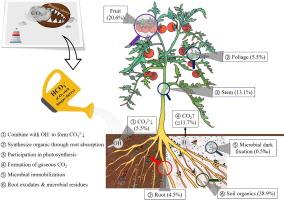
The CO2-rich biogas slurry was verified as a potential CO2 carrier to increase the rhizospheric HCO3– concentration to 36 mol/m3 without causing a physiological stress. About 88.3 % of HCO3– carried by biogas slurry was successfully fixed by tomato-soil ecosystem, in which 43.8 % of HCO3– was assimilated by tomato roots for the metabolism, 0.5 ‰ of HCO3– was used by microorganisms for substances synthesis of cell structure through dark fixation, and 44.4 % of HCO3– was retained in the soil. The rest of HCO3– (∼11.7 %) might escape into the atmosphere through the reaction with H+. Correspondingly, the carbon fixation of tomato-soil ecosystem increased by 150.1 g-CO2/m2-soil during a tomato growth cycle. As for the global countries that would adopt the strategy proposed in this study to cultivate the tomato, an extra carbon sink of soil with about 1031.1 kt-C per year (i.e., an additional 0.21 tons of carbon per hectare soil) could be obtained.
Conclusion
This would be consistent with the goal of soil carbon sink enhancement launched at COP21. Furthermore, the regions with low GDP per capita may easily achieve a high reduction potential of CO2 emissions from the agricultural land after adopting the irrigation of CO2-rich biogas slurry.
期刊介绍:
Journal of Advanced Research (J. Adv. Res.) is an applied/natural sciences, peer-reviewed journal that focuses on interdisciplinary research. The journal aims to contribute to applied research and knowledge worldwide through the publication of original and high-quality research articles in the fields of Medicine, Pharmaceutical Sciences, Dentistry, Physical Therapy, Veterinary Medicine, and Basic and Biological Sciences.
The following abstracting and indexing services cover the Journal of Advanced Research: PubMed/Medline, Essential Science Indicators, Web of Science, Scopus, PubMed Central, PubMed, Science Citation Index Expanded, Directory of Open Access Journals (DOAJ), and INSPEC.



 京公网安备 11010802042870号
京ICP备2023020795号-1
京公网安备 11010802042870号
京ICP备2023020795号-1

 分享
分享
 求助内容:
求助内容: 应助结果提醒方式:
 扫码关注我们
