Using natriuretic peptides to screen for, identify and treat stage B heart failure in people with type 2 diabetes: An initial cost-effectiveness analysis
William B. Horton MD, Marina E. Dart BS, Varun S. Kavuru MD, Mark R. Girton MD, Ruyun Jin MD
{"title":"Using natriuretic peptides to screen for, identify and treat stage B heart failure in people with type 2 diabetes: An initial cost-effectiveness analysis","authors":"William B. Horton MD, Marina E. Dart BS, Varun S. Kavuru MD, Mark R. Girton MD, Ruyun Jin MD","doi":"10.1111/dom.15873","DOIUrl":null,"url":null,"abstract":"<p>The prevalence of heart failure (HF) in people with diabetes ranges from approximately 9% to 22%, which is four times higher than that for the general population.<span><sup>1</sup></span> People with type 2 diabetes are also at heightened risk for incident clinical (i.e. Stages C and D) HF compared to those without diabetes.<span><sup>1</sup></span> Recent consensus reports from the American Diabetes Association and Diabetes Technology Society proposed a natriuretic peptide (NP)-based screening strategy of all people with type 2 diabetes that included specific treatment recommendations aimed at reducing progression from preclinical to clinical HF.<span><sup>1, 2</sup></span> Yet one key limitation of these proposals was a lack of cost-effectiveness data. In the current study, we investigate the cost-effectiveness of using NPs to identify and proactively treat people with type 2 diabetes and stage B HF on a population level within the United States.</p><p>The approach to screening and management was taken directly from recommendations in the aforementioned reports<span><sup>1, 2</sup></span> and key aspects of our analyses were informed by data from randomized clinical trials<span><sup>3, 4</sup></span> and large epidemiological studies.<span><sup>5-14</sup></span> A closed Markov state-transition model (Figure S1) was created and then analysed by Monte Carlo simulation with 10 000 trials. We conducted simulations to assess cost-effectiveness over five, seven, 10, 15 and 20 annual cycles in the United States based on the median life expectancy of those with incident clinical HF<span><sup>15</sup></span> and/or those with incident type 2 diabetes.<span><sup>16</sup></span> A probabilistic sensitivity analysis with 100 samples was also conducted to evaluate the cost-effectiveness acceptability curve. Laboratory, imaging and medication costs were calculated using publicly available Medicare fee schedules and reimbursement rates.<span><sup>17-19</sup></span> All model inputs are listed in Table S1 and a State Transition Diagram is displayed in Figure S2. All costs were from a healthcare sector perspective and reported in June 2022 US dollars (USD). We note that the primary intervention modelled was initiating sodium-glucose co-transporter-2 inhibitor (SGLT2i) therapy once a patient reached Stage B HF and that optimal implementation was the driving strategy (i.e. every patient received medication once they reached Stage B HF). We also assumed that SGLT2is were added onto pre-existing treatment. The primary outcome was the incremental cost-effectiveness ratio (ICER) in terms of net cost per quality-adjusted life year (QALY) gained. QALYs and costs were discounted at 3.5% annually.<span><sup>20</sup></span> We followed recommendations from the Consolidated Health Economic Evaluation Reporting Standards (CHEERS) statement to develop and report this cost-effectiveness study (see Figure S3 for the completed checklist) and followed recommendations on model transparency and validity using the framework suggested by the International Society for Pharmacoeconomics and Outcomes Research and the Society for Medical Decision Making's Good Research practices Model Validation Guidelines (ISPOR-SMDM).<span><sup>21</sup></span> As suggested, we provided a non-technical description of our Markov model and reported the five components of validity in Figure S4. All analyses were performed with TreeAge Pro Version 2024 R1.1 (TreeAge Software, LLC; Williamstown, MA).</p><p>The respective ICER values for five, seven, 10, 15 and 20 annual cycles are presented in Table 1. After 5 years, the ICER value was USD 67 832 per QALY gained, which falls within the definition of an intervention providing intermediate value according to the American Heart Association/American College of Cardiology.<span><sup>22</sup></span> However, the ICER value subsequently improved over longer durations and crossed the high value threshold (i.e. ICER < $50 000 per QALY gained) after seven annual cycles (Table 1). The ICER value for NP screening was $19 513 per QALY gained after 20 annual cycles (Table 1) and the corresponding cost-effectiveness acceptability curve is displayed in Figure 1.</p><p>Our cost-effectiveness modelling showed that a population-level HF screening and treatment strategy among people with type 2 diabetes in the United States provided high value<span><sup>22</sup></span> when conducted for at least 7 years with Medicare pricing. Our analysis has some important limitations, so we view this Research Letter as an initial step in the process of evaluating the potential cost-effectiveness of the recommended screening strategy. Focused research to address some of the data gaps noted below will greatly enhance this field and help identify the ideal screening strategy that could be incorporated into clinical practice guidelines.</p><p>As noted, our study has several key limitations that warrant discussion. First, our analyses focused solely on modelling the initiation of SGLT2i therapy and did not model additive therapy with finerenone, a selective and non-steroidal mineralocorticoid receptor antagonist that has been shown to reduce incident HF in patients with both type 2 diabetes and chronic kidney disease.<span><sup>23</sup></span> It is currently unknown whether pairing finerenone with SGLT2i medications provides additive HF benefit, thus there is a need for future studies to answer this question and subsequently inform cost-effectiveness modelling. A second limitation is that echocardiography of Stage B HF patients will almost certainly reveal some who are in Stage B4 and would warrant referral to Cardiology for goal-directed medical therapy.<span><sup>2</sup></span> To the best of our knowledge, there are no data describing how many patients would fall into this category and thus we could not incorporate this specific scenario into our model. Third, we used Medicare pricing for the recommended medications and imaging studies and acknowledge that this represents a probable ‘best-case’ scenario. Fourth, to the best of our knowledge, there are no available data detailing specific rates of developing either HF with preserved or reduced ejection fraction after NP screening in the type 2 diabetes population, thus we incorporated rates from the general population. While we expect that rates would be fairly similar between the two populations, the downstream costs associated with management of each phenotype differ and could therefore alter the results of our study. We also note that the investigation used to quantify the transition rate from Stage A to Stage B HF<span><sup>10</sup></span> was conducted in a community cohort that included people with type 2 diabetes, but was not exclusive to this population. These limitations emphasize a key point from our study: our model is admittedly naïve and required incorporation of probabilities from different studies. There is an urgent need for research quantifying the identified HF phenotypes after screening and quantifying rates of transition from Stage A to Stage B HF specifically in people with type 2 diabetes. Such data would markedly enhance cost-effectiveness analyses in this field.</p><p>In summary, our cost-effectiveness modelling showed that a population-level HF screening and treatment strategy of all people with type 2 diabetes in the United States achieved a high value threshold after 7 years. Further research is now needed to fill in the key data gaps that will help determine whether population-level screening and management or whether targeted screening (e.g. WATCH-DM Score followed by NP testing<span><sup>24</sup></span>) that can identify and treat individuals at high-risk for incident HF who are probable to derive maximum benefit from SGLT2i therapy is preferred from a cost-effectiveness standpoint.</p><p>WBH, MED, VSK and MRG researched data and contributed to discussion. RJ conducted the modelling and statistical analyses. WBH wrote the first draft of the manuscript. All authors reviewed/edited the manuscript and approved the final version of the manuscript. RJ is the guarantor of the manuscript.</p><p>The authors have no potential conflicts of interest to disclose. In the interest of full disclosure, WBH reports that he was a member of the consensus panel for one of the referenced consensus reports.<span><sup>1</sup></span></p>","PeriodicalId":158,"journal":{"name":"Diabetes, Obesity & Metabolism","volume":"26 11","pages":"5470-5473"},"PeriodicalIF":5.7000,"publicationDate":"2024-08-19","publicationTypes":"Journal Article","fieldsOfStudy":null,"isOpenAccess":false,"openAccessPdf":"https://onlinelibrary.wiley.com/doi/epdf/10.1111/dom.15873","citationCount":"0","resultStr":null,"platform":"Semanticscholar","paperid":null,"PeriodicalName":"Diabetes, Obesity & Metabolism","FirstCategoryId":"3","ListUrlMain":"https://dom-pubs.onlinelibrary.wiley.com/doi/10.1111/dom.15873","RegionNum":2,"RegionCategory":"医学","ArticlePicture":[],"TitleCN":null,"AbstractTextCN":null,"PMCID":null,"EPubDate":"","PubModel":"","JCR":"Q1","JCRName":"ENDOCRINOLOGY & METABOLISM","Score":null,"Total":0}
引用次数: 0
Abstract
The prevalence of heart failure (HF) in people with diabetes ranges from approximately 9% to 22%, which is four times higher than that for the general population.1 People with type 2 diabetes are also at heightened risk for incident clinical (i.e. Stages C and D) HF compared to those without diabetes.1 Recent consensus reports from the American Diabetes Association and Diabetes Technology Society proposed a natriuretic peptide (NP)-based screening strategy of all people with type 2 diabetes that included specific treatment recommendations aimed at reducing progression from preclinical to clinical HF.1, 2 Yet one key limitation of these proposals was a lack of cost-effectiveness data. In the current study, we investigate the cost-effectiveness of using NPs to identify and proactively treat people with type 2 diabetes and stage B HF on a population level within the United States.
The approach to screening and management was taken directly from recommendations in the aforementioned reports1, 2 and key aspects of our analyses were informed by data from randomized clinical trials3, 4 and large epidemiological studies.5-14 A closed Markov state-transition model (Figure S1) was created and then analysed by Monte Carlo simulation with 10 000 trials. We conducted simulations to assess cost-effectiveness over five, seven, 10, 15 and 20 annual cycles in the United States based on the median life expectancy of those with incident clinical HF15 and/or those with incident type 2 diabetes.16 A probabilistic sensitivity analysis with 100 samples was also conducted to evaluate the cost-effectiveness acceptability curve. Laboratory, imaging and medication costs were calculated using publicly available Medicare fee schedules and reimbursement rates.17-19 All model inputs are listed in Table S1 and a State Transition Diagram is displayed in Figure S2. All costs were from a healthcare sector perspective and reported in June 2022 US dollars (USD). We note that the primary intervention modelled was initiating sodium-glucose co-transporter-2 inhibitor (SGLT2i) therapy once a patient reached Stage B HF and that optimal implementation was the driving strategy (i.e. every patient received medication once they reached Stage B HF). We also assumed that SGLT2is were added onto pre-existing treatment. The primary outcome was the incremental cost-effectiveness ratio (ICER) in terms of net cost per quality-adjusted life year (QALY) gained. QALYs and costs were discounted at 3.5% annually.20 We followed recommendations from the Consolidated Health Economic Evaluation Reporting Standards (CHEERS) statement to develop and report this cost-effectiveness study (see Figure S3 for the completed checklist) and followed recommendations on model transparency and validity using the framework suggested by the International Society for Pharmacoeconomics and Outcomes Research and the Society for Medical Decision Making's Good Research practices Model Validation Guidelines (ISPOR-SMDM).21 As suggested, we provided a non-technical description of our Markov model and reported the five components of validity in Figure S4. All analyses were performed with TreeAge Pro Version 2024 R1.1 (TreeAge Software, LLC; Williamstown, MA).
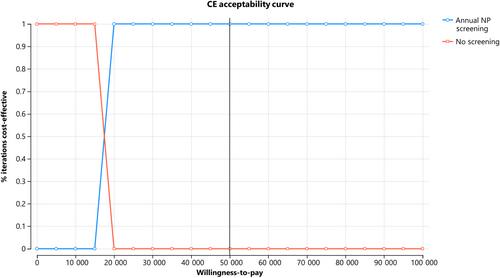
The respective ICER values for five, seven, 10, 15 and 20 annual cycles are presented in Table 1. After 5 years, the ICER value was USD 67 832 per QALY gained, which falls within the definition of an intervention providing intermediate value according to the American Heart Association/American College of Cardiology.22 However, the ICER value subsequently improved over longer durations and crossed the high value threshold (i.e. ICER < $50 000 per QALY gained) after seven annual cycles (Table 1). The ICER value for NP screening was $19 513 per QALY gained after 20 annual cycles (Table 1) and the corresponding cost-effectiveness acceptability curve is displayed in Figure 1.
Our cost-effectiveness modelling showed that a population-level HF screening and treatment strategy among people with type 2 diabetes in the United States provided high value22 when conducted for at least 7 years with Medicare pricing. Our analysis has some important limitations, so we view this Research Letter as an initial step in the process of evaluating the potential cost-effectiveness of the recommended screening strategy. Focused research to address some of the data gaps noted below will greatly enhance this field and help identify the ideal screening strategy that could be incorporated into clinical practice guidelines.
As noted, our study has several key limitations that warrant discussion. First, our analyses focused solely on modelling the initiation of SGLT2i therapy and did not model additive therapy with finerenone, a selective and non-steroidal mineralocorticoid receptor antagonist that has been shown to reduce incident HF in patients with both type 2 diabetes and chronic kidney disease.23 It is currently unknown whether pairing finerenone with SGLT2i medications provides additive HF benefit, thus there is a need for future studies to answer this question and subsequently inform cost-effectiveness modelling. A second limitation is that echocardiography of Stage B HF patients will almost certainly reveal some who are in Stage B4 and would warrant referral to Cardiology for goal-directed medical therapy.2 To the best of our knowledge, there are no data describing how many patients would fall into this category and thus we could not incorporate this specific scenario into our model. Third, we used Medicare pricing for the recommended medications and imaging studies and acknowledge that this represents a probable ‘best-case’ scenario. Fourth, to the best of our knowledge, there are no available data detailing specific rates of developing either HF with preserved or reduced ejection fraction after NP screening in the type 2 diabetes population, thus we incorporated rates from the general population. While we expect that rates would be fairly similar between the two populations, the downstream costs associated with management of each phenotype differ and could therefore alter the results of our study. We also note that the investigation used to quantify the transition rate from Stage A to Stage B HF10 was conducted in a community cohort that included people with type 2 diabetes, but was not exclusive to this population. These limitations emphasize a key point from our study: our model is admittedly naïve and required incorporation of probabilities from different studies. There is an urgent need for research quantifying the identified HF phenotypes after screening and quantifying rates of transition from Stage A to Stage B HF specifically in people with type 2 diabetes. Such data would markedly enhance cost-effectiveness analyses in this field.
In summary, our cost-effectiveness modelling showed that a population-level HF screening and treatment strategy of all people with type 2 diabetes in the United States achieved a high value threshold after 7 years. Further research is now needed to fill in the key data gaps that will help determine whether population-level screening and management or whether targeted screening (e.g. WATCH-DM Score followed by NP testing24) that can identify and treat individuals at high-risk for incident HF who are probable to derive maximum benefit from SGLT2i therapy is preferred from a cost-effectiveness standpoint.
WBH, MED, VSK and MRG researched data and contributed to discussion. RJ conducted the modelling and statistical analyses. WBH wrote the first draft of the manuscript. All authors reviewed/edited the manuscript and approved the final version of the manuscript. RJ is the guarantor of the manuscript.
The authors have no potential conflicts of interest to disclose. In the interest of full disclosure, WBH reports that he was a member of the consensus panel for one of the referenced consensus reports.1
期刊介绍:
Diabetes, Obesity and Metabolism is primarily a journal of clinical and experimental pharmacology and therapeutics covering the interrelated areas of diabetes, obesity and metabolism. The journal prioritises high-quality original research that reports on the effects of new or existing therapies, including dietary, exercise and lifestyle (non-pharmacological) interventions, in any aspect of metabolic and endocrine disease, either in humans or animal and cellular systems. ‘Metabolism’ may relate to lipids, bone and drug metabolism, or broader aspects of endocrine dysfunction. Preclinical pharmacology, pharmacokinetic studies, meta-analyses and those addressing drug safety and tolerability are also highly suitable for publication in this journal. Original research may be published as a main paper or as a research letter.





 京公网安备 11010802042870号
京ICP备2023020795号-1
京公网安备 11010802042870号
京ICP备2023020795号-1

 分享
分享
 求助内容:
求助内容: 应助结果提醒方式:
 扫码关注我们
