{"title":"Percutaneous endobiliary radiofrequency ablation and stent placement for unresectable malignant biliary obstruction: a propensity score matching retrospective study.","authors":"Wei Cui, Jing-Zhi Huang, Qi Wang, Feng Shi, Qing Gou, Xiao-Ming Chen, Jing Zhang, Jia-Ping Li, Rongde Xu","doi":"10.1186/s12876-024-03357-x","DOIUrl":null,"url":null,"abstract":"<p><strong>Background: </strong>Whether endobiliary radiofrequency ablation (EB-RFA) changes the standard role of stent placement in treating unresectable malignant biliary obstruction (MBO) remains unclear. The aim of this study is to compare percutaneous EB-RFA and metal stent placement (RFA-Stent) with metal stent placement alone (Stent) in treating unresectable MBO using a propensity score matching (PSM) analysis.</p><p><strong>Methods: </strong>From June 2013 to June 2018, clinical data from 163 patients with malignant biliary obstruction who underwent percutaneous RFA-Stent or stenting alone were retrospectively analyzed using a nearest-neighbor algorithm to one-to-one PSM analysis to compare primary and secondary stent patency (PSP, SSP), overall survival (OS) and complications between the two groups.</p><p><strong>Results: </strong>Before matching, for whole patients, RFA-Stent resulted in longer median PSP (8.0 vs. 5.1 months, P = 0.003), SSP (9.8 vs. 5.1 months, P < 0.001) and OS (7.0 vs. 4.5 months, P = 0.034) than the Stent group. After matching (54 pairs), RFA-Stent also resulted in better median PSP (8.5 vs. 5.1 months, P < 0.001), SSP (11.0 vs. 6.0 months, P < 0.001), and OS (8.0 vs. 4.0 months, P = 0.007) than Stent. RFA-Stent was comparable with Stent for complication rates. In Cox analysis, RFA-Stent modality and serum total bilirubin level were independent prognostic factors for PSP. RFA-Stent modality, performance status score and combination therapy after stent were independent prognostic factors for OS.</p><p><strong>Conclusion: </strong>Percutaneous RFA-Stent was superior to Stent in terms of PSP, SSP, and OS in selected patients with unresectable MBO.</p>","PeriodicalId":9129,"journal":{"name":"BMC Gastroenterology","volume":"24 1","pages":"270"},"PeriodicalIF":2.5000,"publicationDate":"2024-08-19","publicationTypes":"Journal Article","fieldsOfStudy":null,"isOpenAccess":false,"openAccessPdf":"https://www.ncbi.nlm.nih.gov/pmc/articles/PMC11331891/pdf/","citationCount":"0","resultStr":null,"platform":"Semanticscholar","paperid":null,"PeriodicalName":"BMC Gastroenterology","FirstCategoryId":"3","ListUrlMain":"https://doi.org/10.1186/s12876-024-03357-x","RegionNum":3,"RegionCategory":"医学","ArticlePicture":[],"TitleCN":null,"AbstractTextCN":null,"PMCID":null,"EPubDate":"","PubModel":"","JCR":"Q2","JCRName":"GASTROENTEROLOGY & HEPATOLOGY","Score":null,"Total":0}
引用次数: 0
Abstract
Background: Whether endobiliary radiofrequency ablation (EB-RFA) changes the standard role of stent placement in treating unresectable malignant biliary obstruction (MBO) remains unclear. The aim of this study is to compare percutaneous EB-RFA and metal stent placement (RFA-Stent) with metal stent placement alone (Stent) in treating unresectable MBO using a propensity score matching (PSM) analysis.
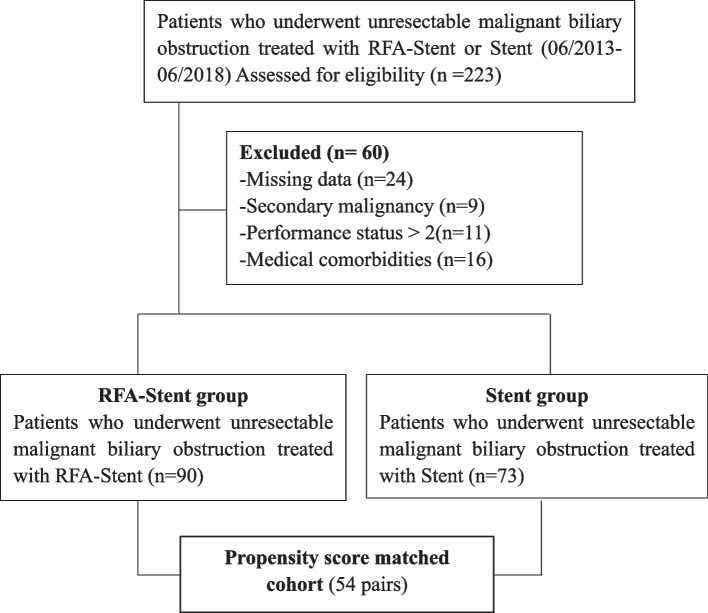
Methods: From June 2013 to June 2018, clinical data from 163 patients with malignant biliary obstruction who underwent percutaneous RFA-Stent or stenting alone were retrospectively analyzed using a nearest-neighbor algorithm to one-to-one PSM analysis to compare primary and secondary stent patency (PSP, SSP), overall survival (OS) and complications between the two groups.
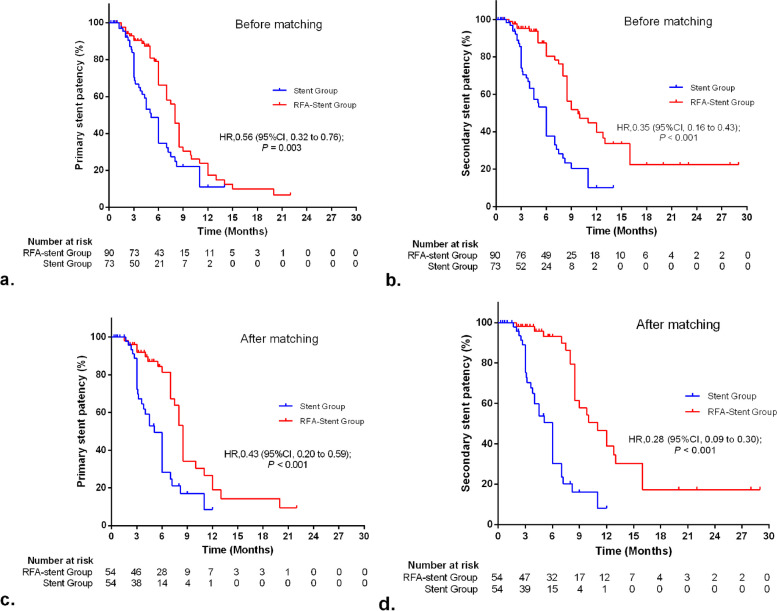
Results: Before matching, for whole patients, RFA-Stent resulted in longer median PSP (8.0 vs. 5.1 months, P = 0.003), SSP (9.8 vs. 5.1 months, P < 0.001) and OS (7.0 vs. 4.5 months, P = 0.034) than the Stent group. After matching (54 pairs), RFA-Stent also resulted in better median PSP (8.5 vs. 5.1 months, P < 0.001), SSP (11.0 vs. 6.0 months, P < 0.001), and OS (8.0 vs. 4.0 months, P = 0.007) than Stent. RFA-Stent was comparable with Stent for complication rates. In Cox analysis, RFA-Stent modality and serum total bilirubin level were independent prognostic factors for PSP. RFA-Stent modality, performance status score and combination therapy after stent were independent prognostic factors for OS.
Conclusion: Percutaneous RFA-Stent was superior to Stent in terms of PSP, SSP, and OS in selected patients with unresectable MBO.
期刊介绍:
BMC Gastroenterology is an open access, peer-reviewed journal that considers articles on all aspects of the prevention, diagnosis and management of gastrointestinal and hepatobiliary disorders, as well as related molecular genetics, pathophysiology, and epidemiology.



 京公网安备 11010802042870号
京ICP备2023020795号-1
京公网安备 11010802042870号
京ICP备2023020795号-1

 分享
分享
 求助内容:
求助内容: 应助结果提醒方式:
 扫码关注我们
