Yanqiu Long, Fang Lei, Jie Hu, Zhiyun Zheng, Shuangying Gui, Ning He
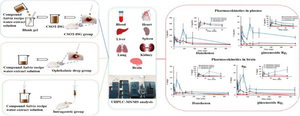
{"title":"Design and Evaluation of Ophthalmic Thermosensitive In Situ Gel of Compound Salvia","authors":"Yanqiu Long, Fang Lei, Jie Hu, Zhiyun Zheng, Shuangying Gui, Ning He","doi":"10.1208/s12249-024-02913-8","DOIUrl":null,"url":null,"abstract":"<div><p>The compound <i>Salvia</i> Recipe has been shown to have a relatively significant curative effect in management of cardiovascular and cerebrovascular diseases. This work aimed to prepare a thermosensitive <i>in situ</i> gel (ISG) delivery system that utilizes Poloxamer 407, Poloxamer 188, and hydroxypropyl methylcellulose for ocular administration of the compound <i>Salvia</i> recipe to treat cardiovascular and cerebrovascular diseases. The central composite design-response surface method was utilized to improve the prescription of the gel. The formulated gel was characterized and assessed in terms of stability, retention time, <i>in vitro</i> release, rheology, ocular irritation, pharmacokinetics studies, and tissue distribution. The gel was a liquid solution at room temperature and became semisolid at physiological temperature, prolonging its stay time in the eye. Pharmacokinetics and tissue distribution experiments indicated that thermosensitive ISG had enhanced targeting of heart and brain tissues. Additionally, it could lower drug toxicity and side effects in the lungs and kidneys. The compound <i>Salvia</i> ophthalmic thermosensitive ISG is a promising drug delivery system for the management of cardiovascular and cerebrovascular illnesses.</p><h3>Graphical Abstract</h3>\n<div><figure><div><div><picture><source><img></source></picture></div></div></figure></div></div>","PeriodicalId":6925,"journal":{"name":"AAPS PharmSciTech","volume":"25 7","pages":""},"PeriodicalIF":4.0000,"publicationDate":"2024-08-20","publicationTypes":"Journal Article","fieldsOfStudy":null,"isOpenAccess":false,"openAccessPdf":"","citationCount":"0","resultStr":null,"platform":"Semanticscholar","paperid":null,"PeriodicalName":"AAPS PharmSciTech","FirstCategoryId":"3","ListUrlMain":"https://link.springer.com/article/10.1208/s12249-024-02913-8","RegionNum":4,"RegionCategory":"医学","ArticlePicture":[],"TitleCN":null,"AbstractTextCN":null,"PMCID":null,"EPubDate":"","PubModel":"","JCR":"Q2","JCRName":"PHARMACOLOGY & PHARMACY","Score":null,"Total":0}
引用次数: 0
Abstract
The compound Salvia Recipe has been shown to have a relatively significant curative effect in management of cardiovascular and cerebrovascular diseases. This work aimed to prepare a thermosensitive in situ gel (ISG) delivery system that utilizes Poloxamer 407, Poloxamer 188, and hydroxypropyl methylcellulose for ocular administration of the compound Salvia recipe to treat cardiovascular and cerebrovascular diseases. The central composite design-response surface method was utilized to improve the prescription of the gel. The formulated gel was characterized and assessed in terms of stability, retention time, in vitro release, rheology, ocular irritation, pharmacokinetics studies, and tissue distribution. The gel was a liquid solution at room temperature and became semisolid at physiological temperature, prolonging its stay time in the eye. Pharmacokinetics and tissue distribution experiments indicated that thermosensitive ISG had enhanced targeting of heart and brain tissues. Additionally, it could lower drug toxicity and side effects in the lungs and kidneys. The compound Salvia ophthalmic thermosensitive ISG is a promising drug delivery system for the management of cardiovascular and cerebrovascular illnesses.
期刊介绍:
AAPS PharmSciTech is a peer-reviewed, online-only journal committed to serving those pharmaceutical scientists and engineers interested in the research, development, and evaluation of pharmaceutical dosage forms and delivery systems, including drugs derived from biotechnology and the manufacturing science pertaining to the commercialization of such dosage forms. Because of its electronic nature, AAPS PharmSciTech aspires to utilize evolving electronic technology to enable faster and diverse mechanisms of information delivery to its readership. Submission of uninvited expert reviews and research articles are welcomed.




 京公网安备 11010802042870号
京ICP备2023020795号-1
京公网安备 11010802042870号
京ICP备2023020795号-1

 分享
分享
 求助内容:
求助内容: 应助结果提醒方式:
 扫码关注我们
