Prompt engineering with a large language model to assist providers in responding to patient inquiries: a real-time implementation in the electronic health record.
Majid Afshar, Yanjun Gao, Graham Wills, Jason Wang, Matthew M Churpek, Christa J Westenberger, David T Kunstman, Joel E Gordon, Cherodeep Goswami, Frank J Liao, Brian Patterson
{"title":"Prompt engineering with a large language model to assist providers in responding to patient inquiries: a real-time implementation in the electronic health record.","authors":"Majid Afshar, Yanjun Gao, Graham Wills, Jason Wang, Matthew M Churpek, Christa J Westenberger, David T Kunstman, Joel E Gordon, Cherodeep Goswami, Frank J Liao, Brian Patterson","doi":"10.1093/jamiaopen/ooae080","DOIUrl":null,"url":null,"abstract":"<p><strong>Background: </strong>Large language models (LLMs) can assist providers in drafting responses to patient inquiries. We examined a prompt engineering strategy to draft responses for providers in the electronic health record. The aim was to evaluate the change in usability after prompt engineering.</p><p><strong>Materials and methods: </strong>A pre-post study over 8 months was conducted across 27 providers. The primary outcome was the provider use of LLM-generated messages from Generative Pre-Trained Transformer 4 (GPT-4) in a mixed-effects model, and the secondary outcome was provider sentiment analysis.</p><p><strong>Results: </strong>Of the 7605 messages generated, 17.5% (<i>n</i> = 1327) were used. There was a reduction in negative sentiment with an odds ratio of 0.43 (95% CI, 0.36-0.52), but message use decreased (<i>P</i> < .01). The addition of nurses after the study period led to an increase in message use to 35.8% (<i>P</i> < .01).</p><p><strong>Discussion: </strong>The improvement in sentiment with prompt engineering suggests better content quality, but the initial decrease in usage highlights the need for integration with human factors design.</p><p><strong>Conclusion: </strong>Future studies should explore strategies for optimizing the integration of LLMs into the provider workflow to maximize both usability and effectiveness.</p>","PeriodicalId":36278,"journal":{"name":"JAMIA Open","volume":"7 3","pages":"ooae080"},"PeriodicalIF":3.4000,"publicationDate":"2024-08-20","publicationTypes":"Journal Article","fieldsOfStudy":null,"isOpenAccess":false,"openAccessPdf":"https://www.ncbi.nlm.nih.gov/pmc/articles/PMC11335368/pdf/","citationCount":"0","resultStr":null,"platform":"Semanticscholar","paperid":null,"PeriodicalName":"JAMIA Open","FirstCategoryId":"1085","ListUrlMain":"https://doi.org/10.1093/jamiaopen/ooae080","RegionNum":0,"RegionCategory":null,"ArticlePicture":[],"TitleCN":null,"AbstractTextCN":null,"PMCID":null,"EPubDate":"2024/10/1 0:00:00","PubModel":"eCollection","JCR":"Q2","JCRName":"HEALTH CARE SCIENCES & SERVICES","Score":null,"Total":0}
引用次数: 0
Abstract
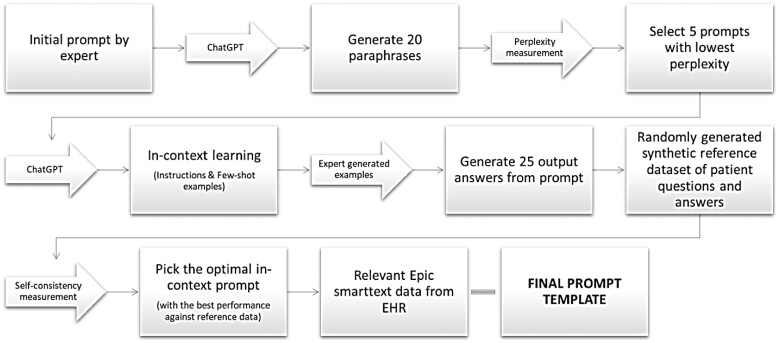
Background: Large language models (LLMs) can assist providers in drafting responses to patient inquiries. We examined a prompt engineering strategy to draft responses for providers in the electronic health record. The aim was to evaluate the change in usability after prompt engineering.
Materials and methods: A pre-post study over 8 months was conducted across 27 providers. The primary outcome was the provider use of LLM-generated messages from Generative Pre-Trained Transformer 4 (GPT-4) in a mixed-effects model, and the secondary outcome was provider sentiment analysis.
Results: Of the 7605 messages generated, 17.5% (n = 1327) were used. There was a reduction in negative sentiment with an odds ratio of 0.43 (95% CI, 0.36-0.52), but message use decreased (P < .01). The addition of nurses after the study period led to an increase in message use to 35.8% (P < .01).
Discussion: The improvement in sentiment with prompt engineering suggests better content quality, but the initial decrease in usage highlights the need for integration with human factors design.
Conclusion: Future studies should explore strategies for optimizing the integration of LLMs into the provider workflow to maximize both usability and effectiveness.






 京公网安备 11010802042870号
京ICP备2023020795号-1
京公网安备 11010802042870号
京ICP备2023020795号-1

 分享
分享
 求助内容:
求助内容: 应助结果提醒方式:
 扫码关注我们
