Gianni Dall'Ara , Sara Piciucchi , Carolina Moretti , Caterina Cavazza , Miriam Compagnone , Giuseppe Guerrieri , Simone Grotti , Daniela Spartà , Roberto Carletti , Elisabetta Fabbri , Emanuela Giampalma , Andrea Santarelli , Filippo Ottani , Marco Balducelli , Francesco Saia , Fabio Felice Tarantino , Marcello Galvani
{"title":"Aortic balloon valvuloplasty outcome according to calcium distribution and valve geometry – The ABCD study","authors":"Gianni Dall'Ara , Sara Piciucchi , Carolina Moretti , Caterina Cavazza , Miriam Compagnone , Giuseppe Guerrieri , Simone Grotti , Daniela Spartà , Roberto Carletti , Elisabetta Fabbri , Emanuela Giampalma , Andrea Santarelli , Filippo Ottani , Marco Balducelli , Francesco Saia , Fabio Felice Tarantino , Marcello Galvani","doi":"10.1016/j.carrev.2024.08.004","DOIUrl":null,"url":null,"abstract":"<div><h3>Background</h3><div>There is little data on the outcome of balloon aortic valvuloplasty (BAV) in relation to valve dimensions and calcification patterns. The procedure is not standardized, particularly the choice of balloon size.</div></div><div><h3>Methods</h3><div>This retrospective multicenter study focused on BAV efficacy and safety by analyzing the relationship between balloon size, annulus geometry (i.e., diameters, perimeter, and area), and calcification patterns (total burden and calcium distribution over each individual leaflet). From March 2018 to March 2023, all consecutive patients who underwent clinically indicated BAV and ECG-gated multidetector computed tomography of the aorta were included, except those with a bicuspid valve. Calcium score was calculated on contrast-enhanced images based on a luminal attenuation threshold of +100 HU.</div></div><div><h3>Results</h3><div>One hundred and fifteen patients were included. Procedural success was 82.6 %. The balloon-to-annulus ratio (BAR) relative to diameter, perimeter, and area was higher in patients with successful BAV. Patients with unsuccessful BAV had a significantly higher aortic valve calcium burden. The complication rate was 4.3 % and there was no association with valve geometry or calcium burden. A trend towards a reduced complication rate was found as calcium asymmetry increased. BAR minimum annulus diameter was the best parameter in predicting procedural success, with a cut-off at 0.85.</div></div><div><h3>Conclusions</h3><div>BAV efficacy is correlated directly with balloon size in relation to annulus dimension and inversely with total calcium burden. The minimum diameter of the valve may be adopted as a reference for balloon sizing.</div></div>","PeriodicalId":47657,"journal":{"name":"Cardiovascular Revascularization Medicine","volume":"74 ","pages":"Pages 21-27"},"PeriodicalIF":1.9000,"publicationDate":"2025-05-01","publicationTypes":"Journal Article","fieldsOfStudy":null,"isOpenAccess":false,"openAccessPdf":"","citationCount":"0","resultStr":null,"platform":"Semanticscholar","paperid":null,"PeriodicalName":"Cardiovascular Revascularization Medicine","FirstCategoryId":"1085","ListUrlMain":"https://www.sciencedirect.com/science/article/pii/S1553838924006274","RegionNum":0,"RegionCategory":null,"ArticlePicture":[],"TitleCN":null,"AbstractTextCN":null,"PMCID":null,"EPubDate":"2024/8/16 0:00:00","PubModel":"Epub","JCR":"Q3","JCRName":"CARDIAC & CARDIOVASCULAR SYSTEMS","Score":null,"Total":0}
引用次数: 0
Abstract
Background
There is little data on the outcome of balloon aortic valvuloplasty (BAV) in relation to valve dimensions and calcification patterns. The procedure is not standardized, particularly the choice of balloon size.
Methods
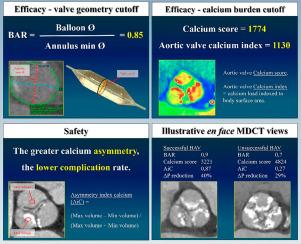
This retrospective multicenter study focused on BAV efficacy and safety by analyzing the relationship between balloon size, annulus geometry (i.e., diameters, perimeter, and area), and calcification patterns (total burden and calcium distribution over each individual leaflet). From March 2018 to March 2023, all consecutive patients who underwent clinically indicated BAV and ECG-gated multidetector computed tomography of the aorta were included, except those with a bicuspid valve. Calcium score was calculated on contrast-enhanced images based on a luminal attenuation threshold of +100 HU.
Results
One hundred and fifteen patients were included. Procedural success was 82.6 %. The balloon-to-annulus ratio (BAR) relative to diameter, perimeter, and area was higher in patients with successful BAV. Patients with unsuccessful BAV had a significantly higher aortic valve calcium burden. The complication rate was 4.3 % and there was no association with valve geometry or calcium burden. A trend towards a reduced complication rate was found as calcium asymmetry increased. BAR minimum annulus diameter was the best parameter in predicting procedural success, with a cut-off at 0.85.
Conclusions
BAV efficacy is correlated directly with balloon size in relation to annulus dimension and inversely with total calcium burden. The minimum diameter of the valve may be adopted as a reference for balloon sizing.
期刊介绍:
Cardiovascular Revascularization Medicine (CRM) is an international and multidisciplinary journal that publishes original laboratory and clinical investigations related to revascularization therapies in cardiovascular medicine. Cardiovascular Revascularization Medicine publishes articles related to preclinical work and molecular interventions, including angiogenesis, cell therapy, pharmacological interventions, restenosis management, and prevention, including experiments conducted in human subjects, in laboratory animals, and in vitro. Specific areas of interest include percutaneous angioplasty in coronary and peripheral arteries, intervention in structural heart disease, cardiovascular surgery, etc.



 京公网安备 11010802042870号
京ICP备2023020795号-1
京公网安备 11010802042870号
京ICP备2023020795号-1

 分享
分享
 求助内容:
求助内容: 应助结果提醒方式:
 扫码关注我们
