Use of real-time continuous glucose monitoring in non-critical care insulin-treated inpatients under non-diabetes speciality teams in hospital: A pilot randomized controlled study
Hood Thabit PhD, Jose Rubio RN, Mini Karuppan RN, Womba Mubita RN, Jonathan Lim PhD, Teffy Thomas RN, Ines Fonseca MPharm, Catherine Fullwood PhD, Lalantha Leelarathna PhD, Jonathan Schofield PhD
{"title":"Use of real-time continuous glucose monitoring in non-critical care insulin-treated inpatients under non-diabetes speciality teams in hospital: A pilot randomized controlled study","authors":"Hood Thabit PhD, Jose Rubio RN, Mini Karuppan RN, Womba Mubita RN, Jonathan Lim PhD, Teffy Thomas RN, Ines Fonseca MPharm, Catherine Fullwood PhD, Lalantha Leelarathna PhD, Jonathan Schofield PhD","doi":"10.1111/dom.15885","DOIUrl":null,"url":null,"abstract":"<p>Inpatient hyperglycaemia is widely recognized as a poor prognostic marker in terms of morbidity and mortality, increased length of stay and cost to the health care system.<span><sup>1, 2</sup></span> Inpatients who experience hypoglycaemia have a higher risk of mortality and an increased length of stay in the hospital.<span><sup>3</sup></span> Despite currently available guidelines,<span><sup>4, 5</sup></span> management of glycaemic control in non-critical care inpatients remains suboptimal and varies widely between centres.</p><p>Several factors contribute to the discordance between clinical evidence and practice, potentially undermining glycaemic outcomes. Among these factors is the admission of the majority of people with diabetes under non-diabetes speciality teams or health care professionals lacking expertise in diabetes management.<span><sup>6, 7</sup></span> In addition, current inpatient glucose monitoring strategies are based on bedside capillary blood glucose (CBG), which are inadequate and inherently limited in the detection of dysglycaemia, because of the infrequency of which it is performed in hospital and increased ward staff burden.</p><p>Professional societies recommendations of target glucose levels in non-critical care settings are based upon the clinical needs of the individual, as well as centre-specific characteristics focusing on safety.<span><sup>8, 9</sup></span> However, expert consensus recommends a target range of 5.6–10.0 mmol/L for non-critically ill inpatients with known diabetes before admission,<span><sup>10</sup></span> as levels less than 5.6 mmol/L were found to be predictors of hypoglycaemia within the next 24 h.<span><sup>11</sup></span></p><p>Real-time continuous glucose monitoring (RT-CGM) use in outpatient settings has been shown to improve outpatient glycaemic outcomes in various cohorts.<span><sup>12-14</sup></span> Use of RT-CGM in hospitals may benefit those with unstable glycaemia and support busy ward staff. This pilot study aimed to provide exploratory and preliminary data on whether the use of RT-CGM in the UK NHS inpatient setting may provide an effective method of managing glycaemic control for inpatients under the care of non-diabetes speciality teams.</p><p>Participants were recruited from general wards at Manchester Royal Infirmary, Manchester, UK. Inclusion criteria encompassed individuals aged ≥18 years, diagnosed with type 2 diabetes according to the World Health Organization definition for at least 1 year, and receiving insulin therapy with or without additional glucose-lowering therapy. Exclusion criteria included those treated in intensive care units, expected length of stay <3 days, individuals undergoing dialysis, and pregnant or breastfeeding women. Participants signed informed consent before the start of study-related procedures. The study concluded after 10 days in the hospital or until discharge, whichever occurred first.</p><p>Participants were randomized (1:1 block) using a centralized web-based program<span><sup>15</sup></span> to either intervention or control (Figure 1). Those allocated to the control arm had a blinded Dexcom G7 sensor (glucose values not displayed) inserted for data collection purposes and received standard hospital practice management using CBG monitoring. Participants in the intervention group, using the RT-CGM systems (Dexcom G7; Dexcom Inc.), had their insulin dosage adjustments managed by non-diabetes speciality clinical teams following face-to-face education provided by the specialist diabetes team and educators. General ward staff, who were non-diabetes specialist trained, were briefed and furnished with pragmatic guidelines for making clinical and therapeutic decisions, guided by sensor glucose levels, hypo-/hyperglycaemia alerts and trends. Training and education of up to 45 min in duration on using CGM values for inpatient diabetes management were provided onsite via face-to-face ward sessions by members of the diabetes specialist team. During these sessions, guidance on insulin therapy dose adjustments based on CGM and CBG values was reviewed and discussed. Ward staff were trained to view and use the electronically prescribed insulin dosages in the patients' electronic medical record system. They were encouraged to respond to CGM alerts and review CGM readings regularly. Ward staff were advised to confirm hypo- and hyperglycaemia alerts with a point-of-care glucose meter and respond accordingly; if a patient was confirmed to be hypoglycaemic, they were to be treated as per hospital hypoglycaemia guidelines and if hyperglycaemic, to be provided with supplemental insulin correction doses as electronically prescribed in their electronic medical records. The hypoglycaemia alert was set at 4.0 mmol/L, while the hyperglycaemia alert was at 13.0 mmol/L. In response to feedback from general ward staff to minimize alarm frequency, the ‘High Repeat’ alarm was deactivated, and adjustments to the hyperglycaemia threshold were permitted.</p><p>Participants in both study arms maintained their regular insulin and oral hypoglycaemic therapies. They received extra correction doses of rapid-acting insulin before meals, in addition to their scheduled doses (see Table SA). If participants were fasting or unable to eat, they received supplemental insulin every 6 h based on the ‘sensitive’ dose on the supplemental insulin scale. During the study, participants selected standard ward meals at regular meal times without restrictions on additional meals or snacks. Their usual activities in the general ward were unrestricted.</p><p>In total, 25 participants who were admitted to non-critical care wards were recruited, with one participant being withdrawn because of inpatient duration of stay <3 days. Data from the 24 completed participants [21% women, 63% White, aged 62.1 (9.0) years, glycated haemoglobin 86.0 (21.3) mmol/mol, body mass index 28.5 (3.8) kg/m<sup>2</sup>] were included in the final analysis.</p><p>No significant differences in percentage sensor use, glycated haemoglobin, total daily insulin dose or BMI were found between both groups at baseline (Table SB). The primary endpoint (TIR) was similar for both arms (Table 1, <i>p</i> = 0.604). Time spent in range 3.9–10 mmol/L was also comparable.</p><p>We found no difference in the overall proportions of time in hyperglycaemia >10 mmol/L (<i>p</i> = 0.631) and 16.7 mmol/L (<i>p</i> = 0.583) between the RT-CGM and CBG arms (Figures S1 and S2). Time spent in hypoglycaemia was <3.9 mmol/L, and <3.0 were low and comparable. Total daily insulin and changes in daily insulin doses did not differ between and within groups.</p><p>In this pilot study, we explored the effects of RT-CGM among inpatients managed by non-diabetes speciality teams and observed no significant differences in glycaemic outcomes between RT-CGM and CBG utilization. The role of RT-CGM is well established in type 1 diabetes<span><sup>12, 16</sup></span> and growing evidence shows that RT-CGM use in insulin<span><sup>17, 18</sup></span> and non-insulin-treated<span><sup>19</sup></span> type 2 diabetes in outpatient settings may lead to improvements in glycaemic control and quality of life, thereby potentially broadening the use of RT-CGM application in this population. However, previous randomized controlled studies comparing RT-CGM with CBG among hospitalized diabetes patients have shown mixed outcomes. In a study involving 110 inpatients on insulin therapy, participants were randomized to either RT-CGM or CBG, with a diabetes advanced practice nurse overseeing sensor glucose data and providing daily guidance to ward staff, resulting in standardized insulin dose adjustments to optimize therapy.<span><sup>20</sup></span> No significant differences in TIR (3.9–10.0 mmol/L) and below range were found between groups. Another larger randomized controlled trial comprising 162 inpatients with type 1 or type 2 diabetes had a board-certified endocrinologist offering insulin dose titration recommendations.<span><sup>21</sup></span> Use of RT-CGM compared with CBG exhibited a tendency towards reducing hypoglycaemic events and time spent below the target range, while TIR remained comparable across both groups.</p><p>To our knowledge, no randomized controlled studies have evaluated RT-CGM effectiveness compared with CBG in the NHS general ward settings. In the UK, the majority of inpatients with diabetes are admitted and managed by non-diabetes speciality teams. A recent survey from 17 trusts covering 30 hospital sites showed that on average there are less than two inpatient diabetes team staff members per 100 inpatients with diabetes. In addition, all surveyed trusts reported insufficient diabetes staff compared with the optimal service requirements.<span><sup>22</sup></span> Given this scenario, we adopted a pragmatic approach aligned with the expected clinical capacity and workflow in an NHS general ward. Education regarding diabetes management, insulin dose adjustments and glucose sensor usage was provided by our diabetes educator and inpatient diabetes team. The use of different insulin regimens and continuation of non-insulin therapy aligns with current clinical practice in the UK and thus is applicable across various settings.</p><p>Findings from our pilot study will provide exploratory information and hypotheses for a definitive randomized controlled study in the future. Our preliminary findings suggest that use of RT-CGM without direct stewardship and guidance from diabetes specialist teams does not appear to overcome the well-reported therapeutic inertia, where despite the availability of continuous glucose levels and hyperglycaemia alerts, hyperglycaemia remains prevalent with no significant changes in daily insulin dose adjustments. This suggests that RT-CGM for inpatient diabetes management still requires significant input to overcome this inertia. However, our results should be interpreted with caution, as this was an exploratory pilot study with a small sample size, which was not powered to show superiority or non-inferiority. In contrast, glycaemic outcomes were significantly improved in studies where insulin delivery was automated through fully closed-loop systems,<span><sup>23</sup></span> perhaps highlighting the importance of reducing ward staff workload burden as well if improvement in hospital diabetes management is to be achieved. Limitations of our study include the relatively short study duration and small sample size; thus, potential confounders between both groups could not be excluded.</p><p>Glycaemic control in non-critical care inpatients under non-diabetes specialist teams during RT-CGM use showed no difference from CBG in this pilot study. Future well-powered studies may need to incorporate both structured education for general ward staff and specialist input from inpatient diabetes teams to enhance the effectiveness of RT-CGM in hospital settings.</p><p>This work was funded by the Manchester Academic Health Science Centre (MAHSC) CVD Domain, Health Innovation Manchester. Dexcom supplied discounted CGM devices. The views expressed in this publication are those of the author(s) and not necessarily those of the NHS, or the Department of Health.</p><p>HT receives consulting fees and speaker honoraria from Eli Lilly, reports having received research support from Dexcom Inc and participated in advisory groups for Medtronic and Roche Diabetes. IF has received speaker honoraria from Novo Nordisk, AstraZeneca, Eli Lilly, Napp and Boehringer Ingelheim, and received educational support grants from Novo Nordisk, and Eli Lilly. LL has received research support from Abbott Diabetes Care and Dexcom, participated in advisory groups for Abbott Diabetes Care, Insulet, Dexcom, Medtronic, and Roche Diabetes, and received fees for speaking from Sanofi, Insulet, Medtronic, and Abbott Diabetes Care. JS received grants and research support from Astra Zeneca, Daiichi-Sankyo, Eli Lilly and Company and Novo Nordisk; speaker fees from Astra Zeneca, Daiichi-Sankyo, Novartis and Sanofi; and consultancy fees from Amgen, Boehringer Ingelheim, Eli Lilly and Company and Sanofi. JR, MK, WM, JL, TT and CF have no conflicts of interest to declare.</p>","PeriodicalId":158,"journal":{"name":"Diabetes, Obesity & Metabolism","volume":"26 11","pages":"5483-5487"},"PeriodicalIF":5.7000,"publicationDate":"2024-08-21","publicationTypes":"Journal Article","fieldsOfStudy":null,"isOpenAccess":false,"openAccessPdf":"https://onlinelibrary.wiley.com/doi/epdf/10.1111/dom.15885","citationCount":"0","resultStr":null,"platform":"Semanticscholar","paperid":null,"PeriodicalName":"Diabetes, Obesity & Metabolism","FirstCategoryId":"3","ListUrlMain":"https://dom-pubs.onlinelibrary.wiley.com/doi/10.1111/dom.15885","RegionNum":2,"RegionCategory":"医学","ArticlePicture":[],"TitleCN":null,"AbstractTextCN":null,"PMCID":null,"EPubDate":"","PubModel":"","JCR":"Q1","JCRName":"ENDOCRINOLOGY & METABOLISM","Score":null,"Total":0}
引用次数: 0
Abstract
Inpatient hyperglycaemia is widely recognized as a poor prognostic marker in terms of morbidity and mortality, increased length of stay and cost to the health care system.1, 2 Inpatients who experience hypoglycaemia have a higher risk of mortality and an increased length of stay in the hospital.3 Despite currently available guidelines,4, 5 management of glycaemic control in non-critical care inpatients remains suboptimal and varies widely between centres.
Several factors contribute to the discordance between clinical evidence and practice, potentially undermining glycaemic outcomes. Among these factors is the admission of the majority of people with diabetes under non-diabetes speciality teams or health care professionals lacking expertise in diabetes management.6, 7 In addition, current inpatient glucose monitoring strategies are based on bedside capillary blood glucose (CBG), which are inadequate and inherently limited in the detection of dysglycaemia, because of the infrequency of which it is performed in hospital and increased ward staff burden.
Professional societies recommendations of target glucose levels in non-critical care settings are based upon the clinical needs of the individual, as well as centre-specific characteristics focusing on safety.8, 9 However, expert consensus recommends a target range of 5.6–10.0 mmol/L for non-critically ill inpatients with known diabetes before admission,10 as levels less than 5.6 mmol/L were found to be predictors of hypoglycaemia within the next 24 h.11
Real-time continuous glucose monitoring (RT-CGM) use in outpatient settings has been shown to improve outpatient glycaemic outcomes in various cohorts.12-14 Use of RT-CGM in hospitals may benefit those with unstable glycaemia and support busy ward staff. This pilot study aimed to provide exploratory and preliminary data on whether the use of RT-CGM in the UK NHS inpatient setting may provide an effective method of managing glycaemic control for inpatients under the care of non-diabetes speciality teams.
Participants were recruited from general wards at Manchester Royal Infirmary, Manchester, UK. Inclusion criteria encompassed individuals aged ≥18 years, diagnosed with type 2 diabetes according to the World Health Organization definition for at least 1 year, and receiving insulin therapy with or without additional glucose-lowering therapy. Exclusion criteria included those treated in intensive care units, expected length of stay <3 days, individuals undergoing dialysis, and pregnant or breastfeeding women. Participants signed informed consent before the start of study-related procedures. The study concluded after 10 days in the hospital or until discharge, whichever occurred first.
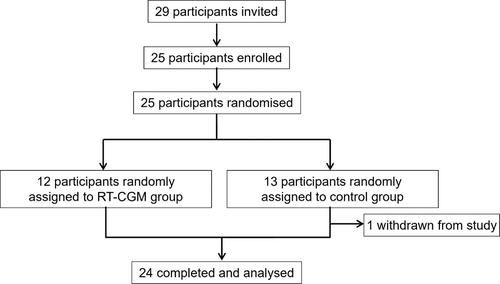
Participants were randomized (1:1 block) using a centralized web-based program15 to either intervention or control (Figure 1). Those allocated to the control arm had a blinded Dexcom G7 sensor (glucose values not displayed) inserted for data collection purposes and received standard hospital practice management using CBG monitoring. Participants in the intervention group, using the RT-CGM systems (Dexcom G7; Dexcom Inc.), had their insulin dosage adjustments managed by non-diabetes speciality clinical teams following face-to-face education provided by the specialist diabetes team and educators. General ward staff, who were non-diabetes specialist trained, were briefed and furnished with pragmatic guidelines for making clinical and therapeutic decisions, guided by sensor glucose levels, hypo-/hyperglycaemia alerts and trends. Training and education of up to 45 min in duration on using CGM values for inpatient diabetes management were provided onsite via face-to-face ward sessions by members of the diabetes specialist team. During these sessions, guidance on insulin therapy dose adjustments based on CGM and CBG values was reviewed and discussed. Ward staff were trained to view and use the electronically prescribed insulin dosages in the patients' electronic medical record system. They were encouraged to respond to CGM alerts and review CGM readings regularly. Ward staff were advised to confirm hypo- and hyperglycaemia alerts with a point-of-care glucose meter and respond accordingly; if a patient was confirmed to be hypoglycaemic, they were to be treated as per hospital hypoglycaemia guidelines and if hyperglycaemic, to be provided with supplemental insulin correction doses as electronically prescribed in their electronic medical records. The hypoglycaemia alert was set at 4.0 mmol/L, while the hyperglycaemia alert was at 13.0 mmol/L. In response to feedback from general ward staff to minimize alarm frequency, the ‘High Repeat’ alarm was deactivated, and adjustments to the hyperglycaemia threshold were permitted.
Participants in both study arms maintained their regular insulin and oral hypoglycaemic therapies. They received extra correction doses of rapid-acting insulin before meals, in addition to their scheduled doses (see Table SA). If participants were fasting or unable to eat, they received supplemental insulin every 6 h based on the ‘sensitive’ dose on the supplemental insulin scale. During the study, participants selected standard ward meals at regular meal times without restrictions on additional meals or snacks. Their usual activities in the general ward were unrestricted.
In total, 25 participants who were admitted to non-critical care wards were recruited, with one participant being withdrawn because of inpatient duration of stay <3 days. Data from the 24 completed participants [21% women, 63% White, aged 62.1 (9.0) years, glycated haemoglobin 86.0 (21.3) mmol/mol, body mass index 28.5 (3.8) kg/m2] were included in the final analysis.
No significant differences in percentage sensor use, glycated haemoglobin, total daily insulin dose or BMI were found between both groups at baseline (Table SB). The primary endpoint (TIR) was similar for both arms (Table 1, p = 0.604). Time spent in range 3.9–10 mmol/L was also comparable.
We found no difference in the overall proportions of time in hyperglycaemia >10 mmol/L (p = 0.631) and 16.7 mmol/L (p = 0.583) between the RT-CGM and CBG arms (Figures S1 and S2). Time spent in hypoglycaemia was <3.9 mmol/L, and <3.0 were low and comparable. Total daily insulin and changes in daily insulin doses did not differ between and within groups.
In this pilot study, we explored the effects of RT-CGM among inpatients managed by non-diabetes speciality teams and observed no significant differences in glycaemic outcomes between RT-CGM and CBG utilization. The role of RT-CGM is well established in type 1 diabetes12, 16 and growing evidence shows that RT-CGM use in insulin17, 18 and non-insulin-treated19 type 2 diabetes in outpatient settings may lead to improvements in glycaemic control and quality of life, thereby potentially broadening the use of RT-CGM application in this population. However, previous randomized controlled studies comparing RT-CGM with CBG among hospitalized diabetes patients have shown mixed outcomes. In a study involving 110 inpatients on insulin therapy, participants were randomized to either RT-CGM or CBG, with a diabetes advanced practice nurse overseeing sensor glucose data and providing daily guidance to ward staff, resulting in standardized insulin dose adjustments to optimize therapy.20 No significant differences in TIR (3.9–10.0 mmol/L) and below range were found between groups. Another larger randomized controlled trial comprising 162 inpatients with type 1 or type 2 diabetes had a board-certified endocrinologist offering insulin dose titration recommendations.21 Use of RT-CGM compared with CBG exhibited a tendency towards reducing hypoglycaemic events and time spent below the target range, while TIR remained comparable across both groups.
To our knowledge, no randomized controlled studies have evaluated RT-CGM effectiveness compared with CBG in the NHS general ward settings. In the UK, the majority of inpatients with diabetes are admitted and managed by non-diabetes speciality teams. A recent survey from 17 trusts covering 30 hospital sites showed that on average there are less than two inpatient diabetes team staff members per 100 inpatients with diabetes. In addition, all surveyed trusts reported insufficient diabetes staff compared with the optimal service requirements.22 Given this scenario, we adopted a pragmatic approach aligned with the expected clinical capacity and workflow in an NHS general ward. Education regarding diabetes management, insulin dose adjustments and glucose sensor usage was provided by our diabetes educator and inpatient diabetes team. The use of different insulin regimens and continuation of non-insulin therapy aligns with current clinical practice in the UK and thus is applicable across various settings.
Findings from our pilot study will provide exploratory information and hypotheses for a definitive randomized controlled study in the future. Our preliminary findings suggest that use of RT-CGM without direct stewardship and guidance from diabetes specialist teams does not appear to overcome the well-reported therapeutic inertia, where despite the availability of continuous glucose levels and hyperglycaemia alerts, hyperglycaemia remains prevalent with no significant changes in daily insulin dose adjustments. This suggests that RT-CGM for inpatient diabetes management still requires significant input to overcome this inertia. However, our results should be interpreted with caution, as this was an exploratory pilot study with a small sample size, which was not powered to show superiority or non-inferiority. In contrast, glycaemic outcomes were significantly improved in studies where insulin delivery was automated through fully closed-loop systems,23 perhaps highlighting the importance of reducing ward staff workload burden as well if improvement in hospital diabetes management is to be achieved. Limitations of our study include the relatively short study duration and small sample size; thus, potential confounders between both groups could not be excluded.
Glycaemic control in non-critical care inpatients under non-diabetes specialist teams during RT-CGM use showed no difference from CBG in this pilot study. Future well-powered studies may need to incorporate both structured education for general ward staff and specialist input from inpatient diabetes teams to enhance the effectiveness of RT-CGM in hospital settings.
This work was funded by the Manchester Academic Health Science Centre (MAHSC) CVD Domain, Health Innovation Manchester. Dexcom supplied discounted CGM devices. The views expressed in this publication are those of the author(s) and not necessarily those of the NHS, or the Department of Health.
HT receives consulting fees and speaker honoraria from Eli Lilly, reports having received research support from Dexcom Inc and participated in advisory groups for Medtronic and Roche Diabetes. IF has received speaker honoraria from Novo Nordisk, AstraZeneca, Eli Lilly, Napp and Boehringer Ingelheim, and received educational support grants from Novo Nordisk, and Eli Lilly. LL has received research support from Abbott Diabetes Care and Dexcom, participated in advisory groups for Abbott Diabetes Care, Insulet, Dexcom, Medtronic, and Roche Diabetes, and received fees for speaking from Sanofi, Insulet, Medtronic, and Abbott Diabetes Care. JS received grants and research support from Astra Zeneca, Daiichi-Sankyo, Eli Lilly and Company and Novo Nordisk; speaker fees from Astra Zeneca, Daiichi-Sankyo, Novartis and Sanofi; and consultancy fees from Amgen, Boehringer Ingelheim, Eli Lilly and Company and Sanofi. JR, MK, WM, JL, TT and CF have no conflicts of interest to declare.
期刊介绍:
Diabetes, Obesity and Metabolism is primarily a journal of clinical and experimental pharmacology and therapeutics covering the interrelated areas of diabetes, obesity and metabolism. The journal prioritises high-quality original research that reports on the effects of new or existing therapies, including dietary, exercise and lifestyle (non-pharmacological) interventions, in any aspect of metabolic and endocrine disease, either in humans or animal and cellular systems. ‘Metabolism’ may relate to lipids, bone and drug metabolism, or broader aspects of endocrine dysfunction. Preclinical pharmacology, pharmacokinetic studies, meta-analyses and those addressing drug safety and tolerability are also highly suitable for publication in this journal. Original research may be published as a main paper or as a research letter.




 京公网安备 11010802042870号
京ICP备2023020795号-1
京公网安备 11010802042870号
京ICP备2023020795号-1

 分享
分享
 求助内容:
求助内容: 应助结果提醒方式:
 扫码关注我们
