Katia Cristina Bassichetto, Thiago Félix Pinheiro, Claudia Barros, Paula Andrea Morelli Fonseca, Rita Suely Bacuri de Queiroz, Sandro Sperandei, Maria Amélia de Sousa Mascena Veras
{"title":"Bodies of desire: use of nonprescribed hormones among transgender women and travestis in five Brazilian capitals (2019-2021).","authors":"Katia Cristina Bassichetto, Thiago Félix Pinheiro, Claudia Barros, Paula Andrea Morelli Fonseca, Rita Suely Bacuri de Queiroz, Sandro Sperandei, Maria Amélia de Sousa Mascena Veras","doi":"10.1590/1980-549720240010.supl.1","DOIUrl":null,"url":null,"abstract":"<p><strong>Objective: </strong>To analyze the experiences of transgender women and travestis regarding the use of hormones for body changes without a medical prescription.</p><p><strong>Methods: </strong>This is a cross-sectional, quantitative and qualitative study, using data from \"TransOdara\", which estimated the prevalence of Sexually Transmitted Infections in transgender women and travestis recruited through Respondent-Driven Sampling, between December 2019 and July 2021, in São Paulo, Campo Grande, Manaus, Porto Alegre, and Salvador, Brazil. The main outcome was: use of hormones without medical prescription and associated risk factors. Descriptive analysis, mixed univariate logistic regression models, and semi-structured interviews were carried out.</p><p><strong>Results: </strong>Of the 1,317 recruited participants, 85.9% had already used hormones. The current use of hormones was reported by 40.7% (536) of them. Of those who were able to inform the place where they obtained them, 72.6% (381/525) used them without a medical prescription. The variables associated with the outcome were: current full-time sex work (OR 4.59; 95%CI 1.90-11.06) or in the past (OR 1.92; 95%CI 1.10-3.34), not having changed their name (OR 3.59; 95%CI 2.23-5.76), not currently studying (OR 1.83; 95%CI 1.07-3.13), being younger (OR 2.16; 95%CI 1.31-3.56), and having suffered discrimination at some point in life for being a transgender women and travestis (OR 0.40; 95%CI 0.20-0.81).</p><p><strong>Conclusion: </strong>The use of nonprescribed hormones is high among transgender women and travestis, especially among those who are younger, did not study, have not changed their name, and with a history of sex work. This use is related to the urgency for gender transition, with excessive use and damage to health.</p>","PeriodicalId":74697,"journal":{"name":"Revista brasileira de epidemiologia = Brazilian journal of epidemiology","volume":"27Suppl 1 Suppl 1","pages":"e240010.supl.1"},"PeriodicalIF":2.0000,"publicationDate":"2024-08-19","publicationTypes":"Journal Article","fieldsOfStudy":null,"isOpenAccess":false,"openAccessPdf":"https://www.ncbi.nlm.nih.gov/pmc/articles/PMC11338539/pdf/","citationCount":"0","resultStr":null,"platform":"Semanticscholar","paperid":null,"PeriodicalName":"Revista brasileira de epidemiologia = Brazilian journal of epidemiology","FirstCategoryId":"1085","ListUrlMain":"https://doi.org/10.1590/1980-549720240010.supl.1","RegionNum":0,"RegionCategory":null,"ArticlePicture":[],"TitleCN":null,"AbstractTextCN":null,"PMCID":null,"EPubDate":"2024/1/1 0:00:00","PubModel":"eCollection","JCR":"","JCRName":"","Score":null,"Total":0}
引用次数: 0
Abstract
Objective: To analyze the experiences of transgender women and travestis regarding the use of hormones for body changes without a medical prescription.
Methods: This is a cross-sectional, quantitative and qualitative study, using data from "TransOdara", which estimated the prevalence of Sexually Transmitted Infections in transgender women and travestis recruited through Respondent-Driven Sampling, between December 2019 and July 2021, in São Paulo, Campo Grande, Manaus, Porto Alegre, and Salvador, Brazil. The main outcome was: use of hormones without medical prescription and associated risk factors. Descriptive analysis, mixed univariate logistic regression models, and semi-structured interviews were carried out.
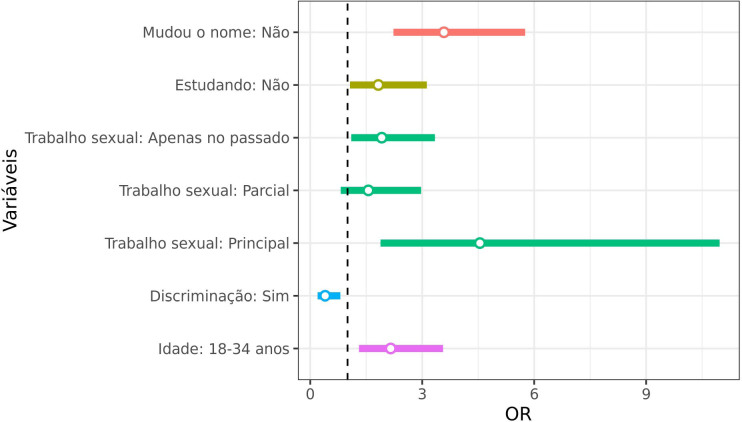
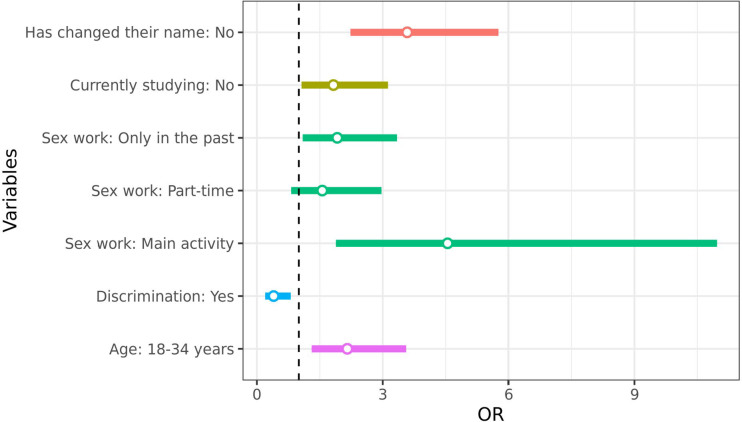
Results: Of the 1,317 recruited participants, 85.9% had already used hormones. The current use of hormones was reported by 40.7% (536) of them. Of those who were able to inform the place where they obtained them, 72.6% (381/525) used them without a medical prescription. The variables associated with the outcome were: current full-time sex work (OR 4.59; 95%CI 1.90-11.06) or in the past (OR 1.92; 95%CI 1.10-3.34), not having changed their name (OR 3.59; 95%CI 2.23-5.76), not currently studying (OR 1.83; 95%CI 1.07-3.13), being younger (OR 2.16; 95%CI 1.31-3.56), and having suffered discrimination at some point in life for being a transgender women and travestis (OR 0.40; 95%CI 0.20-0.81).
Conclusion: The use of nonprescribed hormones is high among transgender women and travestis, especially among those who are younger, did not study, have not changed their name, and with a history of sex work. This use is related to the urgency for gender transition, with excessive use and damage to health.



 京公网安备 11010802042870号
京ICP备2023020795号-1
京公网安备 11010802042870号
京ICP备2023020795号-1

 分享
分享

 求助内容:
求助内容: 应助结果提醒方式:
 扫码关注我们
