Zheng Fang , Qingyan He , Yanyu Hu , Xu Chen , Fan Li , Xixi Cai
{"title":"Polydopamine-assisted smart bacteria-responsive hydrogel: Switchable antimicrobial and antifouling capabilities for accelerated wound healing","authors":"Zheng Fang , Qingyan He , Yanyu Hu , Xu Chen , Fan Li , Xixi Cai","doi":"10.1016/j.jare.2024.08.025","DOIUrl":null,"url":null,"abstract":"<div><h3>Introduction</h3><div>Wound infections and formation of biofilms caused by multidrug-resistant bacteria have constituted a series of wound deteriorated and life-threatening problems. The <em>in situ</em> resisting bacterial adhesion, killing multidrug-resistance bacteria, and releasing dead bacteria is strongly required to supply a gap of existing sterilization strategies.</div></div><div><h3>Objectives</h3><div>This study aims to present a facile approach to construct a bacteria-responsive hydrogel with switchable antimicrobial-antifouling properties through a “resisting-killing-releasing” method.</div></div><div><h3>Methods</h3><div>The smart bacteria-responsive hydrogel was constructed by two-step immersion strategy: a simple immersion-coating process to construct Polydopamine (pDA) coatings on the surface of a gelatin-chitosan composite hydrogel and followed by grafting of bactericidal quaternary ammonium chitosan (QCS) as well as pH-responsive PMAA to this pDA coating. The <em>in vitro</em> antimicrobial activity, biocompatibility and the <em>in vivo</em> wound healing effects in a mouse MRSA-infected full-thickness defect model of the hydrogel were further evaluated.</div></div><div><h3>Results</h3><div>Assisted by polydopamine coating, the pH-responsive PMAA and bactericidal QCS are successfully grafted onto a gelatin-chitosan composite hydrogel surface and hydrogels maintain the adequate mechanical properties. At physiological conditions, the PMAA hydration layer endows the hydrogel with resistance to initial bacterial attachment. Once bacteria colonize and acidize local environment, the swelling PMAA chains tend to collapse then expose the bactericidal QCS, realizing the on-demand kill bacteria. Moreover, the dead bacteria can be released and the hydrogel will resume the resistance due to hydrophilicity of PMAA at increased pH, endowing the surface renewable ability. <em>In vitro</em> and <em>in vivo</em> studies demonstrate the favorable biocompatibility and wound healing capacity of hydrogels that can inhibit infection and further facilitate granulation tissue, angiogenesis, and collagen synthesis.</div></div><div><h3>Conclusion</h3><div>This strategy provides a novel methodology for the development and design of smart wound dressing to combat multidrug-resistant bacteria infections.</div></div>","PeriodicalId":14952,"journal":{"name":"Journal of Advanced Research","volume":"73 ","pages":"Pages 283-294"},"PeriodicalIF":13.0000,"publicationDate":"2025-07-01","publicationTypes":"Journal Article","fieldsOfStudy":null,"isOpenAccess":false,"openAccessPdf":"","citationCount":"0","resultStr":null,"platform":"Semanticscholar","paperid":null,"PeriodicalName":"Journal of Advanced Research","FirstCategoryId":"103","ListUrlMain":"https://www.sciencedirect.com/science/article/pii/S2090123224003680","RegionNum":1,"RegionCategory":"综合性期刊","ArticlePicture":[],"TitleCN":null,"AbstractTextCN":null,"PMCID":null,"EPubDate":"2024/8/19 0:00:00","PubModel":"Epub","JCR":"Q1","JCRName":"MULTIDISCIPLINARY SCIENCES","Score":null,"Total":0}
引用次数: 0
Abstract
Introduction
Wound infections and formation of biofilms caused by multidrug-resistant bacteria have constituted a series of wound deteriorated and life-threatening problems. The in situ resisting bacterial adhesion, killing multidrug-resistance bacteria, and releasing dead bacteria is strongly required to supply a gap of existing sterilization strategies.
Objectives
This study aims to present a facile approach to construct a bacteria-responsive hydrogel with switchable antimicrobial-antifouling properties through a “resisting-killing-releasing” method.
Methods
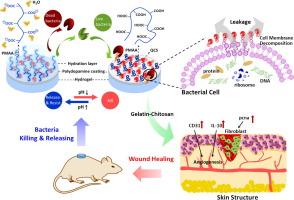
The smart bacteria-responsive hydrogel was constructed by two-step immersion strategy: a simple immersion-coating process to construct Polydopamine (pDA) coatings on the surface of a gelatin-chitosan composite hydrogel and followed by grafting of bactericidal quaternary ammonium chitosan (QCS) as well as pH-responsive PMAA to this pDA coating. The in vitro antimicrobial activity, biocompatibility and the in vivo wound healing effects in a mouse MRSA-infected full-thickness defect model of the hydrogel were further evaluated.
Results
Assisted by polydopamine coating, the pH-responsive PMAA and bactericidal QCS are successfully grafted onto a gelatin-chitosan composite hydrogel surface and hydrogels maintain the adequate mechanical properties. At physiological conditions, the PMAA hydration layer endows the hydrogel with resistance to initial bacterial attachment. Once bacteria colonize and acidize local environment, the swelling PMAA chains tend to collapse then expose the bactericidal QCS, realizing the on-demand kill bacteria. Moreover, the dead bacteria can be released and the hydrogel will resume the resistance due to hydrophilicity of PMAA at increased pH, endowing the surface renewable ability. In vitro and in vivo studies demonstrate the favorable biocompatibility and wound healing capacity of hydrogels that can inhibit infection and further facilitate granulation tissue, angiogenesis, and collagen synthesis.
Conclusion
This strategy provides a novel methodology for the development and design of smart wound dressing to combat multidrug-resistant bacteria infections.
期刊介绍:
Journal of Advanced Research (J. Adv. Res.) is an applied/natural sciences, peer-reviewed journal that focuses on interdisciplinary research. The journal aims to contribute to applied research and knowledge worldwide through the publication of original and high-quality research articles in the fields of Medicine, Pharmaceutical Sciences, Dentistry, Physical Therapy, Veterinary Medicine, and Basic and Biological Sciences.
The following abstracting and indexing services cover the Journal of Advanced Research: PubMed/Medline, Essential Science Indicators, Web of Science, Scopus, PubMed Central, PubMed, Science Citation Index Expanded, Directory of Open Access Journals (DOAJ), and INSPEC.



 京公网安备 11010802042870号
京ICP备2023020795号-1
京公网安备 11010802042870号
京ICP备2023020795号-1

 分享
分享
 求助内容:
求助内容: 应助结果提醒方式:
 扫码关注我们
