{"title":"Investigation of heat-induced pork batter quality detection and change mechanisms using Raman spectroscopy coupled with deep learning algorithms","authors":"Huanhuan Li , Wei Sheng , Selorm Yao-Say Solomon Adade , Xorlali Nunekpeku , Quansheng Chen","doi":"10.1016/j.foodchem.2024.140798","DOIUrl":null,"url":null,"abstract":"<div><p>Pork batter quality significantly affects its product. Herein, this study explored the use of Raman spectroscopy combined with deep learning algorithms for rapidly detecting pork batter quality and revealing the mechanisms of quality changes during heating. Results showed that heating increased β-sheet content (from 26.38 to 41.42%) and exposed hidden hydrophobic groups, which formed aggregates through chemical bonds. Dominant hydrophobic interactions further cross-linked these aggregates, establishing a more homogeneous and denser network at 80 °C. Subsequently, convolutional neural networks (CNN), long short-term memory neural networks (LSTM), and CNN-LSTM were comparatively used to predict gel strength and whiteness in batters based on the Raman spectrum. Thereinto, CNN-LSTM provided the optimal results for gel strength (Rp = 0.9515, RPD = 3.1513) and whiteness (Rp = 0.9383, RPD = 3.0152). Therefore, this study demonstrated the potential of Raman spectroscopy combined with deep learning algorithms as non-destructive tools for predicting pork batter quality and elucidating quality change mechanisms.</p></div>","PeriodicalId":318,"journal":{"name":"Food Chemistry","volume":"461 ","pages":"Article 140798"},"PeriodicalIF":9.8000,"publicationDate":"2024-12-15","publicationTypes":"Journal Article","fieldsOfStudy":null,"isOpenAccess":false,"openAccessPdf":"","citationCount":"0","resultStr":null,"platform":"Semanticscholar","paperid":null,"PeriodicalName":"Food Chemistry","FirstCategoryId":"97","ListUrlMain":"https://www.sciencedirect.com/science/article/pii/S0308814624024488","RegionNum":1,"RegionCategory":"农林科学","ArticlePicture":[],"TitleCN":null,"AbstractTextCN":null,"PMCID":null,"EPubDate":"2024/8/8 0:00:00","PubModel":"Epub","JCR":"Q1","JCRName":"CHEMISTRY, APPLIED","Score":null,"Total":0}
引用次数: 0
Abstract
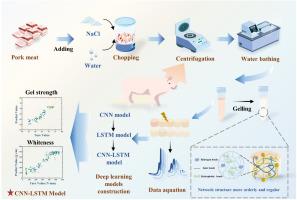
Pork batter quality significantly affects its product. Herein, this study explored the use of Raman spectroscopy combined with deep learning algorithms for rapidly detecting pork batter quality and revealing the mechanisms of quality changes during heating. Results showed that heating increased β-sheet content (from 26.38 to 41.42%) and exposed hidden hydrophobic groups, which formed aggregates through chemical bonds. Dominant hydrophobic interactions further cross-linked these aggregates, establishing a more homogeneous and denser network at 80 °C. Subsequently, convolutional neural networks (CNN), long short-term memory neural networks (LSTM), and CNN-LSTM were comparatively used to predict gel strength and whiteness in batters based on the Raman spectrum. Thereinto, CNN-LSTM provided the optimal results for gel strength (Rp = 0.9515, RPD = 3.1513) and whiteness (Rp = 0.9383, RPD = 3.0152). Therefore, this study demonstrated the potential of Raman spectroscopy combined with deep learning algorithms as non-destructive tools for predicting pork batter quality and elucidating quality change mechanisms.
期刊介绍:
Food Chemistry publishes original research papers dealing with the advancement of the chemistry and biochemistry of foods or the analytical methods/ approach used. All papers should focus on the novelty of the research carried out.



 京公网安备 11010802042870号
京ICP备2023020795号-1
京公网安备 11010802042870号
京ICP备2023020795号-1

 分享
分享
 求助内容:
求助内容: 应助结果提醒方式:
 扫码关注我们
