Madeleine Wiebe, Marnie Mackay, Ragur Krishnan, Julie Tian, Jakob Larsson, Setayesh Modanloo, Christiane Job McIntosh, Melissa Sztym, Gail Elton-Smith, Alyssa Rose, Chester Ho, Andrew Greenshaw, Bo Cao, Andrew Chan, Jake Hayward
{"title":"Feasibility characteristics of wrist-worn fitness trackers in health status monitoring for post-COVID patients in remote and rural areas.","authors":"Madeleine Wiebe, Marnie Mackay, Ragur Krishnan, Julie Tian, Jakob Larsson, Setayesh Modanloo, Christiane Job McIntosh, Melissa Sztym, Gail Elton-Smith, Alyssa Rose, Chester Ho, Andrew Greenshaw, Bo Cao, Andrew Chan, Jake Hayward","doi":"10.1371/journal.pdig.0000571","DOIUrl":null,"url":null,"abstract":"<p><strong>Introduction: </strong>Common, consumer-grade biosensors mounted on fitness trackers and smartwatches can measure an array of biometrics that have potential utility in post-discharge medical monitoring, especially in remote/rural communities. The feasibility characteristics for wrist-worn biosensors are poorly described for post-COVID conditions and rural populations.</p><p><strong>Methods: </strong>We prospectively recruited patients in rural communities who were enrolled in an at-home rehabilitation program for post-COVID conditions. They were asked to wear a FitBit Charge 2 device and biosensor parameters were analyzed [e.g. heart rate, sleep, and activity]. Electronic patient reported outcome measures [E-PROMS] for mental [bi-weekly] and physical [daily] symptoms were collected using SMS text or email [per patient preference]. Exit surveys and interviews evaluated the patient experience.</p><p><strong>Results: </strong>Ten patients were observed for an average of 58 days and half [N = 5] were monitored for 8 weeks or more. Five patients [50%] had been hospitalized with COVID [mean stay = 41 days] and 4 [36%] had required mechanical ventilation. As baseline, patients had moderate to severe levels of anxiety, depression, and stress; fatigue and shortness of breath were the most prevalent physical symptoms. Four patients [40%] already owned a smartwatch. In total, 575 patient days of patient monitoring occurred across 10 patients. Biosensor data was usable for 91.3% of study hours and surveys were completed 82.1% and 78.7% of the time for physical and mental symptoms, respectively. Positive correlations were observed between stress and resting heart rate [r = 0.360, p<0.01], stress and daily steps [r = 0.335, p<0.01], and anxiety and daily steps [r = 0.289, p<0.01]. There was a trend toward negative correlation between sleep time and physical symptom burden [r = -0.211, p = 0.05]. Patients reported an overall positive experience and identified the potential for wearable devices to improve medical safety and access to care. Concerns around data privacy/security were infrequent.</p><p><strong>Conclusions: </strong>We report excellent feasibility characteristics for wrist-worn biosensors and e-PROMS as a possible substrate for multi-modal disease tracking in post-COVID conditions. Adapting consumer-grade wearables for medical use and scalable remote patient monitoring holds great potential.</p>","PeriodicalId":74465,"journal":{"name":"PLOS digital health","volume":"3 8","pages":"e0000571"},"PeriodicalIF":7.7000,"publicationDate":"2024-08-22","publicationTypes":"Journal Article","fieldsOfStudy":null,"isOpenAccess":false,"openAccessPdf":"https://www.ncbi.nlm.nih.gov/pmc/articles/PMC11340956/pdf/","citationCount":"0","resultStr":null,"platform":"Semanticscholar","paperid":null,"PeriodicalName":"PLOS digital health","FirstCategoryId":"1085","ListUrlMain":"https://doi.org/10.1371/journal.pdig.0000571","RegionNum":0,"RegionCategory":null,"ArticlePicture":[],"TitleCN":null,"AbstractTextCN":null,"PMCID":null,"EPubDate":"2024/8/1 0:00:00","PubModel":"eCollection","JCR":"","JCRName":"","Score":null,"Total":0}
引用次数: 0
Abstract
Introduction: Common, consumer-grade biosensors mounted on fitness trackers and smartwatches can measure an array of biometrics that have potential utility in post-discharge medical monitoring, especially in remote/rural communities. The feasibility characteristics for wrist-worn biosensors are poorly described for post-COVID conditions and rural populations.
Methods: We prospectively recruited patients in rural communities who were enrolled in an at-home rehabilitation program for post-COVID conditions. They were asked to wear a FitBit Charge 2 device and biosensor parameters were analyzed [e.g. heart rate, sleep, and activity]. Electronic patient reported outcome measures [E-PROMS] for mental [bi-weekly] and physical [daily] symptoms were collected using SMS text or email [per patient preference]. Exit surveys and interviews evaluated the patient experience.
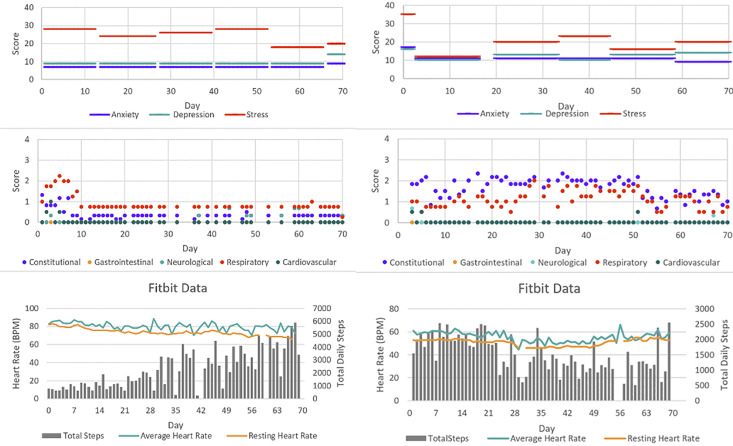
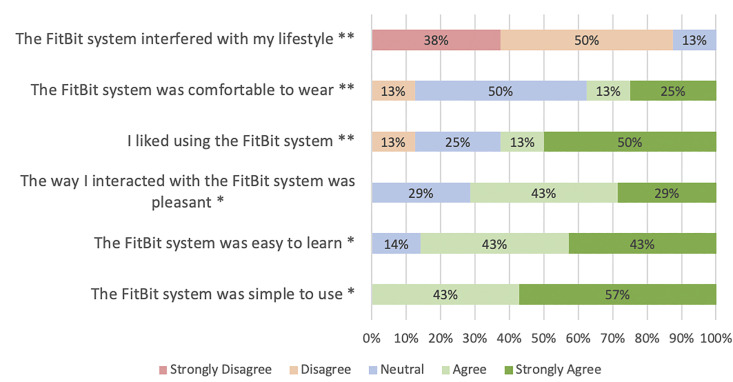
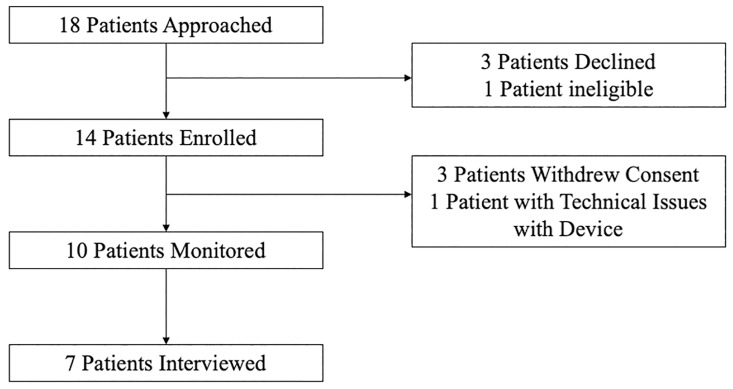
Results: Ten patients were observed for an average of 58 days and half [N = 5] were monitored for 8 weeks or more. Five patients [50%] had been hospitalized with COVID [mean stay = 41 days] and 4 [36%] had required mechanical ventilation. As baseline, patients had moderate to severe levels of anxiety, depression, and stress; fatigue and shortness of breath were the most prevalent physical symptoms. Four patients [40%] already owned a smartwatch. In total, 575 patient days of patient monitoring occurred across 10 patients. Biosensor data was usable for 91.3% of study hours and surveys were completed 82.1% and 78.7% of the time for physical and mental symptoms, respectively. Positive correlations were observed between stress and resting heart rate [r = 0.360, p<0.01], stress and daily steps [r = 0.335, p<0.01], and anxiety and daily steps [r = 0.289, p<0.01]. There was a trend toward negative correlation between sleep time and physical symptom burden [r = -0.211, p = 0.05]. Patients reported an overall positive experience and identified the potential for wearable devices to improve medical safety and access to care. Concerns around data privacy/security were infrequent.
Conclusions: We report excellent feasibility characteristics for wrist-worn biosensors and e-PROMS as a possible substrate for multi-modal disease tracking in post-COVID conditions. Adapting consumer-grade wearables for medical use and scalable remote patient monitoring holds great potential.



 京公网安备 11010802042870号
京ICP备2023020795号-1
京公网安备 11010802042870号
京ICP备2023020795号-1

 分享
分享

 求助内容:
求助内容: 应助结果提醒方式:
 扫码关注我们
