Aijiao Yuan, Rui Sha, Wenjing Xie, Guangbo Qu, Hongquan Zhang, Hailin Wang, X Chris Le, Guibin Jiang, Hanyong Peng
{"title":"RNA-Activated CRISPR/Cas12a Nanorobots Operating in Living Cells.","authors":"Aijiao Yuan, Rui Sha, Wenjing Xie, Guangbo Qu, Hongquan Zhang, Hailin Wang, X Chris Le, Guibin Jiang, Hanyong Peng","doi":"10.1021/jacs.4c02354","DOIUrl":null,"url":null,"abstract":"<p><p>Active clustered regularly interspaced short palindromic repeats (CRISPR/Cas12a) systems possess both <i>cis</i>-cleavage (targeted) and <i>trans</i>-cleavage (collateral) activities, which are useful for genome engineering and diagnostic applications. Both single- and double-stranded DNA can activate crRNA-Cas12a ribonucleoprotein (RNP) to achieve <i>cis</i>- and <i>trans</i>-cleavage enzymatic activities. However, it is not clear whether RNA can activate the CRISPR/Cas12a system and what is critical to the <i>trans</i>-cleavage activity. We report here that RNA can activate the CRISPR/Cas12a system and trigger its <i>trans</i>-cleavage activity. We reveal that the activated crRNA-Cas12a RNP favors the <i>trans</i>-cleavage of longer sequences than commonly used. These new findings of the RNA-activated <i>trans</i>-cleavage capability of Cas12a provided the foundation for the design and construction of CRISPR nanorobots that operate in living cells. We assembled the crRNA-Cas12a RNP and nucleic acid substrates on gold nanoparticles to form CRISPR nanorobots, which dramatically increased the local effective concentration of the substrate in relation to the RNP and the <i>trans</i>-cleavage kinetics. Binding of the target microRNA to the crRNA-Cas12a RNP activated the nanorobots and their <i>trans</i>-cleavage function. The repeated (multiple-turnover) <i>trans</i>-cleavage of the fluorophore-labeled substrates generated amplified fluorescence signals. Sensitive and real-time imaging of specific microRNA in live cells demonstrated the promising potential of the CRISPR nanorobot system for future applications in monitoring and modulating biological functions within living cells.</p>","PeriodicalId":49,"journal":{"name":"Journal of the American Chemical Society","volume":" ","pages":"26657-26666"},"PeriodicalIF":15.6000,"publicationDate":"2024-10-02","publicationTypes":"Journal Article","fieldsOfStudy":null,"isOpenAccess":false,"openAccessPdf":"","citationCount":"0","resultStr":null,"platform":"Semanticscholar","paperid":null,"PeriodicalName":"Journal of the American Chemical Society","FirstCategoryId":"92","ListUrlMain":"https://doi.org/10.1021/jacs.4c02354","RegionNum":1,"RegionCategory":"化学","ArticlePicture":[],"TitleCN":null,"AbstractTextCN":null,"PMCID":null,"EPubDate":"2024/8/25 0:00:00","PubModel":"Epub","JCR":"Q1","JCRName":"CHEMISTRY, MULTIDISCIPLINARY","Score":null,"Total":0}
引用次数: 0
Abstract
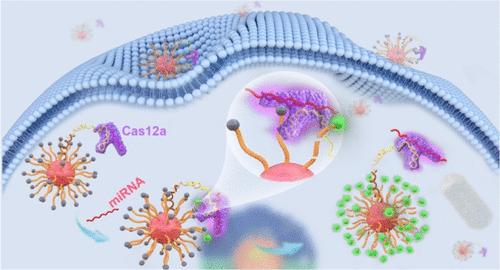
Active clustered regularly interspaced short palindromic repeats (CRISPR/Cas12a) systems possess both cis-cleavage (targeted) and trans-cleavage (collateral) activities, which are useful for genome engineering and diagnostic applications. Both single- and double-stranded DNA can activate crRNA-Cas12a ribonucleoprotein (RNP) to achieve cis- and trans-cleavage enzymatic activities. However, it is not clear whether RNA can activate the CRISPR/Cas12a system and what is critical to the trans-cleavage activity. We report here that RNA can activate the CRISPR/Cas12a system and trigger its trans-cleavage activity. We reveal that the activated crRNA-Cas12a RNP favors the trans-cleavage of longer sequences than commonly used. These new findings of the RNA-activated trans-cleavage capability of Cas12a provided the foundation for the design and construction of CRISPR nanorobots that operate in living cells. We assembled the crRNA-Cas12a RNP and nucleic acid substrates on gold nanoparticles to form CRISPR nanorobots, which dramatically increased the local effective concentration of the substrate in relation to the RNP and the trans-cleavage kinetics. Binding of the target microRNA to the crRNA-Cas12a RNP activated the nanorobots and their trans-cleavage function. The repeated (multiple-turnover) trans-cleavage of the fluorophore-labeled substrates generated amplified fluorescence signals. Sensitive and real-time imaging of specific microRNA in live cells demonstrated the promising potential of the CRISPR nanorobot system for future applications in monitoring and modulating biological functions within living cells.
期刊介绍:
The flagship journal of the American Chemical Society, known as the Journal of the American Chemical Society (JACS), has been a prestigious publication since its establishment in 1879. It holds a preeminent position in the field of chemistry and related interdisciplinary sciences. JACS is committed to disseminating cutting-edge research papers, covering a wide range of topics, and encompasses approximately 19,000 pages of Articles, Communications, and Perspectives annually. With a weekly publication frequency, JACS plays a vital role in advancing the field of chemistry by providing essential research.



 京公网安备 11010802042870号
京ICP备2023020795号-1
京公网安备 11010802042870号
京ICP备2023020795号-1

 分享
分享
 求助内容:
求助内容: 应助结果提醒方式:
 扫码关注我们
