Ye Zhou , Simeng Wang , Jiahua Guo , Chenghao Li , Mengjun Sui , Zekun Zeng , Hui Dang , Qingqing Gu , Jian Zhu , Yangyang Cheng , Peng Hou
{"title":"Harnessing transcription factor-driven ROS for synergistic multimodal lung cancer treatment","authors":"Ye Zhou , Simeng Wang , Jiahua Guo , Chenghao Li , Mengjun Sui , Zekun Zeng , Hui Dang , Qingqing Gu , Jian Zhu , Yangyang Cheng , Peng Hou","doi":"10.1016/j.jconrel.2024.08.035","DOIUrl":null,"url":null,"abstract":"<div><p>Multimodal treatment of cancer is an unstoppable revolution in clinical application. However, designing a platform that integrates therapeutic modalities with different pharmacokinetic characteristics remains a great challenge. Herein, we designed a universal lipid nanoplatform equipping a ROS-cleavable docetaxel prodrug (DTX-L-DTX) and an NF-E2-related factor 2 (NRF2) inhibitor (clobetasol propionate, CP). This simply fabricated nanomedicine enables superior synergistic molecularly targeted/chemo/radio therapy for lung cancer cascade by a transcription factor-driven ROS self-sustainable motion. Chemotherapy is launched via ROS-triggered DTX release. Subsequently, CP inhibits the expression of NRF2 target genes, resulting in efficient targeted therapy, meanwhile inducing sustained ROS generation which in turn facilitates chemotherapy by overcoming ROS consumption during the DTX release process. Finally, the introduction of radiotherapy further amplifies ROS, offering continuous mutual feedback to amplify the ultimate treatment performance. This strategy is conceptually and operationally simple, providing solutions to challenges in clinical cancer treatment and beyond.</p></div>","PeriodicalId":15450,"journal":{"name":"Journal of Controlled Release","volume":"374 ","pages":"Pages 489-504"},"PeriodicalIF":11.5000,"publicationDate":"2024-10-01","publicationTypes":"Journal Article","fieldsOfStudy":null,"isOpenAccess":false,"openAccessPdf":"https://www.sciencedirect.com/science/article/pii/S0168365924005856/pdfft?md5=e25f5f94a5524b280849e6148a9db9c0&pid=1-s2.0-S0168365924005856-main.pdf","citationCount":"0","resultStr":null,"platform":"Semanticscholar","paperid":null,"PeriodicalName":"Journal of Controlled Release","FirstCategoryId":"3","ListUrlMain":"https://www.sciencedirect.com/science/article/pii/S0168365924005856","RegionNum":1,"RegionCategory":"医学","ArticlePicture":[],"TitleCN":null,"AbstractTextCN":null,"PMCID":null,"EPubDate":"2024/8/28 0:00:00","PubModel":"Epub","JCR":"Q1","JCRName":"CHEMISTRY, MULTIDISCIPLINARY","Score":null,"Total":0}
引用次数: 0
Abstract
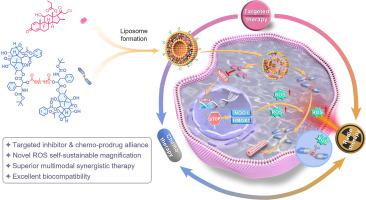
Multimodal treatment of cancer is an unstoppable revolution in clinical application. However, designing a platform that integrates therapeutic modalities with different pharmacokinetic characteristics remains a great challenge. Herein, we designed a universal lipid nanoplatform equipping a ROS-cleavable docetaxel prodrug (DTX-L-DTX) and an NF-E2-related factor 2 (NRF2) inhibitor (clobetasol propionate, CP). This simply fabricated nanomedicine enables superior synergistic molecularly targeted/chemo/radio therapy for lung cancer cascade by a transcription factor-driven ROS self-sustainable motion. Chemotherapy is launched via ROS-triggered DTX release. Subsequently, CP inhibits the expression of NRF2 target genes, resulting in efficient targeted therapy, meanwhile inducing sustained ROS generation which in turn facilitates chemotherapy by overcoming ROS consumption during the DTX release process. Finally, the introduction of radiotherapy further amplifies ROS, offering continuous mutual feedback to amplify the ultimate treatment performance. This strategy is conceptually and operationally simple, providing solutions to challenges in clinical cancer treatment and beyond.
期刊介绍:
The Journal of Controlled Release (JCR) proudly serves as the Official Journal of the Controlled Release Society and the Japan Society of Drug Delivery System.
Dedicated to the broad field of delivery science and technology, JCR publishes high-quality research articles covering drug delivery systems and all facets of formulations. This includes the physicochemical and biological properties of drugs, design and characterization of dosage forms, release mechanisms, in vivo testing, and formulation research and development across pharmaceutical, diagnostic, agricultural, environmental, cosmetic, and food industries.
Priority is given to manuscripts that contribute to the fundamental understanding of principles or demonstrate the advantages of novel technologies in terms of safety and efficacy over current clinical standards. JCR strives to be a leading platform for advancements in delivery science and technology.




 京公网安备 11010802042870号
京ICP备2023020795号-1
京公网安备 11010802042870号
京ICP备2023020795号-1

 分享
分享
 求助内容:
求助内容: 应助结果提醒方式:
 扫码关注我们
